
Cannot Afford PTPTN Repayments? Rescheduling vs Restructuring, and the 50% Arrears Rule
PTPTN instalment too high? Learn the real difference between rescheduling, restructuring and deferment, the 50% arrears rule, myPTPTN steps and what to do when you cannot afford it.

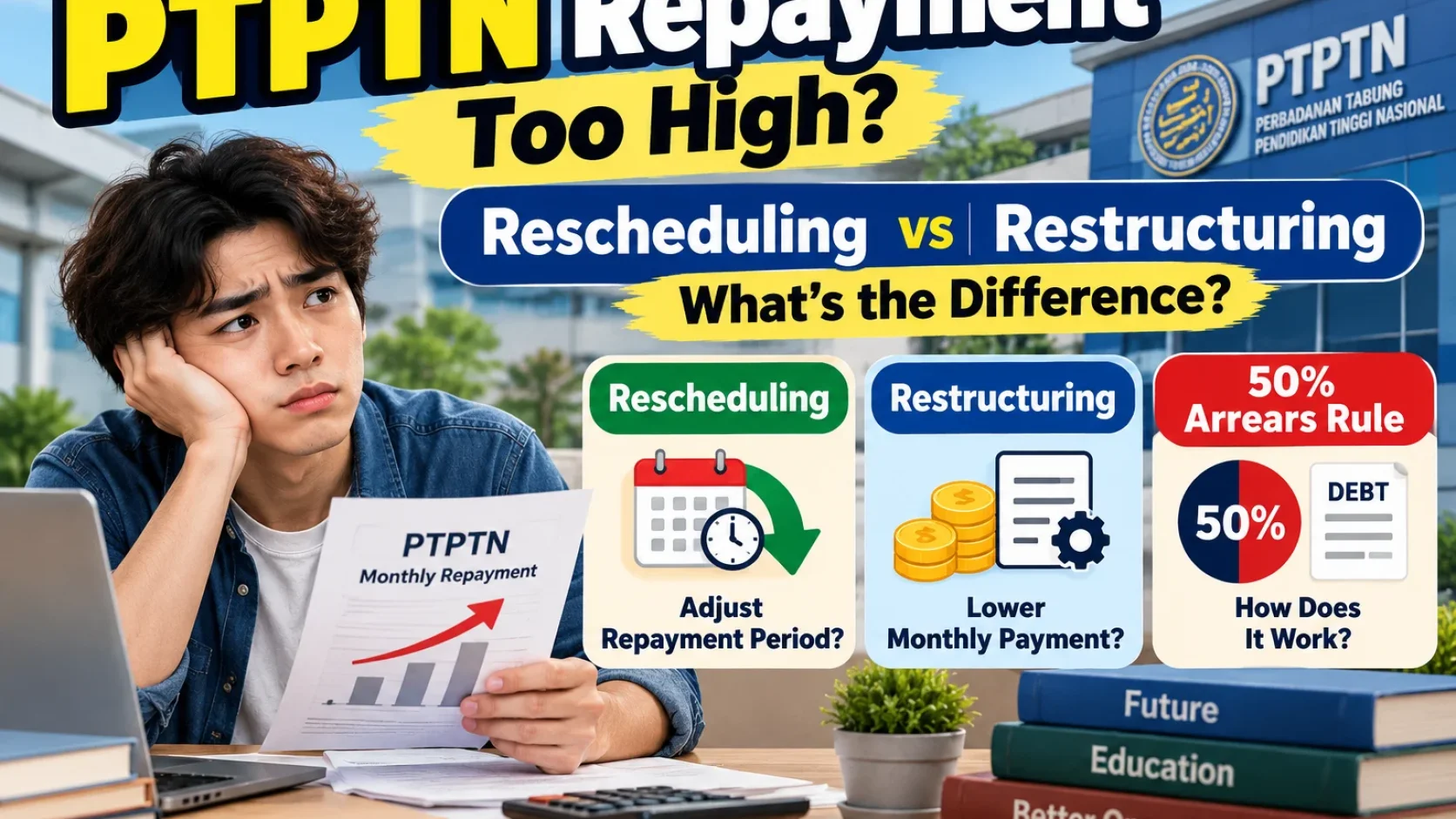
Source: PTPTN official Bayaran Balik, FAQ and APH guidance (Oct 2026)
Struggling with your PTPTN instalment? Simply paying less than the monthly instalment stated in your repayment schedule does not make it a new, agreed instalment. PTPTN says short payments can create arrears. Before applying for help, distinguish rescheduling, restructuring and deferment.
This guide is based on PTPTN's official published rules checked on 9 October 2026. None of these options automatically cancels the original debt.
Rescheduling, restructuring and deferment are not interchangeable
| Option | What it does | Important limit |
|---|---|---|
| Penjadualan Semula — Rescheduling | Rearranges the Repayment Schedule (JBB) within the established repayment period | A revised calendar is not automatically an extension to age 60 |
| Penstrukturan Semula — Restructuring | Changes the repayment structure to consider ability to pay; may extend duration | Normally requires paying at least 50% of arrears plus applicable costs first |
| Penangguhan — Deferment | Temporarily defers repayments for qualifying unemployed borrowers or qualifying full-time studies | Separate documentation and time limits; requires approval |
If you are still earning an income but cannot manage the scheduled amount, ask about restructuring. If you are out of work or a qualifying full-time student, check deferment eligibility as well. Rescheduling might fit if the main need is to reorganise payments within the original term.
Does "pay 50%" mean half your entire PTPTN loan?
No. PTPTN's standard restructuring rules refer to 50% of the arrears (tunggakan), not automatically half of the whole outstanding loan balance. They also mention applicable enforcement, WPP, stamp-duty, takaful and processing costs.
| Illustrative arrears | 50% arrears threshold | Important caution |
|---|---|---|
| RM2,000 | RM1,000 | Other outstanding fees may still apply |
| RM5,000 | RM2,500 | Paying this does not automatically secure approval |
| RM10,000 | RM5,000 | Confirm your official arrears statement first |
These are arithmetic examples, not account-level quotations or a promise that the remaining arrears disappear. PTPTN indicates its restructuring offer is issued only once the required conditions and applicable payments have been met.
This 50% condition took effect in July 2015 under the current official guidance; it should not be presented as a brand-new 2026 penalty.
Could my monthly PTPTN repayment be reduced?
Under restructuring, PTPTN explains that a monthly instalment may be assessed against an estimated 5%–8% of gross income, subject to eligibility, available repayment duration and PTPTN approval. Approved terms may extend up to the borrower's age of 60.
For illustration only:
- Gross income RM3,000/month: 5%–8% is RM150–RM240.
- Gross income RM4,000/month: 5%–8% is RM200–RM320.
These figures are not guaranteed approved instalments. Extending a loan may increase total Ujrah or other costs over time. Compare the new total repayment obligation, not just the proposed monthly amount.
The standard rescheduling and restructuring routes apply to Ujrah loans; ask PTPTN about conversion if your loan remains conventional.
Unemployed? A different process may apply
PTPTN's deferment rules address qualifying unemployed borrowers and people continuing eligible full-time studies. For unemployment, the published framework allows an approved deferment for up to six months per application, generally capped at 24 months total for unemployment-related deferment. Supporting information includes an up-to-date detailed KWSP statement and a statutory declaration; study-based applications require different academic documents.
You must apply and receive approval—deferment is not automatic when your employment ends. PTPTN states that Ujrah is not charged during approved deferment, but outstanding debt does not vanish and deferment is not a blanket guarantee against CCRIS reporting.
How to begin in myPTPTN
- Sign into the official myPTPTN service via the PTPTN repayment portal.
- Inspect your actual repayment balance, arrears (tunggakan), monthly JBB, and Ujrah/conventional classification.
- Decide whether you seek a revised timetable, a capacity-based restructuring, or qualifying deferment.
- For restructuring, ask PTPTN to confirm the 50%-of-arrears requirement and any additional applicable costs. Prepare genuine income or self-employment proof.
- Complete the relevant formal request through myPTPTN and follow PTPTN instructions. Complex legal, enforcement or agency-managed cases may require direct verification of the correct channel.
- Keep all statements, submission records, payment receipts and the approved offer. Do not treat an informal conversation as replacing the existing JBB.
According to the current PTPTN guidance, the first rescheduling/restructuring application has no processing fee; subsequent applications are RM50 second, RM100 third, RM150 fourth, RM200 fifth or later. Other costs can still apply, so ask for a full breakdown.
What if you cannot afford 50% of the arrears?
Suppose arrears are RM10,000, the illustrative 50% threshold is RM5,000, and you have far less cash. The right next step is not to pretend an approval already exists.
- Contact PTPTN directly, state your actual financial situation and request a verified breakdown of arrears and expenses.
- If unemployed or studying full time, check deferment eligibility as a separate official route.
- Ask PTPTN whether any staged arrears arrangement can be considered. This is a request for negotiation, not a published guaranteed entitlement.
- Do not assume a token RM20 or RM50 repayment automatically creates an agreed new monthly instalment.
- Where an account has been assigned to an official Agensi Perunding Hutang (APH), verify its status and fees through PTPTN's APH page before dealing with anyone who contacts you.
Never divert essential living expenses or rely on a stranger's promise to clear a PTPTN account. Ask PTPTN to confirm any arrangement in writing.
Will restructuring automatically remove a travel restriction?
No. The process for changing instalments is distinct from clearing an Immigration travel restriction. Borrowers with a travel restriction must follow the applicable PTPTN and Immigration processes. A signed repayment negotiation is not a guaranteed airport clearance.
Similarly, First Class repayment exemption has a separate set of criteria—do not confuse it with restructuring.
Which option should you check first?
Employed but the monthly instalment is unaffordable? Ask about restructuring and the arrears threshold. Need to adjust your existing timetable? Discuss rescheduling. Unemployed or pursuing qualifying full-time study? Explore deferment.
Your best starting point is your own PTPTN statement. Know what is actually overdue before deciding which formal remedy is realistic.
Official sources: PTPTN repayment · PTPTN FAQ · PTPTN APH.
Useful? Forward it to someone who needs it.
Malaysian policy and hot topics, 2–3 items a week, each with a one-line “so what”.