KWSP i-Emas: Monthly EPF Withdrawals vs Lump Sum at Age 55 and 60
Is i-Emas a new EPF scheme? Compare RM100 minimum monthly withdrawals, partial withdrawals and full lump sums at 55 or 60, with RM100k–RM500k examples and emergency-fund planning.

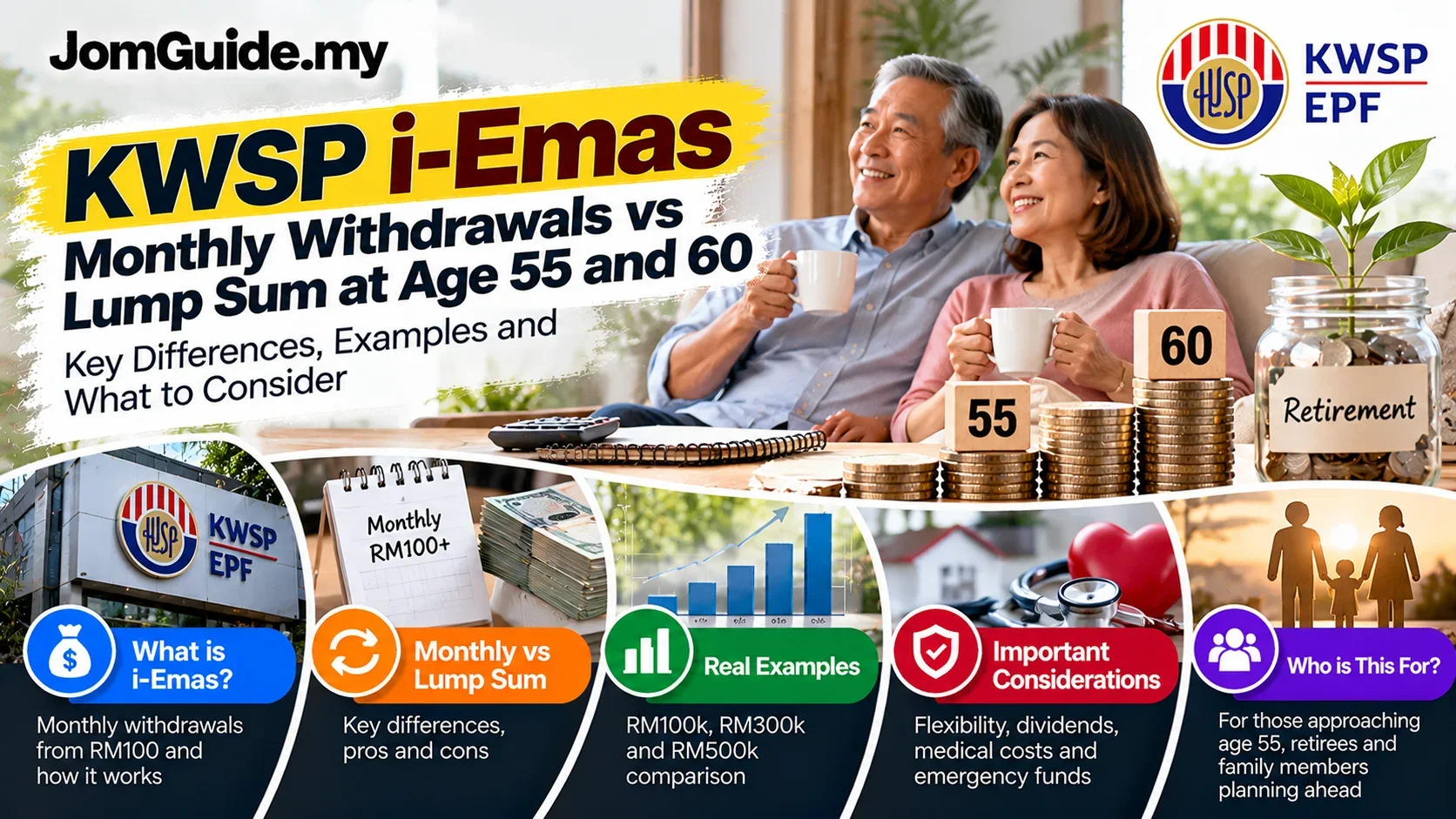
Source: Sources: KWSP Age 55 & 60 Withdrawal; KWSP i-Emas rebranding announcement, 17 Apr 2026; KWSP EPF news, 11 May 2026.
You do not have to choose between withdrawing every ringgit at once and locking yourself into a rigid retirement payment plan. Under KWSP's age-55 and age-60 arrangements, eligible members can consider i-Emas monthly withdrawals, partial withdrawals, a full withdrawal or a combination. The best fit depends on monthly spending needs, other income, health expenses and how much flexibility you want to keep.
Quick fact: i-Emas is the name given in April 2026 to the existing monthly withdrawal method; it is not a new bonus, separate investment account or guaranteed retirement salary. KWSP confirmed that the monthly method was rebranded as i-Emas. Official announcement.
Information checked: 19 October 2026. Confirm your personal eligibility and the latest KWSP rules before applying.
What is i-Emas and who can use it?
KWSP's Age 55 & 60 Withdrawal guide lists i-Emas (monthly payment) as one of its withdrawal categories.
-
Age 55–59: The earlier Akaun Persaraan, Akaun Sejahtera and Akaun Fleksibel balances are combined into Akaun 55. You may apply for eligible full, partial or monthly withdrawals from that account.
-
After age 55, if you continue working: New contributions go into Akaun Emas, which is generally available for withdrawal from age 60, not immediately at 55.
-
Age 60 and above: KWSP offers age-60 withdrawal options, including monthly, partial or full withdrawals from eligible savings. Check the current account balance and categories in i-Akaun.
Don't confuse i-Emas with Akaun Emas. i-Emas is the monthly payment withdrawal method; Akaun Emas is an EPF savings account for post-55 contributions.
Minimum amount, duration and payment date
Under the current official rules:
| i-Emas feature | Official rule |
|---|---|
| Monthly minimum | RM100 per month (or RM1,200 per year under the listed conditions) |
| Minimum arrangement | At least 12 months |
| Upper age limit shown | Up to age 100, subject to eligibility and available savings |
| Typical payment date | 25th of each month; the next working day if it falls on a weekend or public holiday |
| Other retirement options | Full, partial, or monthly + partial withdrawals |
RM100 is a minimum, not a recommended retirement budget. A person's sustainable amount depends on the available balance and expenses. Nor is i-Emas a guaranteed payment after savings run out.
Monthly vs partial vs lump sum: what changes?
| Withdrawal style | Good reason to consider it | Trade-off to understand |
|---|---|---|
| i-Emas monthly | Predictable cash flow for routine expenses | Monthly amount must fit the remaining balance and actual spending |
| Partial withdrawal | One-off medical, home or family needs without withdrawing everything | Less money remains in EPF for later |
| Full lump sum | Maximum immediate control over the savings | More responsibility for security, spending discipline and investing decisions |
| Monthly + partial | Routine income plus flexibility for larger expenses | Requires deliberate planning of both withdrawals and remaining capital |
JomGuide's editorial position is flexibility first, not “everyone must choose one method.” Some retirees need monthly cash flow. Others may have pension income, assets, family responsibilities or an urgent expense. The framework should allow different needs while protecting essential reserves.
Examples: RM100,000, RM300,000 and RM500,000
Consider a purely illustrative RM2,000 withdrawal every month:
| Starting savings |
|---|
| RM100,000 |
| RM300,000 |
| RM500,000 |
Important: This is elementary arithmetic, not a KWSP projection, approved i-Emas schedule or estimate of how long money will actually last. It assumes no dividends, inflation, extra deposits, different withdrawals, fees or other changes. Real account balances and any approved withdrawal arrangement differ.
The lesson is not that RM500,000 guarantees a certain retirement length. It is that your desired monthly spending and available capital must be discussed together. An apparently large lump sum can become much smaller when used regularly over many years.
How to plan without giving up flexibility
Before applying, write down four things:
-
Essential monthly costs: food, housing, utilities, transport and ongoing healthcare.
-
Other reliable income: pension, part-time income, household support or rental income, if applicable.
-
Emergency needs: medical costs, household repairs or family emergencies. Decide what must remain readily accessible.
-
Remaining savings after any planned withdrawal: check the effect of a lump sum or partial withdrawal before committing.
If you're helping parents prepare, use this as a conversation checklist—not a reason to pressure them into a particular withdrawal. Account access and the final decision belong to the member.
What about dividends?
KWSP says savings remaining in eligible EPF accounts can continue to receive declared dividends, but a future dividend rate is not guaranteed. Money fully withdrawn leaves the EPF dividend environment; investing it elsewhere involves a different risk and return profile.
Avoid assuming that annual returns will exactly offset withdrawals. Use conservative scenarios with no assumed returns first, then discuss alternatives.
How to check or apply
-
Open the official KWSP i-Akaun member portal or i-Akaun app and inspect current Akaun 55 / Akaun Emas balances.
-
Visit the official 55/60 withdrawal information page to confirm the withdrawal type, supporting documents and available channels.
-
Select or enquire about i-Emas, partial, full or combined arrangements through the offered channel; available workflows can depend on your eligibility and identity/bank verification.
-
If unsure, use a KWSP office or its official support rather than a third-party agent.
Do not hand over your i-Akaun credentials or OTP to anyone offering to “unlock” retirement money.
Common questions
Is i-Emas the same as Akaun Emas?
No. i-Emas is a monthly withdrawal method; Akaun Emas is an EPF account associated with contributions after 55 and generally withdrawable at 60.
Can I withdraw part of the savings and receive monthly payments?
KWSP lists a combined monthly + partial category. Review the specific terms and your own balance before assuming a particular schedule will be approved.
Will the minimum RM100 be enough to retire?
It is a minimum eligibility amount, not a claim that RM100 covers living costs. Make a household budget based on actual needs.
Does monthly payment beat full withdrawal financially?
Not automatically. The difference is in cash flow, the capital left in EPF, control and the risks you take after withdrawing. Your personal circumstances determine which trade-offs matter.
Bottom line
At age 55 or 60, the strongest retirement decision is often not maximum withdrawal, but maximum clarity: know your monthly costs, preserve a suitable emergency buffer, and understand the options before removing money from EPF. Keep flexibility where you need it; avoid promises that one method fits everyone.
Related JomGuide reading: EPF retirement savings adequacy.
Official references: KWSP Age 55 & 60 · i-Emas announcement.
Useful? Forward it to someone who needs it.
Malaysian policy and hot topics, 2–3 items a week, each with a one-line “so what”.