
TNB Time of Use Malaysia: Peak Hours, Rates & Does ToU Save Money?
Does TNB ToU actually cut your electricity bill? Compare three household timing profiles, 2pm–10pm peak hours, rates, smart-meter eligibility and applications.

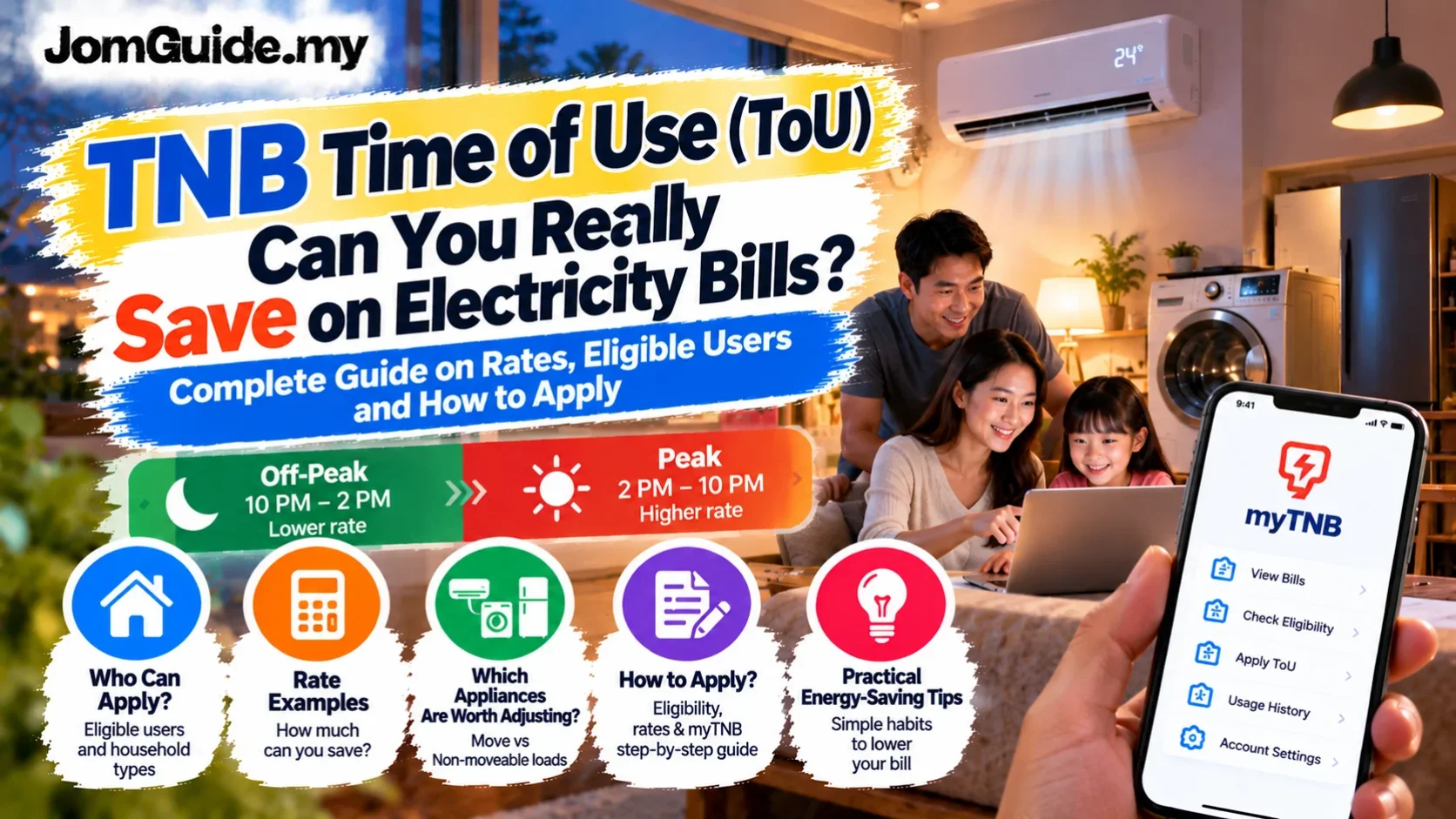
Source: Sources: TNB Time-of-Use; ST RP4 tariff framework & ToU notice (2025). Checked 21 Oct 2026.
TNB Time of Use (ToU) does not mean your electricity bill will automatically fall after 10pm. It is an optional tariff arrangement that charges different energy rates at peak and off-peak times. If enough of your actual consumption happens off-peak, the energy-charge component could be lower; if you use more power during peak hours, it could cost more.
This guide focuses on eligible Tenaga Nasional Berhad customers in Peninsular Malaysia, including domestic accounts with suitable smart-metering arrangements. Sabah and Sarawak use separate electricity systems and tariff arrangements.
JomGuide's rule: look at when your household uses electricity before switching. A RM200 monthly bill alone does not reveal your peak-hour kWh.
What are TNB ToU peak and off-peak hours?
TNB's official explanation and the energy authorities' ToU notice describe these time zones:
| Day | Hours | Tariff period |
|---|---|---|
| Monday to Friday | 2pm–10pm | Peak |
| Monday to Friday | 10pm–2pm the following day | Off-peak |
| Saturday and Sunday | All day | Off-peak |
| Designated public holidays | Applicable times in the official ToU calendar | Off-peak |
It is a common mistake to think only late-night electricity is cheaper. Weekday mornings and lunchtime until 2pm are also off-peak. TNB material refers to 15 selected public holidays; check the current official calendar rather than assuming every possible holiday applies.
How much are the energy charges?
Published domestic energy-charge comparison rates under the tariff structure are:
| Monthly electricity usage | Ordinary energy rate | ToU peak | ToU off-peak |
|---|---|---|---|
| Up to 1,500 kWh | 27.03 sen/kWh | 28.52 sen/kWh | 24.43 sen/kWh |
| Above 1,500 kWh | 37.03 sen/kWh | 38.52 sen/kWh | 34.43 sen/kWh |
These figures illustrate the energy charge only. The actual electricity bill can also include applicable capacity and network components, retail charges, Automatic Fuel Adjustment (AFA), tax, rebates or exemptions. Always check the current full tariff and your account classification at myTNB.
Malaysia also introduced a temporary 800 kWh household protection arrangement in 2026. That is a separate policy, not an automatic percentage off a ToU energy charge.
Three household lifestyles, the same 400 kWh
Comparing a RM100 bill with a RM300 bill without knowing the timing can be misleading. Here, every example uses exactly 400 kWh a month; only the hypothetical timing changes.
At the published rates above, a simplified ordinary energy charge is:
400 kWh × RM0.2703 = RM108.12.
For ToU, the comparable calculation is:
Peak kWh × RM0.2852 + off-peak kWh × RM0.2443.
| Illustrative lifestyle | Peak / Off-peak use | Ordinary energy charge | ToU energy charge | Difference |
|---|---|---|---|---|
| Commuter household: some chores moved to morning or weekend | 40% / 60% | RM108.12 | RM104.26 | RM3.86 lower |
| Work-from-home household: heavier afternoon and evening use | 65% / 35% | RM108.12 | RM108.35 | RM0.23 higher |
| Overnight-charging household: more consumption after 10pm or on weekends | 20% / 80% | RM108.12 | RM100.99 | RM7.13 lower |
These timing percentages are invented solely for comparison, not measured consumption from real households. The figures do not represent complete TNB bills or guaranteed savings: they exclude other charges, adjustments, relief and taxes.
What's the simplified break-even point?
Using only this rate comparison, and holding everything else constant, the off-peak share would need to exceed approximately 36.4% for the ToU energy-charge component to be lower than the ordinary energy rate in these examples.
This is a mathematical illustration, not an official TNB threshold or a promise of lower bills. Real tariff components and exemptions may alter the final outcome.
Which appliances can you actually shift?
| Electricity use | Possible adjustment | Practical limit |
|---|---|---|
| Laundry and drying | Use a morning, suitable evening or weekend slot | Do not disrupt sleep, household safety or routines for marginal savings |
| Air conditioning | Start with efficient settings and maintenance before considering timing | Essential comfort and health should not be sacrificed |
| Electric water heating | Consider appropriate operating times where equipment permits | Never modify wiring or safety systems yourself |
| EV charging | Schedule approved home charging after 10pm where feasible | Follow electrical safety and equipment requirements |
| Fridges and essential medical equipment | Usually cannot sensibly be paused for a tariff | Keep essential functions running safely |
A tariff is worth less than the time, comfort or safety you give up to chase a tiny saving.
Who is eligible for TNB ToU?
The scheme is opt-in for eligible Peninsular Malaysia customers whose installations and metering arrangements meet the current requirements. The energy authorities highlight smart-meter requirements for relevant domestic and low-voltage categories.
Before applying, check that:
- Your account is within the eligible TNB Peninsular Malaysia tariff area.
- Your home has a suitable smart meter, or TNB has confirmed the required metering arrangements.
- You are authorised to make changes to the account, particularly if you rent the property.
- You understand your household's actual kWh and timing profile, not simply the RM total on the bill.
- You have reviewed the latest tariffs, conditions and additional bill components.
How to apply through myTNB
TNB explains that eligible customers can use the Time-of-Use (ToU) Application service on the official myTNB app or portal; support is also available from Kedai Tenaga and TNB CareLine.
- Go to myTNB or open the official app.
- Sign in to your linked electricity account.
- Find Time-of-Use (ToU) Application in the relevant services menu; the exact label or location can change.
- Review metering eligibility, available terms, tariff information and your account details.
- Submit through the official channel and retain the confirmation.
- Check the effective date and review bills after the switch.
Submitting an application does not necessarily activate ToU immediately. If the option is missing or the portal is under maintenance, contact TNB directly instead of an unrelated 'application agent'.
Frequently asked questions
Is electricity cheaper only after 10pm?
No. Off-peak also covers weekday mornings and early afternoon up to 2pm, full weekends and officially designated public holidays.
My bill is RM200. How much will I save?
You cannot determine that from RM200 alone. You need at least the relevant peak and off-peak kWh breakdown and current complete tariff.
Are people working from home always worse off?
No. Weekday hours before 2pm are off-peak. The question is how much electricity your household actually uses between 2pm and 10pm on weekdays.
Do I need a smart meter?
The scheme's eligibility is linked to suitable metering. Ask TNB to check your account and installation rather than assuming automatic eligibility.
Is this the same as Malaysia's 2026 800 kWh bill protection?
No. That temporary policy relates to specific bill protections, while ToU determines energy charges by time. The two require separate checks before estimating a final bill.
JomGuide's pre-switch checklist
- Confirm you're a TNB customer in the eligible area and have suitable metering.
- Know the true peak period: weekday 2pm–10pm.
- Find actual time-of-use kWh data or collect enough consumption information to make a reasonable comparison.
- Distinguish adjustable appliances from essential, non-adjustable loads.
- Compare a complete bill using current official charges—not just this article's energy-rate example.
- Use the official myTNB application route and keep confirmation details.
Bottom line: TNB ToU is a way for some households to make existing usage habits cheaper. It is not an automatic discount for everyone. Calculate first, then decide.
Verified 21 October 2026. Official sources: TNB Time of Use and application guidance, Suruhanjaya Tenaga tariff framework and official ToU scheme announcement.
Useful? Forward it to someone who needs it.
Malaysian policy and hot topics, 2–3 items a week, each with a one-line “so what”.