
Malaysia EV Road Tax 2026: Tesla, BYD & Proton e.MAS Rates and Battery Life
Learn how Malaysia's 2026 power-based EV road tax works, compare Tesla, BYD and Proton e.MAS models, and see five-year expense assumptions and long-term battery risks.

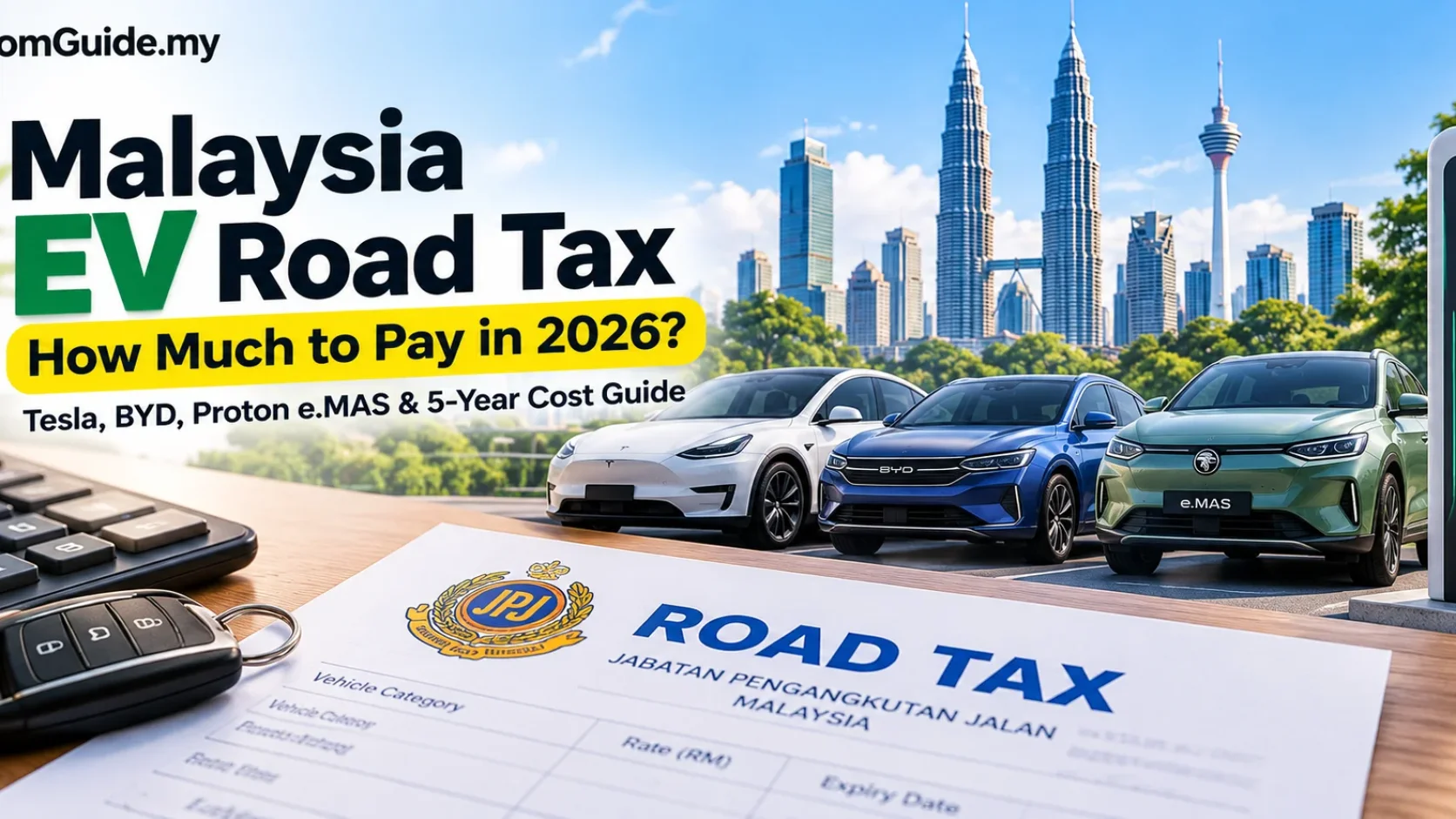
Source: Sources: JPJ 2026 LKM schedule, Tesla and Proton warranties, Geotab 2026 battery study
Checked 22 October 2026. Malaysian EV road tax is no longer automatically zero in 2026. The calculation starts with the electric motor's registered output in kilowatts (kW)—not battery capacity in kilowatt-hours (kWh), purchase price, or brand name.
Here is the important split: JPJ's current annual road tax can be calculated, but no one can guarantee an individual EV's battery life, five-year resale value or total ownership costs in advance.
How Malaysia calculates EV road tax in 2026
Under the fee schedule applying from 2026, non-motorcycle zero-emission vehicles are charged annual Motor Vehicle Licence (LKM) fees according to the registered motor-output bracket.
| Registered motor output | Annual LKM |
|---|---|
| Up to 50 kW | RM20 |
| Over 50 up to 60 kW | RM30 |
| Over 60 up to 70 kW | RM40 |
| Over 90 up to 100 kW | RM70 |
| Over 120 up to 130 kW | RM120 |
| Over 140 up to 150 kW | RM160 |
| Over 150 up to 160 kW | RM180 |
| Over 200 up to 210 kW | RM280 |
| Over 210 up to 220 kW | RM305 |
| Over 220 up to 230 kW | RM335 |
| Over 380 up to 390 kW | RM965 |
The amount is a fixed fee within each power bracket, rather than a flat amount multiplied by each additional kilowatt. If registration lists 160 kW, it falls in the over-150-up-to-160 bracket; a slightly higher registered figure may move it into the next bracket.
Battery size measured in kWh is not motor output measured in kW. Always cross-check your vehicle's registration details and the amount JPJ/MyJPJ actually displays when renewing.
Sources: JPJ official LKM calculation guide; 2026 statutory motor-vehicle fee amendment.
Tesla, BYD and Proton e.MAS: five-year road tax examples
These examples apply to the specified variants and power outputs, not every model or model year sharing a badge. Check the power recorded for your particular car.
| Example variant | Motor output | Annual road tax | Five years at unchanged rates |
|---|---|---|---|
| Proton e.MAS 7 (160 kW specification) | 160 kW | RM180 | RM900 |
| Tesla Model 3 RWD (208 kW specification) | 208 kW | RM280 | RM1,400 |
| Tesla Model Y RWD (220 kW specification) | 220 kW | RM305 | RM1,525 |
| BYD Seal Premium (230 kW specification) | 230 kW | RM335 | RM1,675 |
| BYD Seal Performance (390 kW specification) | 390 kW | RM965 | RM4,825 |
Five-year amounts are simply the current annual charge multiplied by five. They are illustrative, not a promise that the government will hold rates constant for five years. Higher-performance EVs can pay substantially more than lower-output models.
Cross-check with JPJ's official page and the 2026 vehicle/output breakdown.
What does five-year ownership really cost?
Road tax is only one line. Other potential costs include electricity, insurance, tyres, scheduled maintenance, charging equipment, finance charges and unexpected repairs. Depreciation and eventual resale value may be much more significant than small annual road-tax differences, but they cannot be fixed reliably today.
Here is one deliberately hypothetical worksheet, using a Proton e.MAS 7 with 160 kW motor output. It is not a manufacturer quotation, insurance estimate or forecast.
Assume 15,000 km per year, 17 kWh per 100 km, an illustrative effective charging price of RM0.45/kWh, RM2,000 insurance per year, RM400 annual maintenance and RM500 per year for tyres/consumables. The road tax is held at the current RM180/year only for this exercise.
| Five-year expense | Calculation | Hypothetical amount |
|---|---|---|
| Road tax | RM180 × 5 | RM900 |
| Charging electricity | 75,000 km / 100 × 17 × RM0.45 | RM5,737.50 |
| Insurance | RM2,000 × 5 | RM10,000 |
| Maintenance | RM400 × 5 | RM2,000 |
| Tyres and consumables | RM500 × 5 | RM2,500 |
| Illustrative subtotal | RM21,137.50 |
This is NOT the complete five-year cost of ownership. It excludes vehicle purchase cost, financing, charging losses, home wallbox installation, parking, tolls, unexpected repairs, depreciation and eventual resale proceeds. Every non-road-tax price above is an assumption. Replace the inputs with verified energy consumption, personal insurance quotes and your actual charging tariffs.
For a separate explanation of household electricity time bands, see JomGuide's TNB Time of Use guide.
Do not compare different EVs by pretending they all have the same insurance, electricity consumption, tyre cost or depreciation.
Does an eight-year battery warranty mean the battery lasts only eight years?
No. Warranty coverage is not the same as physical battery life. A warranty specifies the manufacturer's obligations for a period or mileage, sometimes with a minimum capacity-retention condition. An EV may remain usable past its warranty, although repair risks rise once coverage ends.
Examples from manufacturer documentation:
- Tesla Malaysia lists 8 years / 160,000 km of battery and drive-unit coverage with a minimum 70% capacity retention for certain Model 3 and Model Y versions; other variants have 8 years / 192,000 km. Your vehicle's actual warranty terms take precedence.
- The Proton e.MAS 7 warranty and service booklet lists 96 months or 160,000 km, whichever occurs first, for specified components including the traction battery.
- For BYD, read the precise local warranty for the chosen model, year and trim rather than assuming every version has identical coverage.
Real-world data provides useful context, not a vehicle-specific guarantee. A 2026 Geotab analysis of more than 22,700 EVs found an average battery-capacity degradation rate of about 2.3% per year across its studied models. Reliance on high-power DC charging and hot climates influenced degradation rates. That aggregate result should not be applied mechanically to forecast an individual car's 20- or 30-year life.
Source: Geotab EV battery health study, January 2026.
Petrol cars can run for 20–30 years. Can EVs?
They may be kept running for a long time, but there is not enough model-specific, decades-long Malaysian evidence to promise that every EV bought today will be economical to operate for 20 or 30 years.
The practical ownership questions extend beyond battery chemistry:
- Will service and replacement parts remain accessible after the vehicle is 10 or 15 years old?
- Can battery modules and electronics be repaired independently?
- Can buyers obtain a credible battery state-of-health (SOH) report?
- Is any remaining warranty transferable, and what exclusions apply?
- Will suitable charging and software support remain available?
These are sensible risk questions, not proof that EVs universally fail early. Petrol cars also require age-related repairs.
What happens to resale value and used EV prices?
A future price depends on new-car discounts, battery health, repair history, warranty coverage, demand, available parts and changing technology. No credible 2026 source can guarantee what a specific 2026 EV will sell for in 2031.
If considering a used EV, pay close attention to credible SOH diagnostics, maintenance and accident history, remaining warranty and suitability for your actual driving needs. An eight-year battery warranty does not imply a worthless vehicle in year nine, but claims that an EV will definitely last 30 years are equally unsupported.
Frequently asked questions
Is Malaysian EV road tax still free in 2026?
The general EV road-tax exemption ended at the close of 2025. The power-based fee schedule applies from 2026, subject to the registered vehicle and JPJ's current assessment.
Is Tesla road tax always higher than BYD or Proton?
No. Compare specific versions and registered kW, not brand labels. A performance-oriented model may occupy a far higher bracket.
Does a 60 kWh battery mean I pay the 60 kW rate?
No. kWh measures stored energy; kW represents motor power for this calculation.
Does your five-year table include resale depreciation?
No. It is an expense illustration only. Depreciation, financing and the eventual sale value are major omitted factors.
Must the battery be replaced as soon as the warranty ends?
No. The end of coverage is not the end of the battery's usable life; condition and repair needs must be assessed.
JomGuide's takeaway
Start with the registered kW and JPJ's fee bracket. Then build your own five-year budget using actual driving distance, charging mix and insurance quotes. If long ownership or buying used is your concern, spend at least as much attention on battery health, repairability and resale uncertainty as on annual road tax.
Last checked 22 October 2026. JPJ's official fee guide is the reference for current registrations. Model output, warranties and government rates can change.
Useful? Forward it to someone who needs it.
Malaysian policy and hot topics, 2–3 items a week, each with a one-line “so what”.