
Salary Still Not In? When Malaysian Employers Must Pay Wages and What You Can Do About Delays
If your salary is late, asking HR first is sensible. Under the Employment Act 1955 framework, ordinary wages generally must be paid no later than the seventh day after the end of the wage period, and JTKSM accepts complaints about late wage payment.

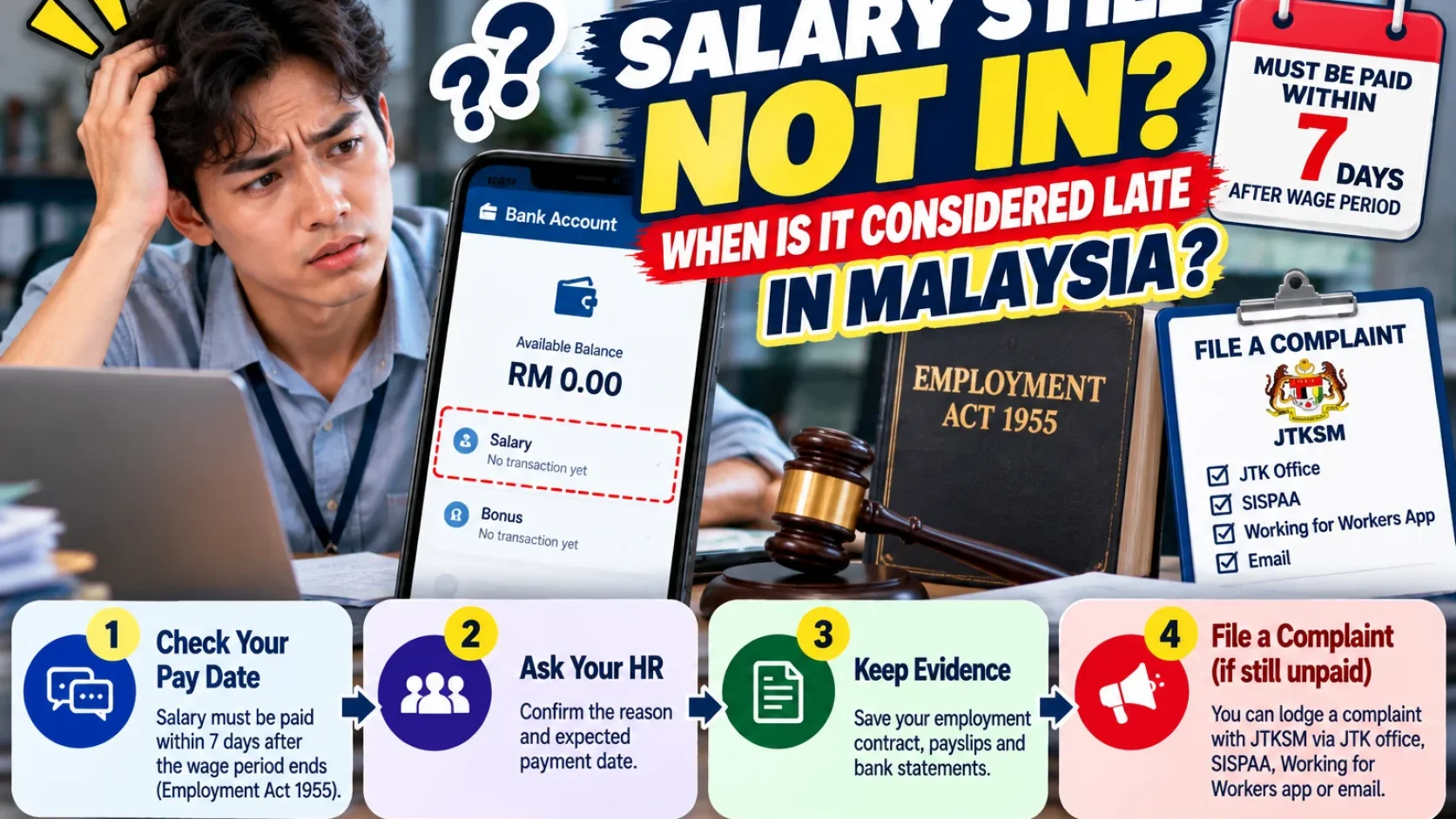
Source: Source: Employment Act 1955 ss.18–21; JTKSM Complaints & Labour Case guidance, accessed Oct 2026
If your employer normally pays at month-end but your salary is still missing on the 3rd or 5th, asking HR first is reasonable.
A one-off delay does not automatically mean the company has broken the law, but employees should know the statutory payment framework.
This guide focuses on Peninsular Malaysia and Labuan under the Employment Act 1955. Sabah and Sarawak have their own labour laws.
When must ordinary wages be paid?
Section 19 of the Employment Act 1955 provides the basic rule:
ordinary wages must generally be paid no later than the seventh day after the last day of the wage period.
For a wage period running from the 1st to the end of the month, that usually means payment no later than the 7th of the following month.
That does not mean every employer can ignore an earlier contractual payday.
If your employment contract promises payment on the 25th, 28th or month-end, that contractual date still matters.
What should you do first?
Ask HR or payroll directly.
For example:
“My salary has not come in yet. Can you confirm the payment status and expected bank-in date?”
Try to get a clear answer on:
- whether payroll has been released;
- the transfer date;
- whether the delay affects everyone;
- whether there is a banking or payroll-system issue.
What if the deadline has passed?
JTKSM explicitly lists late payment of wages by an employer as a complaint issue.
Complaints can be made through channels including:
- a nearby Labour Office;
- JTKSM email;
- SISPAA;
- the Working for Workers (WFW) app;
- phone or walk-in channels.
What should you keep as evidence?
Useful documents include:
- your employment contract or offer letter;
- recent payslips;
- bank records showing when salary was actually credited;
- written HR explanations;
- relevant company and employment details.
Does the seven-day rule apply to OT too?
Not always.
The Employment Act has separate timing rules for additional wages relating to overtime, rest-day work and public-holiday work.
So do not assume every item on a payslip must follow exactly the same date as ordinary wages.
What about bonuses and commissions?
Those can depend on the employment contract, incentive scheme and whether a payment falls within the legal definition of wages.
The simple “seven-day” explanation should not be applied blindly to every bonus or commission arrangement.
Should you complain immediately if HR says payment is coming?
If there is a genuine short technical delay and the employer gives a clear, near-term payment date, you may choose to monitor it first.
But repeated delays deserve more attention, especially when:
- payday keeps moving;
- HR will not provide a clear date;
- only part of the salary is paid;
- the statutory deadline has passed.
Repeated late salary can be a warning sign
One delayed month does not prove a company has financial trouble.
But repeated payroll delays can be a cash-flow warning.
Keep records and also check whether EPF, SOCSO and EIS contributions remain up to date.
Bottom line
Use this sequence:
ask HR → check your contractual payday → compare it with the legal payment framework → keep evidence → escalate to JTKSM if unresolved.
If it is only the 3rd, ask what happened.
If the applicable wage period ended more than seven days ago and your wages are still unpaid, the issue is much more serious than an ordinary bank delay.
Useful? Forward it to someone who needs it.
Malaysian policy and hot topics, 2–3 items a week, each with a one-line “so what”.