EPF Deducted on Your Payslip but Missing From i-Akaun? Ask HR, Then Check and Escalate
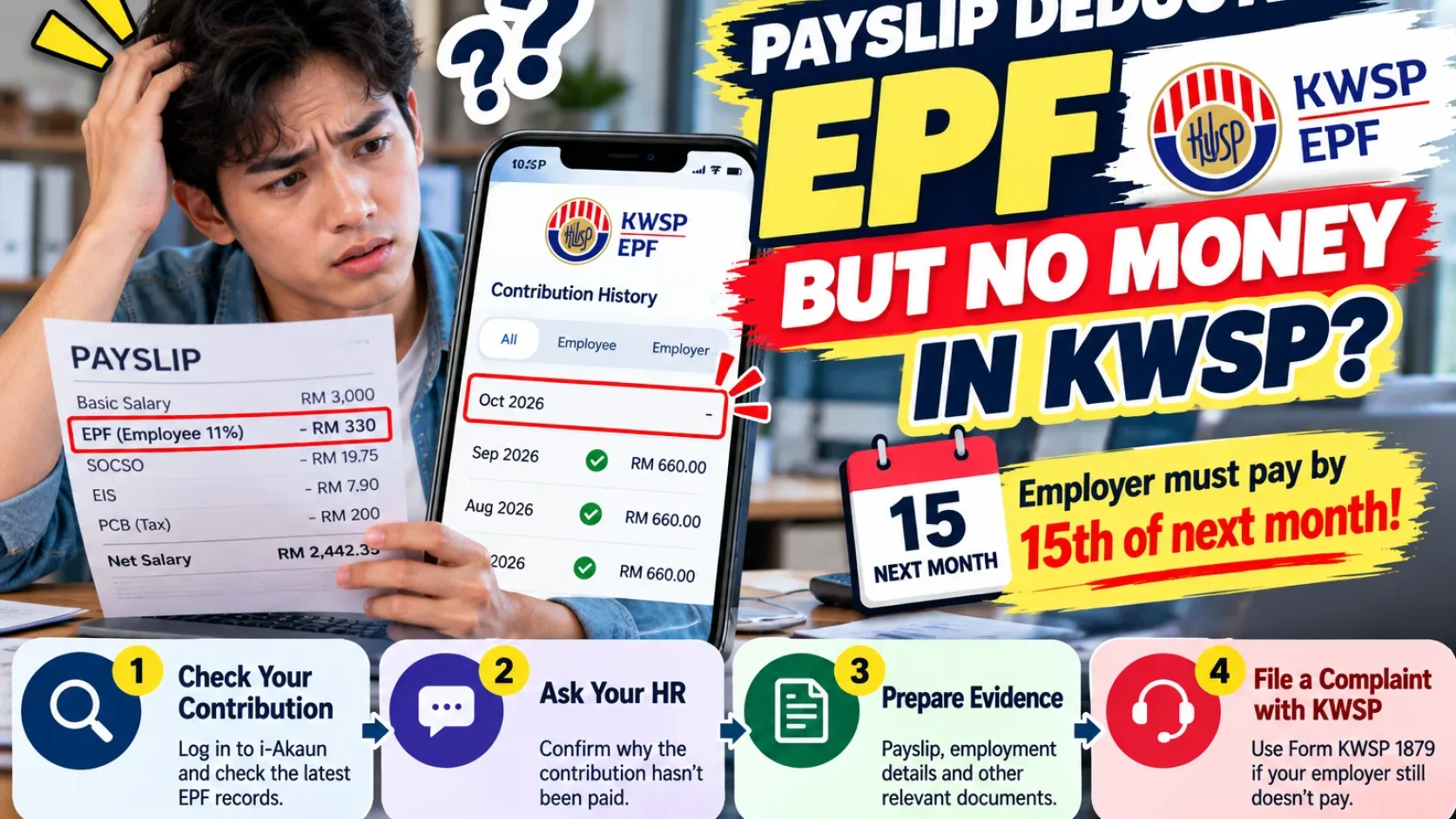
A payslip showing an EPF deduction does not by itself prove the contribution has reached KWSP. Check i-Akaun, ask HR or payroll for the payment status, and escalate to KWSP if the contribution is missing, late or incorrect.

Source: Source: KWSP Mandatory Contribution, Employer Responsibilities and Compliance pages, accessed Oct 2026
If your payslip shows an EPF / KWSP deduction but the contribution is missing from i-Akaun, starting with HR or payroll is reasonable.
But do not assume that because “EPF” appears on the payslip, the money has definitely reached KWSP.
Those are two separate things.
When must the employer pay EPF?
KWSP states that contributions for a month’s wages must be paid:
on or before the 15th of the following month.
For example:
January salary
→ contribution month is February
→ payment is due by 15 February.
If the 15th falls on a weekend or public holiday, payment on the next working day is generally not treated as late.
So not seeing the contribution in the first few days of the next month does not automatically mean something is wrong.
But once the required payment period has passed, check it.
First step: ask HR or payroll
A simple message is enough:
“My payslip shows an EPF deduction but I can’t see the contribution in i-Akaun yet. Can you confirm the submission and payment status?”
Ask for specifics:
- contribution month;
- payment date;
- whether the submission was successful;
- whether there is a payment or payroll confirmation.
Sometimes the issue is processing timing or incorrect employee information.
Sometimes the employer has simply not paid yet.
Second step: check i-Akaun yourself
KWSP advises members to check contributions through:
- the KWSP i-Akaun app;
- i-Akaun (Member) web portal;
- their EPF statement.
Do not only check whether “something” appears.
Verify:
- the contribution month;
- employee share;
- employer share;
- total amount;
- whether any month is missing.
The employer share must be there too
Your payslip usually focuses attention on the employee EPF deducted from your wages.
But the employer must remit:
the employee share and the employer share
to EPF.
The employer’s share is not supposed to be deducted from your take-home salary.
If the employee portion appears but the employer portion is missing or incorrect, that is also something to investigate.
When does KWSP say you should complain?
KWSP explicitly lists situations including:
- employer fails to deduct required EPF;
- either employee or employer share is not paid;
- salary is deducted but the money is not contributed;
- deductions are inaccurate;
- payslip deductions and EPF payments do not match;
- incorrect contribution rates are used;
- correct amounts are paid late.
So the problem is not limited to “nothing entered the account”.
Underpayment and late payment also matter.
What if HR says it has already been paid?
Do not immediately turn it into a confrontation.
Ask HR to confirm:
- the exact contribution month;
- date paid;
- whether payment was successful;
- any available payment reference.
Then compare that information with i-Akaun.
If the record still does not match after a reasonable processing period, contact KWSP directly.
What do you need for a KWSP complaint?
KWSP says useful supporting information includes:
- your name;
- identity-document number;
- EPF membership number;
- employer name and contact details;
- employer address;
- employment period;
- salary paid;
- EPF amount deducted;
- payslips;
- employment contract, if available;
- other relevant documents.
The official employee complaint form is:
KWSP 1879 — Employee's Complaint Form Against Defaulting Employer.
The complaint can be handled through an EPF office.
Why should you keep your payslips?
KWSP’s own FAQ says a payslip is evidence that an employer deducted EPF from your salary.
Keep copies of:
- monthly payslips;
- employment contract;
- salary-credit records;
- i-Akaun contribution history.
If there is ever a dispute, written records are much more useful than a verbal “HR said it was done”.
What if the employer deducted EPF but never remitted it?
KWSP’s compliance information treats this seriously.
An employer who deducts the employee share from wages and fails to pay it to EPF can face legal penalties.
Late payment can also trigger late-payment charges and other consequences.
As an employee, the practical sequence is simpler:
spot the mismatch → keep evidence → ask HR → escalate to KWSP if unresolved.
Should you check i-Akaun every month?
Yes, that is a useful habit.
You do not need to check every day.
But after the normal contribution deadline, a quick monthly check can catch a problem early.
The risky scenario is not always an employer openly saying “we did not pay EPF”.
It can be:
your payslip shows a deduction every month, you assume everything is fine, and only much later discover the money never reached KWSP.
Bottom line
An EPF deduction on your payslip proves that money was deducted from your wages.
It does not by itself prove the contribution was successfully credited to your KWSP account.
Use a simple routine:
check the payslip → check i-Akaun → ask HR about any mismatch → complain to KWSP if it remains unresolved.
Useful? Forward it to someone who needs it.
Malaysian policy and hot topics, 2–3 items a week, each with a one-line “so what”.