
Malaysia's 14% Basic Credit Card: Can Existing Cardholders Reduce Interest Costs?
BNM says banks will offer no-frills Basic Credit Cards with rates capped at 14% per year from October 2026. Compare balances of RM3k, RM5k and RM10k and the trade-offs for existing cardholders.

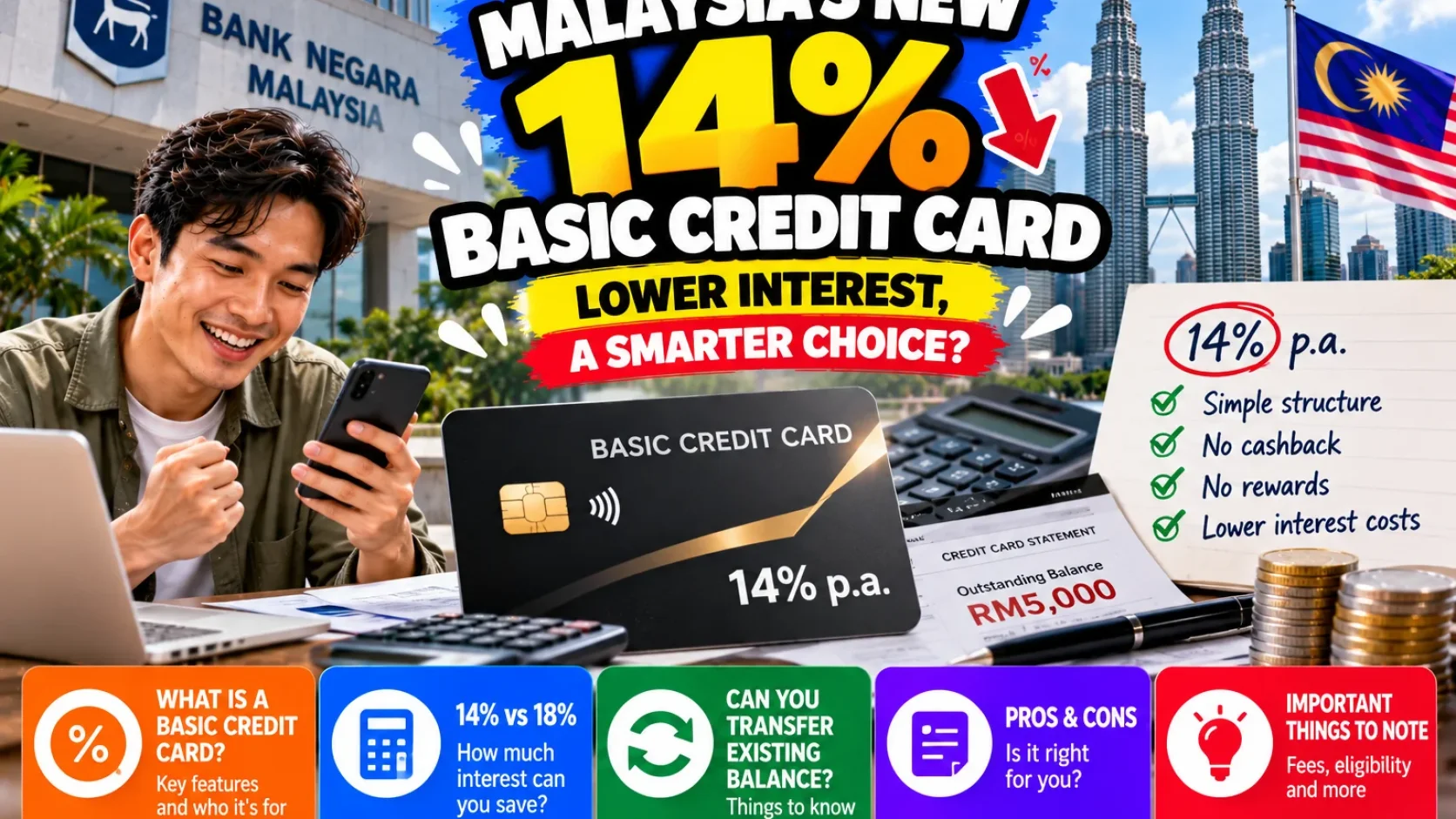
Source: BNM Budget 2027 statement (9 Oct 2026); Alliance Bank Visa Basic Card notice (10 Sep 2026)
On 9 October 2026, Bank Negara Malaysia (BNM) announced that banks would offer Basic Credit Cards (BCCs) in phases from October 2026. They are no-frills products with interest or profit rates capped at 14% annually, without cashback or reward programmes. Existing cardholders may be able to transition and move eligible outstanding balances.
The practical question is not whether everyone should get another credit card. It is whether someone with an existing balance could reduce financing costs, and what conditions apply. See BNM's announcement.
What is different about a Basic Credit Card?
| Feature | Regular credit cards | Announced BCC framework |
|---|---|---|
| Finance charge | Depends on bank, payment history and transaction; 18% used here as illustration | Maximum 14% p.a. |
| Cashback or points | Some products provide them | No cashback or rewards |
| Existing balance | Subject to existing card terms | Eligible balance transfers may be available, depending on the bank |
| Fees | Check annual fees, taxes and transaction charges | No assumption of zero fees; check the Product Disclosure Sheet |
| Best question to ask | Is the whole product good value? | Does it reduce the total cost of existing debt? |
A lower rate is still interest. Paying the minimum due does not automatically stop interest charges.
Illustrative cost of RM3,000, RM5,000 and RM10,000 balances
Assume the same outstanding balance stays unchanged for a full month, there are no new purchases or extra fees, and use the simple annual rate divided by 12. This is not a bank statement or repayment simulation; actual banks may calculate interest daily and repayment patterns change balances.
| Assumed balance | 18% p.a.: approx. one month | 14% p.a.: approx. one month | Difference |
|---|---|---|---|
| RM3,000 | RM45.00 | RM35.00 | RM10.00 |
| RM5,000 | RM75.00 | RM58.33 | RM16.67 |
| RM10,000 | RM150.00 | RM116.67 | RM33.33 |
The RM5,000 example differs by about RM16.67 for that static illustrative month. Do not multiply it into a guaranteed annual saving: actual balances, payments, dates and charges will vary.
Five questions existing cardholders should ask their bank
- Is my current card eligible to move to BCC, and which outstanding transactions may be transferred?
- Does the 14% rate cover my type of balance? Cash advances, instalments and late payments may have different terms.
- Are there transfer fees, annual charges, taxes or other costs?
- How do minimum payments, billing dates, interest-free periods and allocation of repayments work after a switch?
- Does the move lower the total amount paid over my realistic repayment period, not just the headline rate?
For a verified bank-specific example, Alliance Bank's official 10 September 2026 notice confirms that its Visa Basic Credit Card revised retail finance charge to 14% per annum from 1 October 2026; the announced limit is the lower of RM20,000 or twice monthly income, and there are no cashback or reward benefits. Do not assume those exact Alliance Bank details apply to every bank.
No cashback: does that matter?
For someone who already pays the full statement balance on time, avoiding interest entirely may matter more than a headline lower rate; changing cards could mean giving up useful benefits without meaningful savings.
For someone carrying debt, a lower financing rate may matter more—but switching is not a reason to increase spending. Prioritise necessary living expenses, stop adding avoidable balances and ask the bank about sustainable repayment arrangements where needed.
Why minimum payment still matters
Minimum payment is a contractual floor, not a plan to become debt-free quickly. Financing charges may continue when the statement balance is not fully paid.
For detailed illustrations, see JomGuide's earlier guide: RM5,000 Credit Card Balance: Minimum Payment vs Repayment Plan.
FAQ
Can all existing balances be transferred automatically?
No. BNM refers to eligible balances and transitions; product eligibility and fees must be checked with the issuing bank.
Does 14% cover every transaction?
Not necessarily. Check the specific terms for retail purchases, instalments, cash advances and late-payment charges.
Is 14% charged every month?
No. It is an annual rate. The table uses a simplified one-month comparison.
Should someone without debt switch?
There is no universal answer. Costs, benefits and personal needs differ, especially when the card is paid in full.
Bottom line
Compare real repayment costs, transfer conditions and fees before reacting to the headline rate. Financial education is more useful than encouraging new borrowing.
Sources: BNM Budget 2027 statement · Alliance Bank BCC product notice
Useful? Forward it to someone who needs it.
Malaysian policy and hot topics, 2–3 items a week, each with a one-line “so what”.