Does a Malaysia Offer Letter Need RM10 Stamp Duty in 2026? Who Pays and What About Older Contracts?
New job or running HR? See when a Malaysian employment offer letter needs RM10 stamping, who pays, the 30-day deadline and how 2024, 2025 and 2026 contracts differ.

Source: LHDN employment contract FAQ, stamp-duty relief and STSDS/MyTax guidance (Oct 2026)
An employment offer letter signed in 2026 may attract RM10 stamp duty—but the name "offer letter" is not what decides the tax. What matters is whether the document creates an employer–employee relationship, when the contract was executed, and who signed it first.
A major misconception is that stamp duty for employment contracts only began in 2026. It did not: the underlying requirements arise under the Stamp Act 1949. Malaysia introduced targeted exemptions and penalty remission for contracts executed in specified earlier periods.
This guide follows LHDN's official employment-contract FAQ and stamp-duty notices, checked 9 October 2026.
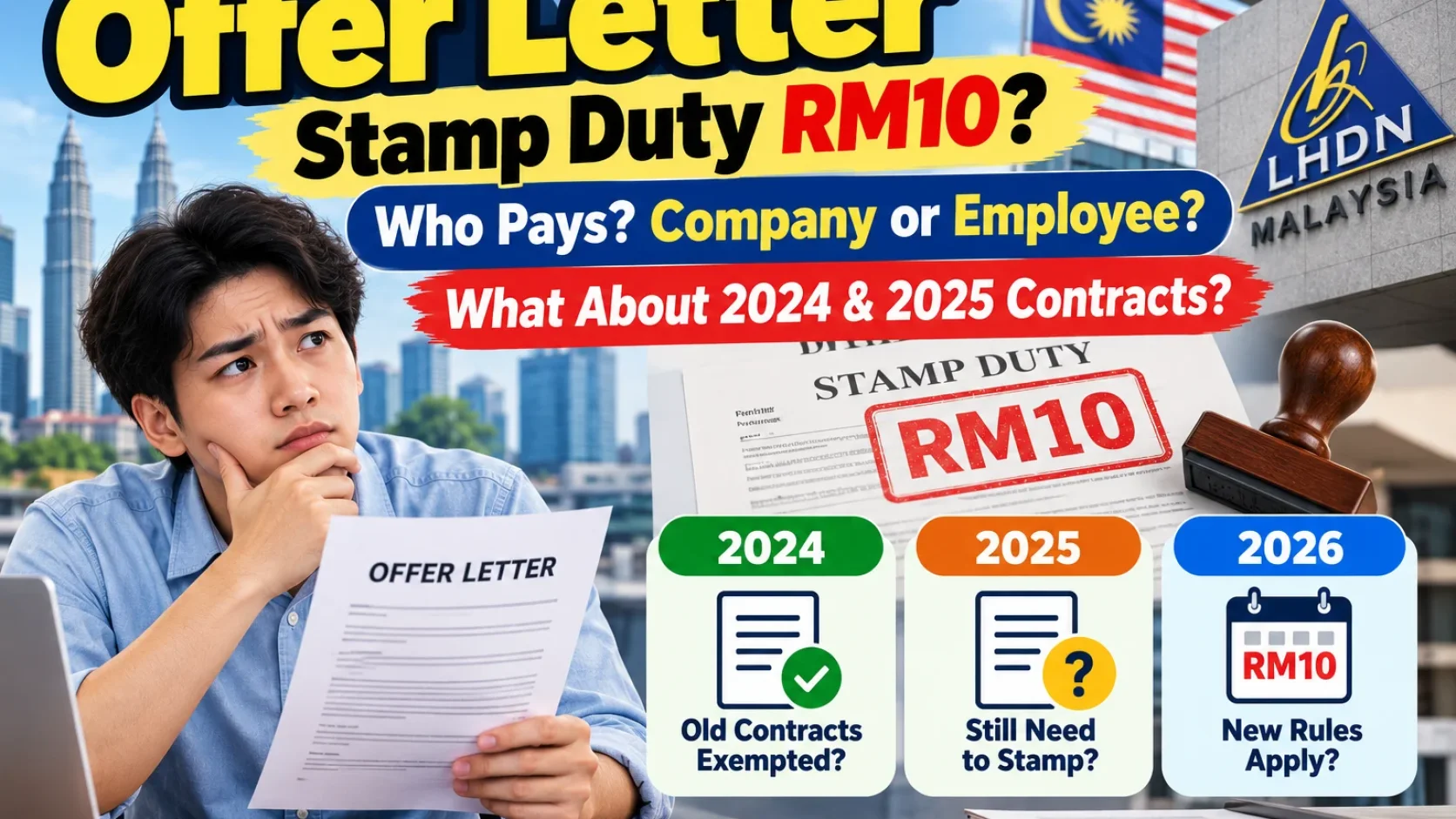
Before 2025, during 2025, or from 2026: what changes?
| When the employment contract was finalised | Stamp duty treatment | Late-stamping issue |
|---|---|---|
| Before 1 January 2025 | Eligible contracts exempted under the published targeted measure | Penalties remitted; an exemption endorsement can be requested if needed |
| 1 January to 31 December 2025 | RM10 generally chargeable | The special late-penalty remission required stamping by 31 December 2025; do not assume it still applies to work done in 2026 |
| From 1 January 2026 | RM10 per qualifying original employment contract | Ordinary statutory stamping deadlines and applicable penalties apply |
So the answer to "Did my old contract need stamping before this new announcement?" is it depends on the execution date. A contract finalised in 2024 generally falls under the targeted exemption; one signed in June 2025 was still chargeable, even though a time-limited late-penalty remission was available in 2025.
Official basis: LHDN FAQ and LHDN's employment-contract stamp-duty announcement.
Is an offer letter the same as an employment contract?
Not always. LHDN says a letter offering employment can count as the taxable employment instrument if it is the only document establishing the binding employment relationship.
Rather than the heading, check for the substance: agreed salary, job duties, required working hours or location, managerial supervision, and employee benefits such as EPF/KWSP, SOCSO/PERKESO and leave. A short email notifying someone of an interview or a proposed offer is not automatically an executed employment agreement.
A genuine freelance contract for services is not automatically classified under the RM10 contract of service (employment) item; different stamp-duty provisions may apply. Document wording alone cannot override the actual working relationship.
Five real-life scenarios
Example 1 — Offer letter executed in 2024. If it is a qualifying employment contract finalised before 1 January 2025, LHDN's targeted measure generally exempts it from the employment-contract duty. An employer can seek an exemption endorsement if documentary confirmation is needed.
Example 2 — Employment contract signed in June 2025, forgotten until October 2026. It was chargeable in 2025. The published remission for late stamping was conditional on completion by 31 December 2025. The company should seek LHDN's assessment rather than assuming there is no stamp duty or penalty.
Example 3 — Employment offer signed in October 2026, employer signs first. Where the letter creates the employment relationship, RM10 stamp duty generally applies, and the first signatory is normally the party liable. It is usually the company, but the sequence should be checked.
Example 4 — Renewed contract in 2026. LHDN treats every new renewal agreement as a separate instrument requiring stamping assessment; last year's stamp is not automatically valid for a brand-new contract.
Example 5 — Freelance designer hired for one project. If this is truly independent work without an employment relationship, do not simply apply the employee contract's RM10 classification. Determine the correct treatment from the instrument and official guidance.
Who should pay RM10—employer or employee?
LHDN's FAQ says the person who first signs the employment contract is liable for duty under the relevant Stamp Act rule. In many companies, the employer signs an offer letter first, so the employer commonly bears the stamp duty.
That is different from a claim that an employee could never be the first signatory, or that every internal payroll or reimbursement arrangement is automatically unlawful. If HR says you must pay, calmly ask how the company applied the first-signature rule and whether it is processing stamping centrally.
A useful short message to HR:
Could you confirm who is responsible for the RM10 stamp duty on my employment agreement under LHDN's first-signatory rule, and whether the company will handle the e-Duti Setem filing?
For a small employer, this is also an easy compliance check before preparing dozens of contracts.
When is stamping due, and what is the penalty?
LHDN says a qualifying agreement should generally be stamped within:
- 30 days after signing in Malaysia; or
- 30 days after receipt in Malaysia, if executed overseas.
LHDN also mentions duty payment within 14 days or the period allowed by the Collector following the relevant assessment process; employers should follow the specific payment notice and not treat every stage as having the same 30-day deadline.
For late stamping, LHDN's published rates are:
- Within three months after the initial 30-day period: RM50 or 10% of the deficient duty, whichever is higher.
- After more than three months beyond that period: RM100 or 20%, whichever is higher.
That can make the penalty greater than the RM10 duty itself. Historical exemptions and remissions require separate assessment.
Official reference: LHDN stamp duty penalties.
How to stamp in 2026: MyTax e-Duti Setem
Do not rely on a 2025 walkthrough telling you to continue filing through the old standalone STAMPS portal. LHDN confirms e-Duti Setem via MyTax is the 2026 access route, with the Stamp Duty Self-Assessment System (STSDS) being implemented in stages.
For HR, payroll teams or small-business owners:
- Identify the final signed contract, instrument type and actual execution date.
- Ensure the duty payer or authorised representative has the required tax identification number (TIN).
- Open MyTax → ezHASiL Services → Stamp Duty / Duti Setem → e-Duti Setem.
- Complete the currently applicable instrument submission, tax assessment/declaration and payment steps accurately.
- Retain the stamped record, payment evidence and underlying instrument; LHDN generally requires record retention for seven years.
Check the exact live portal instructions for the particular category. LHDN has separate guidance about the 2026 phased implementation.
Official sources: LHDN STSDS and MyTax e-Duti Setem transition guidance.
Does an unstamped contract mean the employee has no rights?
It is not that simple. LHDN warns that an insufficiently stamped instrument may be inadmissible as evidence in court until the stamp-duty issue is dealt with, and penalties may arise. But it does not automatically establish that the worker was never employed or that wages and EPF obligations disappear.
Keep signed documents, payslips, messages and proof of actual employment. For a dispute over legal enforcement or contractual evidence, obtain appropriate advice rather than accepting a one-line claim that an unstamped offer is "worthless".
What HR and small employers should audit
Sort contracts into pre-2025, 2025, and 2026 onward groups. Then separately assess employment offers that create contractual obligations, new renewals, binding addenda, and genuine independent-contractor agreements. A signed, binding supplementary agreement can have its own stamp-duty implications; do not automatically bundle every document into one RM10 payment.
The practical rule: assess what the document does, its signing date and the first signatory; for 2026 filings, use the current MyTax e-Duti Setem route.
Official sources: LHDN FAQ · LHDN date-based relief · LHDN STSDS.
Useful? Forward it to someone who needs it.
Malaysian policy and hot topics, 2–3 items a week, each with a one-line “so what”.