Investment-Linked Medical Card Repriced? Before You Top Up, Find Out When Your Policy Could Lapse
When an investment-linked medical card is repriced, your monthly deduction may not change at all, but the policy can lapse years earlier. Using HLA's 9% schedule as an example, here is how to weigh topping up, downgrading or switching.

Source: Source: CodeBlue (21 Oct 2026), Bank Negara Malaysia, Bernama/MOF (22 Jan 2026)
The short version: if your medical cover is a rider on an investment-linked policy (ILP), a repricing may not show up in your monthly deduction at all. It shows up as a policy that lapses earlier. A top-up suggestion from your agent isn't necessarily bad advice, but get the numbers in writing and compare your options before you agree.
For the basics of repricing letters and BNM's 10% measure, start with our earlier guide, Medical Card Premium Going Up?. This piece focuses on investment-linked policies.
Why this matters now
- BNM's interim measures are ending. Introduced in December 2024, they require insurers to spread claims-driven premium increases over at least three years, with at least 80% of affected policyholders expected to see yearly adjustments below 10%. They run only until the end of 2026.
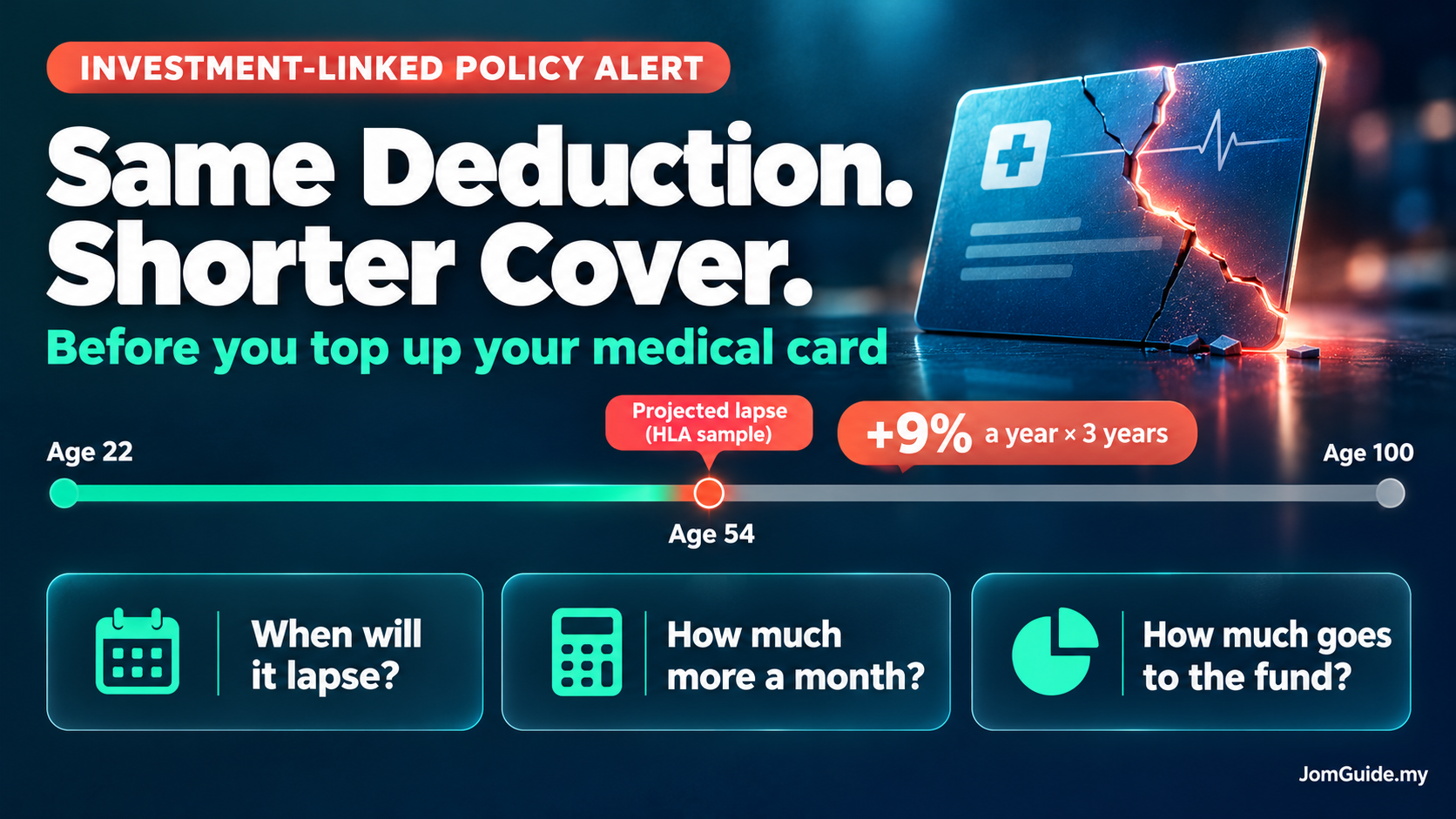
- At least one insurer has set out a multi-year schedule. According to a Hong Leong Assurance (HLA) internal memo reported by CodeBlue in October, nine HLA medical products are being repriced by 9% a year for three years from 1 November 2026, about 27% in total. Indicative increases of 11% and 12% follow in 2029 and 2030, which HLA says could end up higher. If all of that happens, the cumulative rise is roughly 50% by 2030.
Not every insurer will move the same way, but HLA's schedule is a useful real-world example of what ILP holders are facing.
How an investment-linked medical card lapses early
An ILP works roughly like this:
- Most of what you pay each month buys fund units.
- The insurer deducts insurance charges, including the medical rider, from those units every month.
- If the charges rise and your payment doesn't, more goes out than comes in, and your fund value shrinks.
- When the fund can no longer cover the charges, the policy lapses and your medical cover goes with it.
That is the trap: your monthly payment can stay exactly the same, so nothing feels different, while your policy's lifespan quietly gets shorter.
HLA's own examples
The memo cited by CodeBlue includes two sample projections:
- MedGlobal II, age 37, RM200 a month: a possible lapse at 77 if the new premiums aren't paid, and coverage to age 100 if they are.
- MedGlobal III Plan 200, age 22, RM190 a month: a possible lapse at 54. HLA estimates an extra RM98.10 a month is needed to last to 100.
Fifty-four is about the age when you most need medical cover and will find it hardest to buy again.
Know where a top-up goes
According to the same report, HLA says 95% of a recommended top-up goes into investment funds, and up to 3.75% may be paid as commission. And if you're advised to drop your policy for a new one, the new policy may restart the first-year premium allocation and commission structure.
JomGuide's view: a top-up isn't a scam, and it is often the simplest way to keep cover intact. But it's a long-term commitment, and the person recommending it is usually paid on it. Get the figures in writing and do your own sums before deciding.
Your options after a repricing notice
Based on the options in HLA's memo (other insurers differ, so check your own notice):
| Option | Upside | Watch out for |
|---|---|---|
| Pay the new premium or top up regularly | Cover stays the same, no new underwriting | A long-term commitment that may keep rising |
| Keep paying the old amount | No extra cost now | The policy may lapse earlier |
| Downgrade to a cheaper plan | Lower charges | Lower annual limit, room entitlement or higher deductible |
| Convert to another plan with the same insurer | Usually no new underwriting, subject to terms | Compare benefits line by line |
| Move to another insurer | Possibly a better fit | Full underwriting; existing conditions may be excluded |
HLA's memo also offers a temporary downgrade until 31 December 2027, with the option to return within two years or by 31 December 2029, whichever is earlier, without new underwriting. It warns agents not to present hospital income plans as a substitute for medical insurance.
Policyholders aged 60 and above on the lowest plan get a one-year deferment from HLA, but it is a delay, not an exemption.
Comparing other insurers or MediAsas? Don't cancel first
Shopping around is the right instinct; don't rely on a single agent's advice. But the order matters: never cancel your existing policy until a new one is approved.
- A new insurer will underwrite you from scratch. Anything diagnosed since you first bought your policy could be excluded as a pre-existing condition.
- MediAsas, the government-designed base medical plan, is due nationwide in January 2027. According to a Bernama report in January, policyholders facing repricing will be able to switch to it with their current insurer without new medical underwriting. It is a basic plan, and final pricing and terms won't be known until launch, so it's too early to say whether it suits you. Our MediAsas 2027 guide has the details so far.
Six questions to ask before you agree to a top-up
- If I keep paying what I pay now, at what age is the policy projected to lapse? Ask for the written projection or sustainability illustration.
- How much more a month would keep it going, and to what age? What investment return does that figure assume?
- Of each top-up ringgit, how much goes into the fund and how much to charges or commission?
- What conversion or downgrade options do I have, and do any need new underwriting?
- What is the repricing schedule for the next few years? Which increases are confirmed and which are only indicative?
- If I want to move to MediAsas later, how would that work?
If your agent can't or won't give you written figures, ask the insurer's customer service directly.
The bottom line
With an investment-linked medical card, the question isn't "how much is my deduction?" It's "how long will this policy last?" Get the numbers, do the maths and compare your options before choosing to top up, downgrade or switch.
This article is general information, not insurance or financial advice. Policy terms differ between insurers, so rely on your own policy documents and your insurer's written explanation.
FAQ
How do I know if my medical card is investment-linked?
Look for "Investment-Linked" in your policy documents, or fund units and a fund value on your annual statement. If unsure, ask your insurer.
My monthly deduction hasn't changed. Am I unaffected?
Not necessarily. ILP charges come out of your fund value, so a repricing can bring the lapse date forward without changing your deduction.
Didn't BNM cap increases at 10% a year?
BNM's interim measures expect at least 80% of affected policyholders to see yearly claims-driven increases below 10%, and they end with 2026. Age-band increases are handled separately.
Can I cancel now and switch to MediAsas?
MediAsas is due nationwide in January 2027, and reports say existing policyholders will be able to switch with the same insurer without new underwriting. Don't cancel before the switching arrangement is confirmed.
Useful? Forward it to someone who needs it.
Malaysian policy and hot topics, 2–3 items a week, each with a one-line “so what”.
Related articles
More in Jom Money-
Driving Into Singapore From 2027: VEP Rises to S$50 a Day, Free Days and Evening Hours Scrapped. Here's What It Costs You
-
STR 2026 Phase 4 Is Being Paid: Up to RM500 for Households, RM150 for Seniors, 4–6 November, New Recipients From the 16th
-
When Is STR 2026 Phase 4 Paid? Not Announced Yet: What You Can Do Now, Plus STR 2027 Applications