Malaysia Elderly Care SST 2027: 6% Service Tax, RM96,000 Exemption & Family Costs
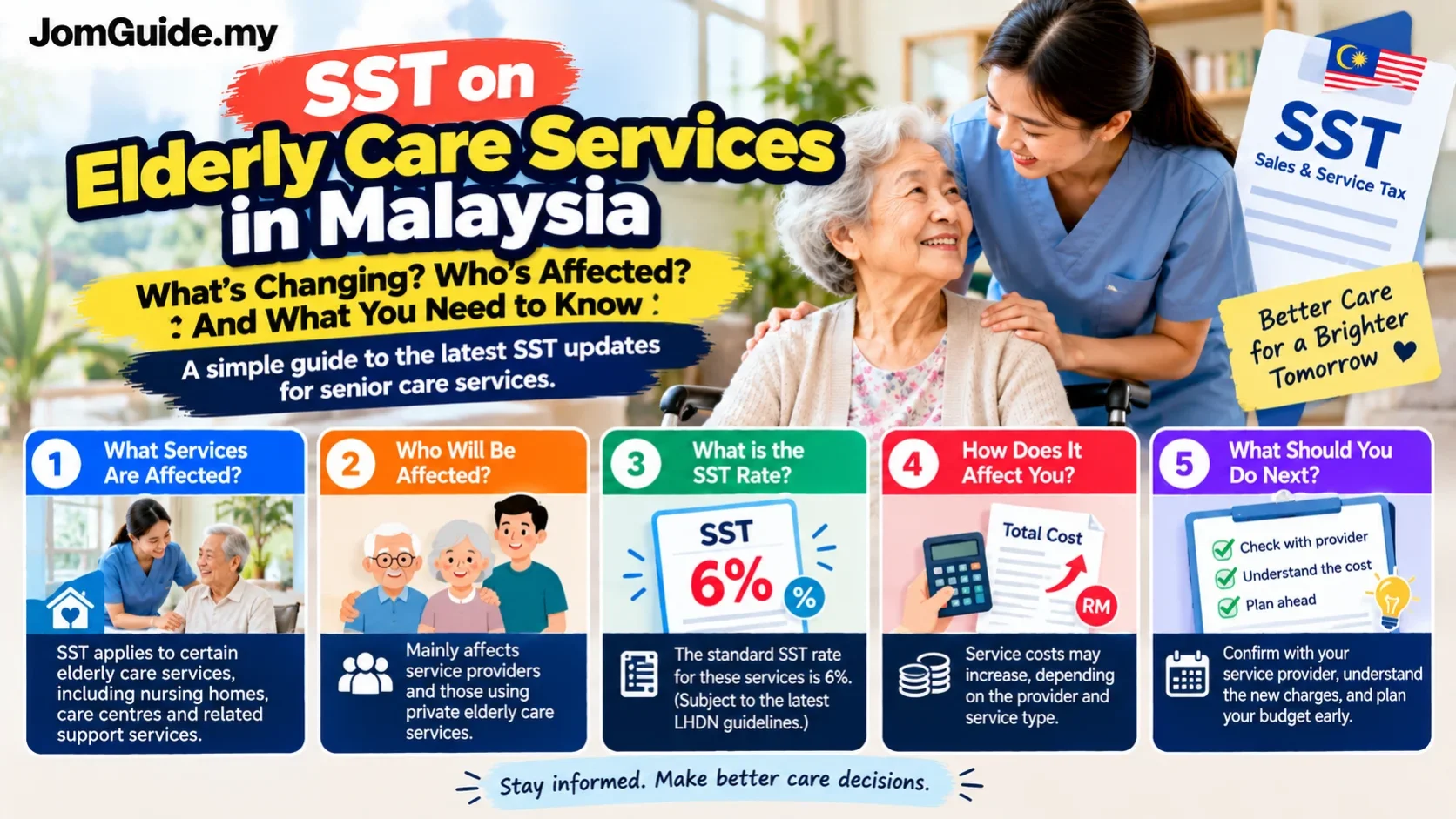
Budget 2027 announced elderly-care service tax will reduce from 8% to 6% from 1 January 2027, with a full exemption for qualifying annual care fees up to RM96,000. Understand RM4k/RM9k illustrations and rules still awaiting detail.

Source: Malaysia Budget 2027 official speech, 9 Oct 2026; Bernama; Royal Malaysian Customs MySST
Checked on 29 October 2026. Malaysia's Budget 2027 announced a change intended to ease the cost of elderly care: from 1 January 2027, the service tax (SST) rate on applicable elderly care services is to fall from 8% to 6%, alongside a full service-tax exemption for qualifying care fees of up to RM96,000 a year. The announcement was made in the Prime Minister and Finance Minister's 9 October 2026 Budget speech. Sources: official Budget 2027 speech and Bernama, 9 October.
Important: This is a Budget announcement with a proposed commencement date, not proof that every care provider has already changed its invoices. The practical coverage, treatment of mixed service fees, annual-limit calculation and transitional invoicing must be checked against the final law and Royal Malaysian Customs Department (RMCD) guidance.
The two Budget 2027 measures
| Item | What was announced |
|---|---|
| Applicable elderly-care service tax | 8% reduced to 6% |
| Intended effective date | 1 January 2027 |
| Eligible annual elderly-care fees of up to RM96,000 | Full exemption announced |
| Are all nursing homes and invoice items automatically exempt? | Not established by the speech alone |
RM96,000 is an annual amount. Dividing by 12 gives RM8,000 per month as an average annual-budget reference, but it does not establish an official monthly cut-off test. How the limit is applied in practice must come from the eventual rules.
RM4,000 and RM9,000 per month: illustrative examples
Assume, for arithmetic illustration only, that an elderly-care charge stays constant each month for 12 months. These figures are not actual provider quotes or binding tax calculations.
| Hypothetical pre-tax monthly fee | Annual total | Comparison with RM96,000 | What you can safely conclude now |
|---|---|---|---|
| RM4,000 | RM48,000 | Below | Could fall within the announced full exemption, if the service and fees satisfy the final criteria |
| RM9,000 | RM108,000 | Above | Cannot assume the full exemption applies; tax treatment of the overall bill awaits detail |
A particularly important uncertainty is what happens when the annual total exceeds RM96,000. The Budget speech alone does not settle whether the eventual taxable base is the entire qualifying amount, only a portion, or affected by separate categories. It would therefore be misleading to state that only RM12,000 will be charged 6%, or to promise a specific yearly SST total for the RM108,000 case.
To understand only the percentage difference, a wholly taxable hypothetical RM1,000 service would generate RM80 at 8% and RM60 at 6%—a RM20 arithmetic difference. That is not a forecast of any actual 2026 or 2027 care invoice.
Why an elderly-care invoice may not simply drop by 2%
A provider's bill can include basic care, accommodation, meals, additional nursing support, rehabilitation, medical services or supplies. These categories may have different legal tax treatments; do not assume that a combined invoice falls entirely under one tax description.
Four matters could affect the actual payable amount:
Provider and service classification. Is the provider registered for the relevant taxable service, and are particular bill items within the intended elderly-care category?
How the annual limit works. Is the final test tied to particular fees, an individual care recipient, provider billing or some other rule? The Budget headline does not resolve the mechanics.
Cross-year transactions. A fee paid in December 2026 for a service delivered in 2027 may raise transitional questions. Don't guess the applicable invoicing treatment.
Price changes unrelated to tax. A care centre can adjust its base charges for other reasons; a lower statutory rate does not automatically equal a specific percentage drop in the final payable amount.
A practical checklist for families
- Ask for an itemised fee schedule, distinguishing basic care from accommodation and any additional services.
- If service tax is already being charged, ask the provider to explain the taxable line items and supporting invoice basis.
- Ask how the centre is preparing for 1 January 2027 and whether it has issued a written update based on final RMCD guidance.
- Read any long-term contract clauses on fee increases, prepayments, cancellations and invoices that span two calendar years.
- Keep the focus on the quality and appropriateness of care as well as affordability. Avoid treating an unfinalised tax calculation as a guaranteed saving.
What should elderly-care providers prepare for?
Providers have a separate operational task: prepare accurate records before changing invoice logic.
- Catalogue each service, its current charges and its existing service-tax treatment, including mixed bundles.
- Follow the official RMCD MySST portal for the legal instrument, service definitions, thresholds and transitional rules.
- Coordinate with the finance team or qualified tax adviser about tax-registration status, invoice timing and any 1 January 2027 system changes.
- Avoid marketing promises such as “every customer will be SST-exempt in 2027” while implementation details remain unsettled.
- Prepare an understandable family-facing explanation of the care fee, tax category, annual-fee test and other charges once the rules are final.
The Government's Budget speech sets out the policy intent; actual compliance depends on the enacted rules and official guidance.
Frequently asked questions
Will the elderly-care SST rate be 6% in 2027? That is what Budget 2027 announced as taking effect 1 January 2027. Verify implementation against final RMCD instruments.
Is RM96,000 a monthly limit? No. The Budget announcement refers to annual fees.
Does RM4,000 a month mean automatic exemption? RM48,000 across 12 months is below the stated threshold, but final eligibility and fee definitions still matter.
For RM9,000 a month, is only the amount over RM96,000 taxed? The speech does not establish that calculation, so do not assume it.
Must care centres reduce their full bills by exactly 2%? No. Bills can have mixed tax treatment and separate price changes.
Sources: PMO Budget 2027 address; Bernama, 9 October 2026; Royal Malaysian Customs Department MySST. General information only; checked 29 October 2026.
Useful? Forward it to someone who needs it.
Malaysian policy and hot topics, 2–3 items a week, each with a one-line “so what”.
Related articles
More in Jom Money-
Driving Into Singapore From 2027: VEP Rises to S$50 a Day, Free Days and Evening Hours Scrapped. Here's What It Costs You
-
STR 2026 Phase 4 Is Being Paid: Up to RM500 for Households, RM150 for Seniors, 4–6 November, New Recipients From the 16th
-
When Is STR 2026 Phase 4 Paid? Not Announced Yet: What You Can Do Now, Plus STR 2027 Applications