PRS and SSPN Before 31 December: How Much Tax Can You Save, and Is Locking Up the Money Worth It?
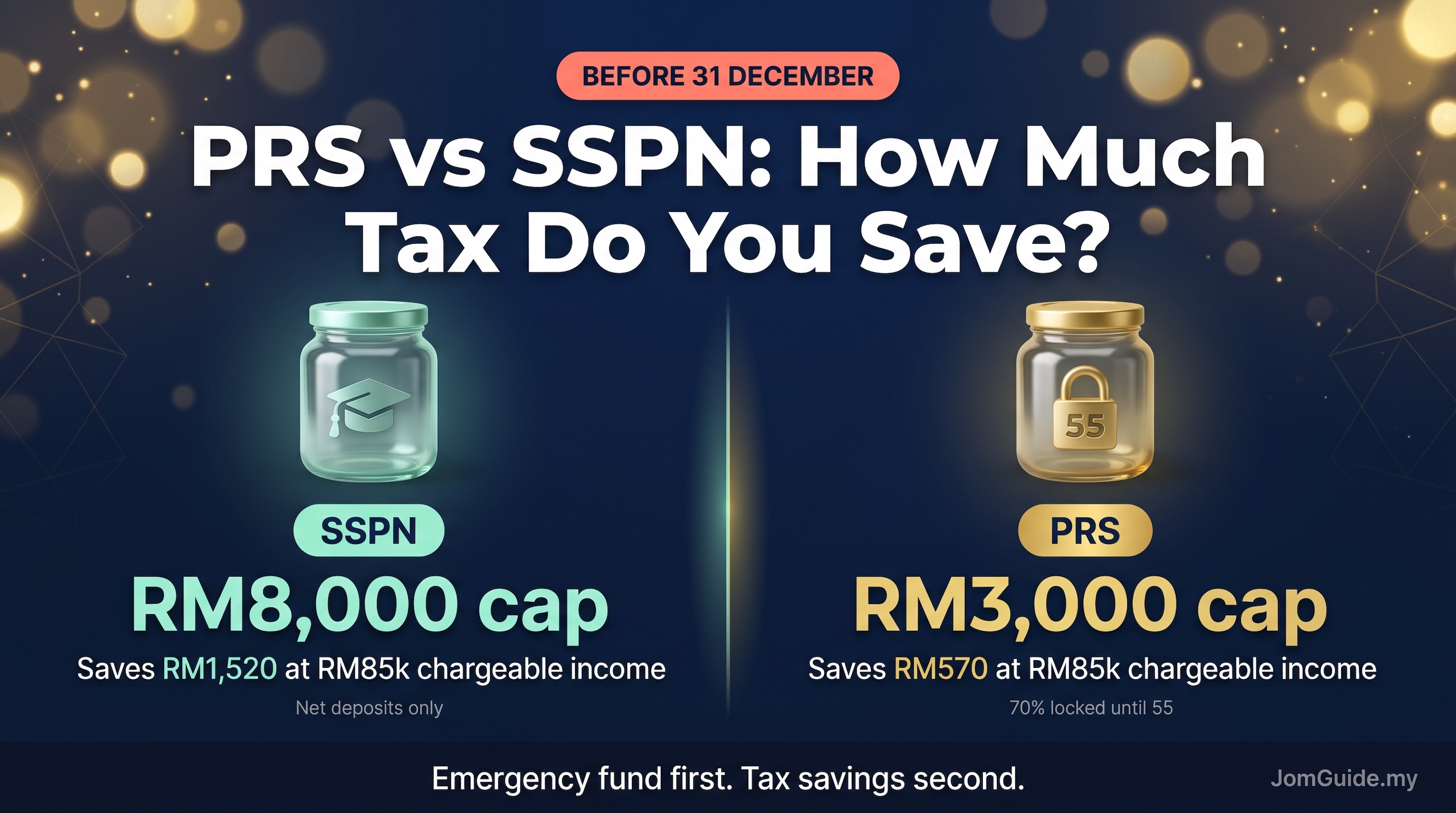
PRS relief is capped at RM3,000 and SSPN at RM8,000, and both count only if the money goes in by 31 December. Here's what you save at chargeable incomes of RM45k to RM120k, and what to weigh before you deposit.

Source: Source: RinggitPlus (Aug 2026), CIMB YA2026 tax relief guide, LHDN
The short answer: money you put into a Private Retirement Scheme (PRS) or the National Education Savings Scheme (SSPN) by 31 December 2026 can be claimed when you file for YA2026 next year. PRS relief is capped at RM3,000 and SSPN at RM8,000. How much you save depends on your tax bracket. Just remember: the tax saving is a bonus, but the lock-up is real.
The two reliefs at a glance
| Relief | Annual cap | Available until | Key point |
|---|---|---|---|
| PRS | RM3,000 | YA2030 | Shared with deferred annuity premiums |
| SSPN | RM8,000 | YA2027 | Based on net deposits into a child's account |
Both are reliefs, not rebates. They reduce your chargeable income, so the tax you actually save is the relief multiplied by your marginal tax rate.
How much you save, by chargeable income
These figures are from RinggitPlus's August 2026 calculations, assuming the full amount is claimed:
| Chargeable income | SSPN RM8,000 saves | PRS RM3,000 saves |
|---|---|---|
| RM45,000 | RM480 | RM180 |
| RM60,000 | RM880 | RM330 |
| RM85,000 | RM1,520 | RM570 |
| RM120,000 | RM2,000 | RM750 |
Note: this is chargeable income, what's left after personal relief, EPF and other deductions, not your monthly salary times 12. Last year's e-Filing will show you roughly where you sit.
The pattern is simple: the higher your bracket, the more each ringgit saves. If your chargeable income is RM35,000 or less, your rate is already low and you get a RM400 rebate, so depositing purely to save tax makes little sense.
SSPN counts net deposits
- Net deposit = what you put in minus what you take out in the same year. Deposit RM8,000 in December after withdrawing RM5,000 earlier in the year, and you can claim only RM3,000.
- The RM8,000 cap is per taxpayer, not per child. Saving RM8,000 each for two children still gets you RM8,000 in relief.
- If spouses file separately, the one in the higher tax band claims it (a rule from YA2025). Divorced parents can each claim up to RM8,000.
- The account must be for your child; you can't claim on one where you are the beneficiary.
PRS: hard to touch before 55
- Every contribution is split: 70% into sub-account A, locked until 55, and 30% into sub-account B.
- You can withdraw from sub-account B early, but only after a year of membership, once a year per provider, and with an 8% tax penalty.
- The penalty is waived for specified housing or healthcare purposes, permanent departure from Malaysia, death or serious disability.
- At 55, everything can be withdrawn penalty-free.
Run the numbers: at RM60,000 chargeable income, RM3,000 in PRS saves RM330. If you need cash next year and pull RM900 from sub-account B, RM72 goes to the penalty, and the other RM2,100 stays put until you're 55.
JomGuide's view: the lock-up until 55 is a genuine drawback. Be sure this is money you really won't need, and don't over-commit just to save a few hundred ringgit in tax.
Who should top up before year-end?
JomGuide's advice: only people who already have an emergency fund, typically three to six months of expenses. Locking money into PRS for a tax break before you have a safety net can cost you more than you save.
It tends to make sense if you:
- already have an emergency fund and a chargeable income above RM50,000;
- were planning to save for your child's education anyway (SSPN fits naturally);
- want retirement savings beyond EPF (PRS).
It's probably not for you if you:
- are still paying off high-interest debt such as a credit card balance (clear that first);
- may need the money next year for a car or a down payment.
Year-end reminders
- The money must land by 31 December. Banks and providers slow down over the holidays, so aim a week or two early.
- Keep your annual statements. Your PRS provider and SSPN will issue them, and you'll need them when filing. See Tax Relief 2026: Receipts You Should Start Keeping Now.
- Deposit only up to the cap. Anything above RM3,000 (PRS) or RM8,000 net (SSPN) earns no extra relief.
This is general information, not tax or financial advice. Actual savings depend on LHDN rules and your circumstances.
FAQ
Which tax year does a 2026 deposit count for?
Deposits made during 2026 are claimed in your YA2026 return, filed in 2027.
Can I claim both PRS and SSPN?
Yes. They are separate reliefs with separate caps.
My chargeable income is low. Is it still worth it?
Not for the tax saving. SSPN can still make sense if you're saving for your child's education, but PRS purely for tax isn't recommended.
Can I take money out of SSPN anytime?
Yes, but withdrawals in the same year reduce the net deposit you can claim.
Free matching
Want a licensed tax agent to file for you?
Leave your details and we will refer you to partner licensed tax agents and accounting firms (Klang Valley, Penang, Johor). Matching is free; they quote you directly.
- Licensed tax agents (LHDN-registered)
- Personal & company filing, bookkeeping, audit
- Contact within 48 hours
Related articles
More in Jom Money-
Driving Into Singapore From 2027: VEP Rises to S$50 a Day, Free Days and Evening Hours Scrapped. Here's What It Costs You
-
STR 2026 Phase 4 Is Being Paid: Up to RM500 for Households, RM150 for Seniors, 4–6 November, New Recipients From the 16th
-
When Is STR 2026 Phase 4 Paid? Not Announced Yet: What You Can Do Now, Plus STR 2027 Applications