Resigning With 8 Days of Annual Leave: Can You Use It Against Notice, and Must Unused Leave Be Paid?
Having eight days of annual leave left does not automatically shorten a one-month notice period by eight days. Under the Employment Act 1955, qualifying annual leave can be taken before termination, while unused entitled leave is generally payable if employment ends before it is taken.

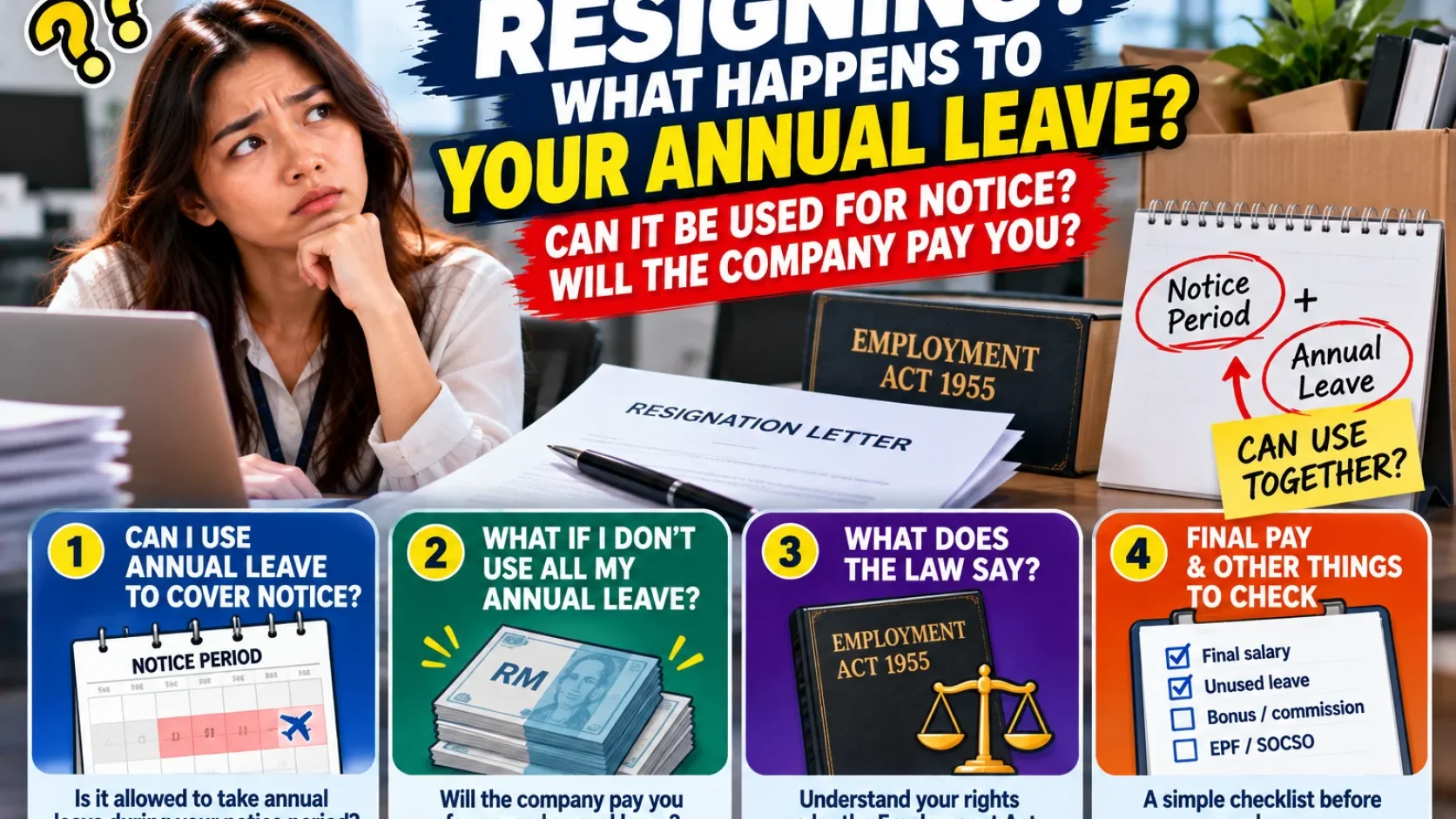
Source: Source: Employment Act 1955 ss.12, 13, 20–21 and 60E; JTKSM official Act text, accessed Oct 2026
If you resign with eight days of annual leave left, it is tempting to think:
“So I can stop working eight days earlier.”
That is not the safest way to understand it.
Separate three things:
- annual-leave entitlement;
- notice period;
- last working day and legal termination date.
This guide focuses on Peninsular Malaysia and Labuan under the Employment Act 1955.
Example: one-month notice plus eight days of leave
Assume:
- you resign on 1 October;
- your contract requires one month of notice;
- HR confirms you have eight days of qualifying annual leave left.
That does not automatically mean:
one month minus eight days = an earlier termination date.
Your notice period and leave entitlement are different legal concepts.
Can annual leave be taken during the notice period?
Section 60E(2A) of the Employment Act provides that upon termination, an employee is entitled to take qualifying paid annual leave before the termination takes effect, including accrued leave for completed months in the termination year.
So, in principle:
qualifying annual leave can be taken before employment ends.
The practical step is to get the leave dates, final working day and official termination date confirmed in writing.
Taking leave is not the same as shortening notice
Scenario A: termination date stays the same
Suppose your official end date remains 31 October.
You use annual leave during part of the notice period.
Employment still ends on 31 October. You are simply on paid leave for some of the remaining days.
Scenario B: you want the employment end date brought forward
That is a separate issue.
Ending the contract earlier can require:
- the employer agreeing to waive part of the notice; or
- notice indemnity / payment in lieu under Section 13, depending on the circumstances.
You should not assume eight days of leave automatically erases eight days of notice.
Can HR simply say all unused leave is forfeited?
Section 60E contains a specific rule for termination.
If employment ends before an employee has taken entitled paid annual leave, Section 60E(3A) generally requires the employer to pay the employee the ordinary rate of pay for each such day.
There is an important exception for dismissal for misconduct under Section 14(1)(a).
If you are resigning normally and HR says all remaining statutory leave is simply lost with no payment, ask for:
- the leave-balance calculation;
- which days are statutory entitlement;
- which days are additional contractual benefits;
- the policy or legal basis for the treatment.
Does every “8 days” shown in the HR app have to be cashed out?
Not necessarily.
A company system may combine different types of leave, such as:
- statutory annual leave;
- extra company leave;
- carried-forward leave;
- special leave.
Company-provided benefits above the statutory minimum may have additional policy terms.
Ask for a final leave breakdown.
What is the statutory annual-leave minimum?
Under Section 60E, the minimum is:
- less than two years of service: 8 days per 12 months;
- two to under five years: 12 days;
- five years or more: 16 days.
Where employment ends before completing 12 months in the relevant year, entitlement is proportionate to completed months, subject to the Act’s fractional-day rules.
An employment contract can provide better benefits.
When should final salary be paid?
For a normal termination under notice, Section 20 provides that wages earned but not yet paid should generally be paid no later than the day the contract terminates.
That means a normal resignation does not automatically mean the final wages can simply wait until the employer’s next ordinary payroll date.
Final settlement can contain several components, including:
- outstanding wages;
- lawful deductions;
- unused annual-leave payment;
- expense claims;
- commission or bonus subject to applicable terms.
Different components can have different rules.
What should you confirm with HR?
Before leaving, get these dates and numbers in writing:
- resignation date;
- notice length;
- official termination date;
- remaining/accrued annual leave;
- any unused-leave payment.
The most common confusion is everyone having a different idea of the “last day”.
Bottom line
Eight days of annual leave does not automatically shorten your notice by eight days.
A more accurate way to think about it is:
annual leave determines your paid-leave entitlement; notice determines when the employment contract ends.
You may be able to take qualifying annual leave before termination, and unused entitled leave is generally payable if employment ends first.
But changing the official termination date is a separate notice issue and should be agreed or otherwise handled under the applicable notice rules.
Useful? Forward it to someone who needs it.
Malaysian policy and hot topics, 2–3 items a week, each with a one-line “so what”.