
Can You Travel Overseas With PTPTN Debt? Malaysia’s 2026 Travel Restriction Is Back — But It Is Targeted
PTPTN travel restrictions returned in 2026, but not every borrower with a balance is automatically blocked. PTPTN currently lists three targeted groups, and borrowers can check their immigration travel status before flying.

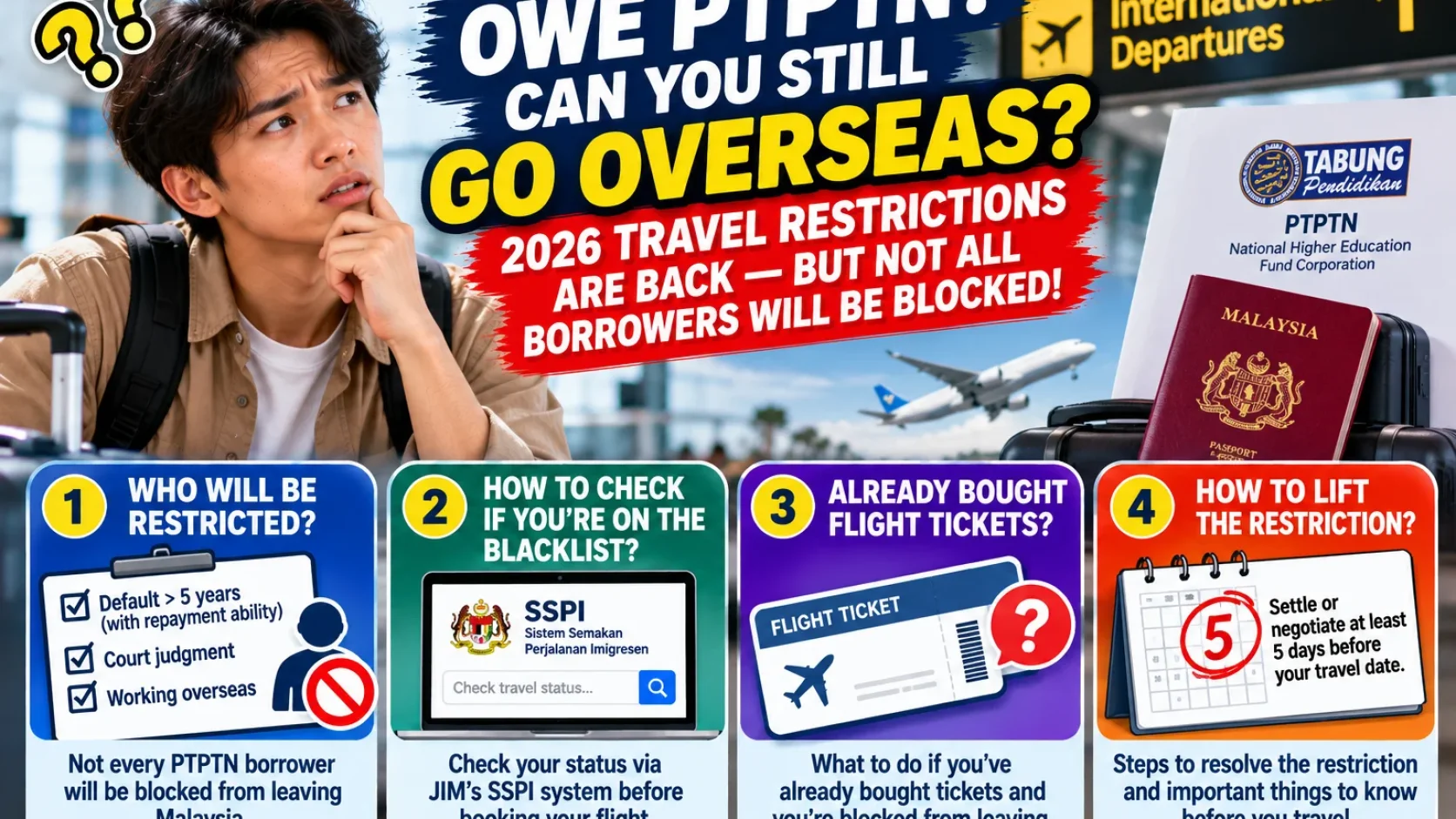
Source: Source: PTPTN official FAQ — Sekatan Perjalanan Ke Luar Negara; Jabatan Imigresen Malaysia SSPI, accessed 7 Oct 2026
Many Malaysians still remember the old answer:
“PTPTN travel blacklists were removed, right?”
In 2026, that is no longer the full story.
PTPTN’s current official FAQ says overseas travel restrictions took effect again from January 2026.
But the most important point is:
Owing PTPTN does not automatically mean you are banned from travelling
The current approach is targeted.
PTPTN lists these categories:
- borrowers with arrears exceeding five years who have the ability to repay; and/or
- borrowers with a court judgment recorded against them; and/or
- borrowers working overseas.
So having an outstanding PTPTN balance by itself does not prove that your name is currently blocked.
What matters before your trip is:
Does Immigration currently show a travel restriction against you?
How do you check before flying?
Do not wait until you reach KLIA.
PTPTN directs borrowers to the Immigration Department’s SSPI travel-status checker.
A practical sequence is:
- check your PTPTN account and arrears;
- open Immigration’s official SSPI service;
- check your travel status;
- if a restriction appears, contact PTPTN immediately;
- resolve the arrangement before your travel date.
People with long-standing arrears, legal notices, court action or overseas employment should be especially careful.
What if you already bought your flight?
Do not rely on explaining the situation at the airport.
PTPTN’s FAQ says a borrower who has been restricted should negotiate with PTPTN at least five days before travelling overseas to avoid being stopped at the airport or border.
That time matters because repayment and restriction records may need to be processed and updated.
How much must you pay to remove the restriction?
PTPTN states that the borrower is required to settle the full arrears, including applicable costs, before the name is removed from the travel restriction.
If you cannot afford that, PTPTN says you may negotiate through myPTPTN Web.
That does not necessarily mean every borrower must immediately settle the entire original loan balance.
The practical path is:
- confirm the arrears;
- negotiate with PTPTN if necessary;
- complete the agreed repayment arrangement;
- check Immigration status again.
“I pay every month. Do I still need to check?”
It is still sensible to check before an important trip.
Regular recent payments do not automatically tell you whether there are:
- older arrears;
- enforcement records;
- a court judgment;
- an unresolved restriction.
If you already paid for flights and hotels, a quick SSPI check is worth doing.
Can this affect passport renewal too?
Yes.
PTPTN’s FAQ says a borrower under travel restriction:
- is not allowed to leave Malaysia; and
- is also subject to Immigration restrictions involving passport application and renewal.
So this is not only an airport problem.
Who should deal with this early?
Do not leave it until the night before your flight if:
- your arrears go back more than five years;
- you have received a demand notice or summons;
- there is already a court judgment;
- you are working overseas;
- your passport also needs renewal.
If you are not blacklisted, can you ignore the arrears?
No.
Travel restriction is only one possible enforcement consequence.
PTPTN arrears can still affect areas such as:
- CCRIS;
- collection action;
- legal enforcement;
- repayment restructuring.
Being allowed to travel today does not mean the loan account is healthy.
A simple pre-travel checklist
Step 1: Check myPTPTN for your latest balance and arrears.
Step 2: Check whether you have received legal notices or have court action.
Step 3: Check Immigration SSPI for your travel status.
Step 4: If restricted, negotiate with PTPTN at least five days before travel.
Step 5: Check SSPI again before departure rather than relying on an old screenshot.
Bottom line
Malaysia’s PTPTN overseas travel restriction is indeed back in 2026.
But the rule is not:
“PTPTN balance = automatic travel ban.”
It is a targeted restriction.
Before paying for a major trip — and definitely before heading to the airport — check your current Immigration travel status.
Useful? Forward it to someone who needs it.
Malaysian policy and hot topics, 2–3 items a week, each with a one-line “so what”.