Japan, Korea or Taiwan in October–November? Compare Autumn Timing, Budget and Entry Rules
For Malaysians planning an autumn trip, Korea is strongest for late-October foliage, Japan becomes more attractive for Tokyo-area colours in late November, and Taiwan is an easier choice for a shorter, milder trip. Here is a practical comparison of season, budget and entry rules.

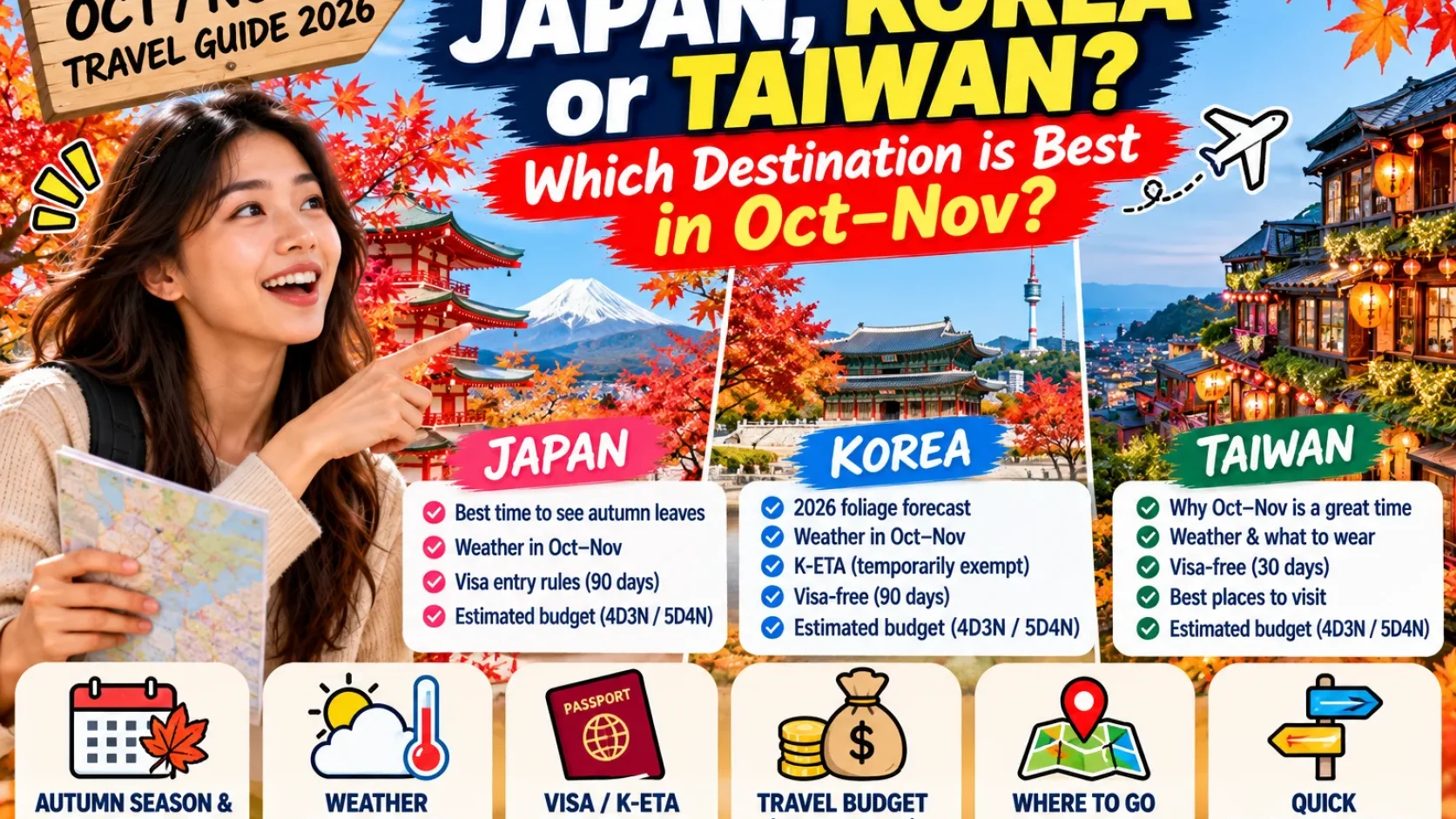
Source: Source: JNTO 2026 Autumn Leaves Forecast; Korea Tourism Organization 2026 Fall Foliage Forecast; Japan Embassy Malaysia; Korea K-ETA / MOFA; Taiwan BOCA. Accessed 7 Oct 2026.
If it is October or November and you have a few days of annual leave, three obvious choices are:
Japan, Korea and Taiwan.
All three work — but for very different reasons.
If your real question is:
“Where makes the most sense this month?”
start with the quick answer.
Quick answer
For autumn foliage in October
Choose Korea first.
Korea Tourism Organization’s 2026 forecast expects peak colours across the country from mid-October into early November.
Seoraksan is forecast to peak around 25 October, while Bukhansan near Seoul is around 4 November.
For classic Japan autumn colours
Late November is stronger for Tokyo.
JNTO’s 2026 forecast places:
- Sapporo around late October;
- Tokyo around late November;
- Osaka around early December.
Japan is huge, so “Japan in October” is not one single season.
For a shorter, milder trip
Taiwan is an easy option.
It is less about dramatic nationwide foliage and more about:
- comfortable city travel;
- food;
- night markets;
- cafés;
- easy 4D3N planning.
Which traveller are you?
| What you want | Best fit |
|---|---|
| October foliage | Korea |
| Late-November foliage | Japan |
| Milder weather | Taiwan |
| Big-city shopping | Japan / Korea |
| Short food-focused trip | Taiwan |
| Strong seasonal feel | Korea / Japan |
| Limited annual leave | Taiwan |
Korea: why October works so well
Korea’s official 2026 foliage forecast gives a clear seasonal window.
Examples:
- Seoraksan first foliage: around 3 Oct
- Seoraksan peak: around 25 Oct
- Bukhansan / Seoul peak: around 4 Nov
- Jirisan: around 5 Nov
- Naejangsan: around 11 Nov
- Hallasan: around 13 Nov
For a Malaysian planning now:
late October into early November is one of the easiest Korea windows to understand.
You get:
- autumn scenery;
- Seoul city time;
- café and shopping options;
- possible day trips for foliage.
Japan: choose the city before choosing the month
Japan’s foliage timing changes dramatically from north to south.
JNTO’s 2026 forecast includes:
- Sapporo: late October
- Tokyo / Chiyoda: around 28 November
- Osaka: around 1 December
So:
October
Hokkaido can make sense for autumn colours.
Tokyo or Osaka may be early if foliage is your only reason for travelling.
Late November
Tokyo becomes much stronger for autumn colour.
Early December
Some Kansai and southern areas may still be in season.
Do not only ask:
“When is autumn in Japan?”
Ask:
“Which Japanese city am I visiting?”
Taiwan: a different kind of autumn choice
Taiwan does not need to beat Japan or Korea on foliage.
Its advantage is ease.
For Malaysian travellers, it works well when you want:
- a shorter flight;
- a compact city itinerary;
- food and night markets;
- milder autumn conditions;
- a 4D3N trip without rushing.
Taipei plus one or two nearby day trips can already fill a short break.
Rough planning budget
These are illustrative land-only planning ranges, not live package quotes.
They exclude international flights and major shopping, and assume:
- two people sharing a room;
- ordinary hotel / business hotel;
- local food;
- public transport;
- normal paid attractions.
Taiwan 4D3N
About RM800–RM1,300 per person
Korea 5D4N
About RM1,200–RM2,000 per person
Japan 5D4N
About RM1,400–RM2,300 per person
The biggest variables are hotel location, weekends, long-distance transport, attractions, exchange rates and how you eat.
Flights should be compared separately because departure city, baggage and promotions can change the total substantially.
Entry rules for Malaysian passport holders
Japan
Malaysian nationals holding an ICAO-compliant biometric passport generally do not need a visa for short-term stays of up to 90 days for tourism and other eligible short-term purposes.
Long-term stay or work is different.
Korea
Malaysia is covered by Korea’s visa-exemption arrangements for stays of up to 90 days.
Korea also extended the current temporary K-ETA exemption through 31 December 2026 for countries and regions already covered by the exemption.
Entry rules can change, so check the official Korea entry notice again before departure.
Taiwan
Taiwan’s current BOCA information lists Malaysian nationals as eligible for visa-exempt entry for up to 30 days.
That is more than enough for an ordinary 4D3N or 5D4N holiday.
If you are travelling in October
A simple ranking:
1. Korea — strongest straightforward foliage timing
2. Taiwan — easier if you dislike cold weather
3. Japan — depends heavily on region; Hokkaido works better than Tokyo/Osaka for early foliage
If you are travelling in November
Early November
Korea remains strong.
Mid-November
Korea’s later regions can still be attractive, while Japan becomes increasingly seasonal.
Late November
Japan becomes especially attractive for Tokyo-area autumn colours.
Taiwan remains the easier non-foliage choice.
First overseas trip?
Want the simplest short trip
Taiwan
Want the strongest seasonal experience
Korea in late October / early November
Want a bigger city trip with shopping and food
Japan
Before booking, check five things
- passport validity;
- latest entry rules;
- current Korea K-ETA status;
- updated foliage forecast;
- the full hotel + flight cost, not only a cheap airfare.
Foliage dates are forecasts.
Weather can shift the actual peak.
Bottom line
A useful rule of thumb is:
October: Korea.
Late November: Japan.
Want something milder and easier: Taiwan.
But the best answer comes from combining:
month + city + the type of trip you actually want.
Useful? Forward it to someone who needs it.
Malaysian policy and hot topics, 2–3 items a week, each with a one-line “so what”.