
Malaysia Northeast Monsoon 2026/27: Oct 27 Start, Rainy Months and Flood-Risk Timeline
MetMalaysia expects the northeast monsoon from 27 October 2026 through March 2027, with three to five prolonged heavy-rain episodes forecast for November–January. A practical timeline—not a live flood map.

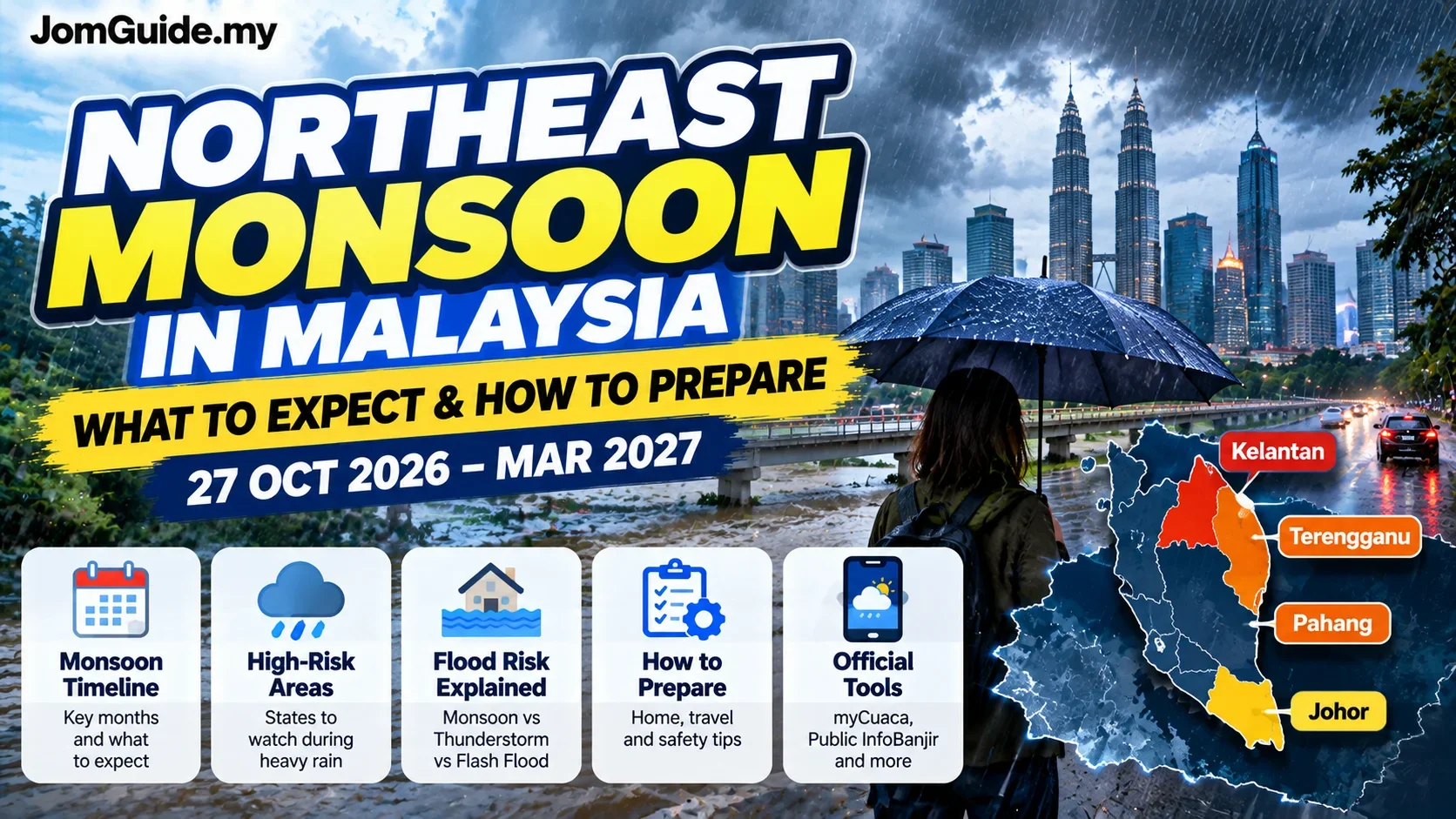
Source: MetMalaysia October 2026 outlook; Bernama, 23 Oct 2026; NADMA; JPS Public InfoBanjir
Information checked: 27 October 2026 (Malaysia time). MetMalaysia expects the 2026/27 Northeast Monsoon (Monsun Timur Laut, or MTL) to begin today. That is a seasonal forecast, not a statement that the whole country is flooded or that a particular road is closed.
The agency expects the season to run from 27 October 2026 to March 2027. During its early stage, November 2026 to January 2027, it forecasts three to five episodes of prolonged heavy rain. Which districts will face specific warnings, and on which days, must be checked against later weather bulletins. See Bernama's 23 October report and MetMalaysia.
The monsoon calendar, explained
| Period | Current outlook | What it does—and doesn't—tell you |
|---|---|---|
| From 27 October | Expected start of the northeast monsoon | Not a nationwide flood declaration |
| November–January | Three to five episodes of prolonged heavy rainfall expected | A preparation signal; not a forecast that every area floods |
| February–March | Season expected to last until March | Check updated forecasts rather than assuming early-season conditions continue unchanged |
Our editorial rule is simple: a seasonal forecast is not a live road-closure or flood map.
Where should households pay closer attention?
The northeast monsoon is Malaysia's principal rainy season and can bring extended rain, notably to parts of the peninsula's east coast. Parts of Sabah and Sarawak may also experience monsoon effects. Still, risk varies by location, timing, drainage and river conditions. Being in an affected state does not mean every street will flood.
If you live near a river, in a low-lying neighbourhood or on a road that regularly floods, plan ahead without assuming the worst will happen at a specific address. Check your district's official notices before travel.
Northeast monsoon vs thunderstorm vs flash flood
Northeast monsoon describes a months-long seasonal weather pattern. Continuous-rain warnings are issued for particular areas and valid periods. Thunderstorm warnings concern shorter, more localised conditions. Flash floods are flooding events and cannot be inferred for an exact road from the monsoon start date alone.
This is distinct from JomGuide's earlier October article on the inter-monsoon transition, which concerns shorter-duration thunderstorms and flash-flood preparedness. NADMA's October transition briefing gives that context.
Three checks before travelling
- MetMalaysia and myCuaca: look for your district's forecast and active thunderstorm or continuous-rain warnings. Check issue and expiry times.
- JPS Public InfoBanjir: find the relevant river or rainfall station, its reading and its latest update. A station reading is not your street's flood depth.
- Local authorities, police and disaster-management announcements: verify actual road restrictions, assistance centres or local actions. Old screenshots should never replace current notices.
Families can save key contacts, check important documents, consider an alternative route and follow evacuation instructions if any are issued. Never drive through moving or unknown-depth floodwater.
Quick questions
Will it flood everywhere on 27 October? No such conclusion follows from the seasonal start forecast.
Does 'three to five episodes' mean three to five days of rain? No. An episode isn't a fixed one-day event, and no exact district-by-district schedule is implied.
What should I check daily? Your area's current weather advisories, relevant river-gauge updates and local road announcements.
Related JomGuide guides
- October inter-monsoon thunderstorms and flash-flood preparation
- How to read Public InfoBanjir river-level alerts
Source note: This article explains the outlook available on 27 October; it does not claim real-time flood or road-closure information.
Related articles
More in Jom Trending-
Malaysia Fuel Prices 12–18 November 2026: RON97 Down 50 Sen to RM4.20, RON95 RM3.87, Diesel RM4.87, BUDI95 Still RM1.99
-
TuJu Now Sends You to Google Maps: The Latest on the Waze Ban, and No, the Public Isn't Banned
-
Malaysia Fuel Prices 5–11 November 2026: All Down, RON95 RM4.27, RON97 RM4.70, Diesel RM5.12, BUDI95 Still RM1.99