Littering in Malaysia: RM2,000 Fine, Community Service Orders and What to Do
A cigarette butt or food wrapper can trigger littering enforcement. Here's how Act 672 works in relevant jurisdictions, what the RM2,000 and 12-hour limits mean, and how to verify an SWCorp or council notice.

Source: SWCorp official FAQ/Community Service Order guidance; Bernama Jan and Oct 2026 reports (checked 27 Oct 2026)
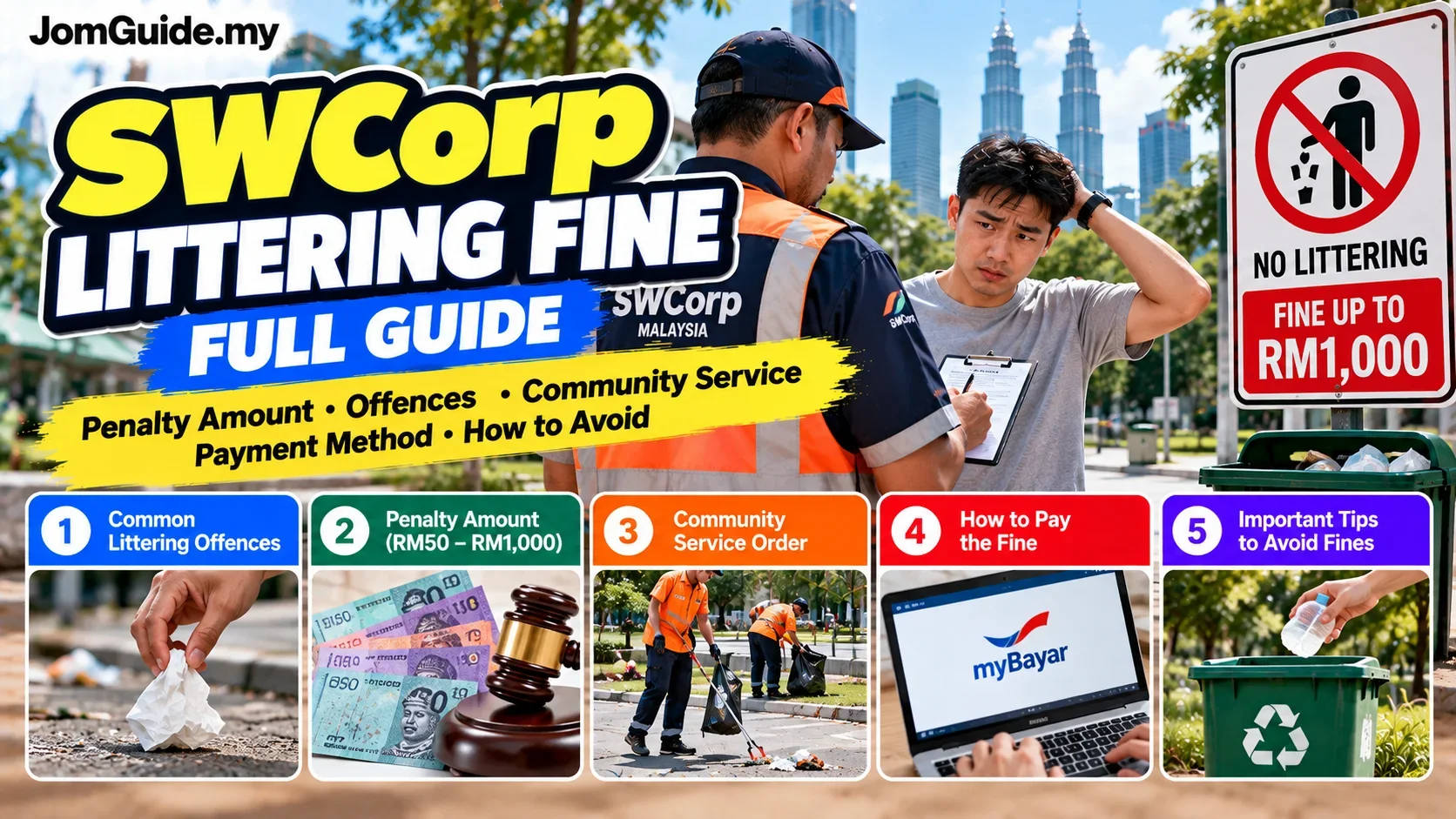
Throwing a cigarette butt, bottle or food wrapper in a public place is not too small to matter. In jurisdictions where Malaysia's Solid Waste and Public Cleansing Management Act 2007 (Act 672) applies, the 2026 enforcement framework can expose an offender, upon conviction, to a fine up to RM2,000, with court-ordered community service provisions.
Two distinctions are essential: RM2,000 is a legal ceiling, not the automatic amount on every notice; and a 12-hour community service limit is not an on-the-spot sentence handed down by an enforcement officer.
SWCorp's enforcement changes began on 1 January 2026. An October report citing the corporation mentioned 17,732 littering offence notices; notices are not equivalent to that number of court convictions. Bernama's January enforcement report; October SWCorp reporting.
What can count as littering?
In SWCorp's published enforcement examples, public-place and roadside litter included:
- Cigarette butts, tissues, plastic and food wrappers;
- Drink cans and bottles;
- Other small discarded items left in public places or on roads.
Dropping rubbish from a vehicle should not be treated as a loophole. Which offence and penalty provisions apply to a particular act depend on the location, evidence and relevant law. Bernama on observed offences.
RM2,000 and 12 hours: what do they actually mean?
| Issue | What the reported rules say | What they don't mean |
|---|---|---|
| Fine | Up to RM2,000 on conviction, under the applicable Act 672 provision | Every notice automatically demands RM2,000 |
| Community Service Order / PKM | Court may order service, with a total work limit of 12 hours | Every case comes with 12 hours of work |
| Work schedule | Reported framework allows completion within up to six months, with no more than four hours a day | Six months of daily cleaning |
| Offence notice | Starts or records an enforcement process | Proof of conviction by itself |
Community service can involve cleaning public areas. Any actual sanction depends on the relevant provision, legal process and court decision; do not infer the same punishment for everyone. Bernama's description of the framework.
Is this the same across all Malaysian states?
No. SWCorp's official FAQ lists its Act 672 jurisdictions as Johor, Melaka, Negeri Sembilan, Pahang, Kedah, Perlis, and the Federal Territories of Kuala Lumpur and Putrajaya. Elsewhere, local councils may act under other applicable laws or by-laws. The sensible thing is to verify the legal basis and issuing authority instead of assuming every council uses the same procedure.
This matters to residents, drivers, business operators and visitors alike.
Received an SWCorp or council notice? Check these details
- Read the actual notice. Identify the authority, relevant provision, date, location, case number and any stated next-action deadline.
- Verify the document independently. Use the issuing authority's website—SWCorp where applicable, or your PBT/local council—to check the legitimate process. Don't rely solely on a phone number printed in a forwarded message.
- Keep your records. Preserve the notice and factual information about the event. Don't share other people's personal details publicly.
- Follow the official steps. A case may involve investigation, a summons or court proceedings. If you dispute the facts, seek guidance from the issuing authority or a qualified adviser; don't ignore a genuine official notice.
- Check payment channels. Do not transfer money to an individual's private bank account claiming to collect an enforcement fine, or surrender banking OTPs through an unfamiliar link.
These steps help with accurate compliance and scam avoidance, not evasion of lawful enforcement.
Reporting littering: SWCorp or PBT?
For a location covered by SWCorp's Act 672 enforcement, start with SWCorp's official contact and complaint channels. For other areas or services managed by a municipal council, check the relevant PBT website. Provide factual details such as time, place and relevant evidence without making unverified accusations against an individual.
Frequently asked questions
Can one cigarette butt be relevant? Yes. Cigarette butts appear among SWCorp's reported littering examples.
Will everyone pay RM2,000? No. The figure is the maximum stated for relevant offences upon conviction.
Can an officer force someone to do 12 hours immediately? Community service under this framework involves a legal order and procedure, not an informal on-site arrangement.
Could a WhatsApp fine notice be fake? Possibly. Verify the issuing institution and payment channel directly rather than trusting a forwarded number or payment link.
Source note: Checked 27 October 2026 against SWCorp's FAQ, Bernama's January account and October SWCorp statistics report.
Related articles
More in Jom Trending-
Malaysia Fuel Prices 12–18 November 2026: RON97 Down 50 Sen to RM4.20, RON95 RM3.87, Diesel RM4.87, BUDI95 Still RM1.99
-
TuJu Now Sends You to Google Maps: The Latest on the Waze Ban, and No, the Public Isn't Banned
-
Malaysia Fuel Prices 5–11 November 2026: All Down, RON95 RM4.27, RON97 RM4.70, Diesel RM5.12, BUDI95 Still RM1.99