Malaysia Car Loans Changed in 2026: Flat Rate, Reducing Balance and Rule of 78 Explained
Malaysia's hire-purchase rules changed from June 2026, but banks are still transitioning. Here's what Flat Rate, Reducing Balance, Rule of 78 and EIR mean for new buyers, existing borrowers and early settlement.

Malaysia's car-loan system is changing.
The simple version is:
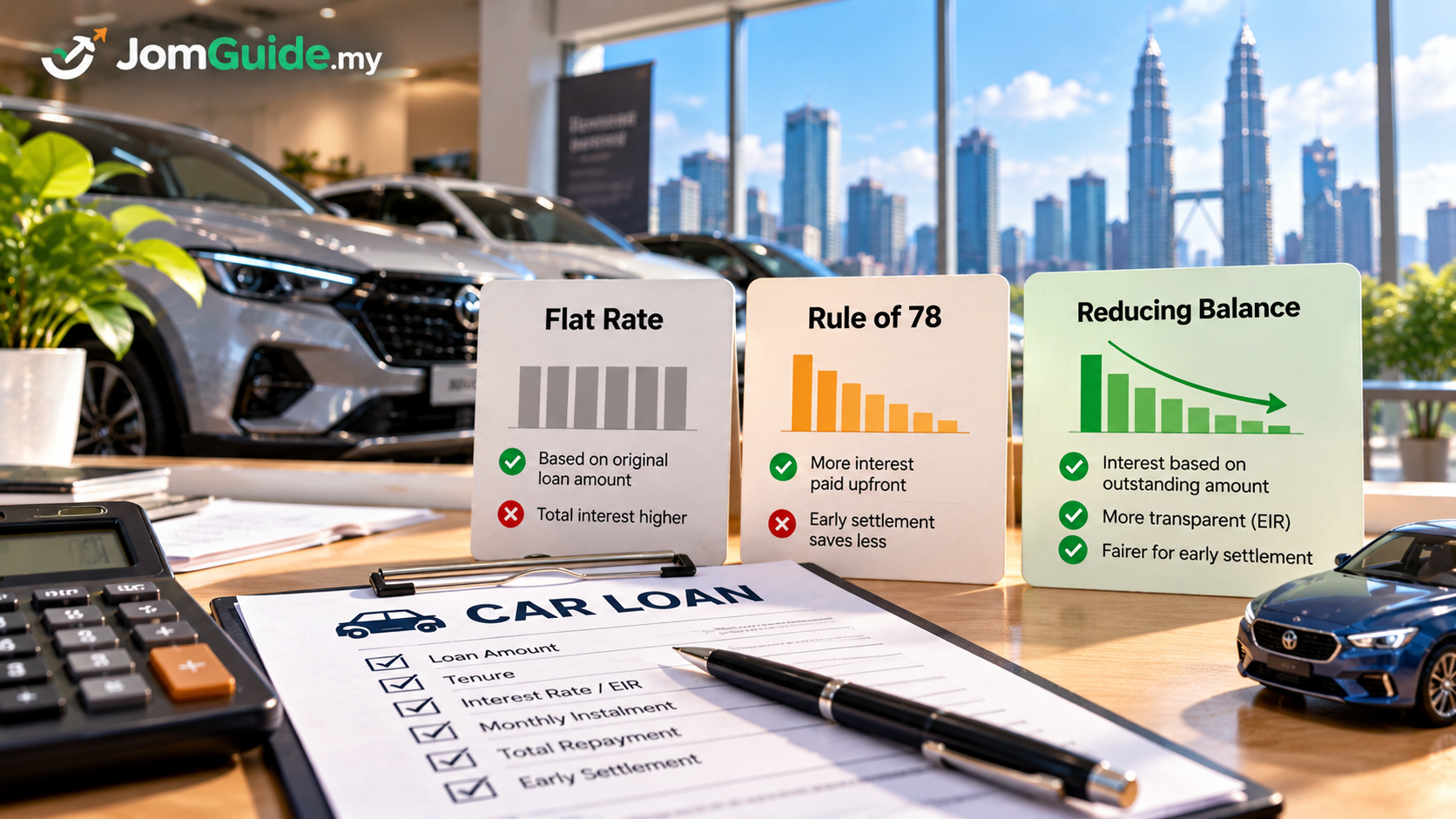
Traditional flat-rate pricing and the Rule of 78 are being phased out for hire-purchase financing, with the new framework moving towards the reducing balance method and Effective Interest Rate (EIR).
But there's an important catch.
The Hire-Purchase (Amendment) Act 2026 took effect on:
1 June 2026.
Banks, however, have a transition period until:
31 March 2027.
That means buying a car today doesn't automatically guarantee that every bank will already be offering hire purchase under the new reducing balance framework.
During the transition, you may encounter both old and new methods.
So when a salesperson tells you:
“The interest rate is only 2.8%.”
Don't stop there.
Ask:
“Is that flat rate or reducing balance, and what's the EIR?”
How did traditional Malaysian car loans work?
Many traditional hire-purchase agreements use a:
Flat interest rate.
Interest is calculated using the original financing amount rather than recalculating it based on the principal still outstanding each month.
For example:
Loan amount: RM100,000
Flat rate: 3% p.a.
Tenure: 9 years
Simple interest:
RM100,000 × 3% × 9
Total interest:
RM27,000
Total repayment:
RM127,000
Across 108 months:
Approximately RM1,175.93 per month
This is one reason a “3% car loan” shouldn't automatically be compared with a “3% housing loan”.
The calculation methods may be very different.
What is reducing balance?
Under the reducing balance method, interest is calculated based on:
The principal you still owe.
As you make repayments, the outstanding principal falls.
The amount on which future interest is calculated falls with it.
That's the basic idea behind:
Reducing Balance.
RM100,000: Flat 3% vs Reducing Balance 3%
Here's a deliberately simplified mathematical example.
Assume:
RM100,000 financing
9-year tenure
3%
3% Flat Rate
Total interest:
RM27,000
Total repayment:
RM127,000
Monthly instalment:
Approximately RM1,175.93
3% Reducing Balance
If we assume purely for illustration that 3% is the annual reducing-balance borrowing rate across 108 equal monthly payments:
Monthly instalment:
Approximately RM1,057.69
Total repayment:
Approximately RM114,231
Total interest:
Approximately RM14,231
That's a large difference.
But this example does not mean every new RM100,000 car loan will suddenly fall from RM127,000 to RM114,231.
Why?
Because:
A 3% flat rate and a 3% reducing-balance rate are not equivalent pricing.
A bank moving from the old framework won't simply convert an old headline 3% flat rate into a new 3% EIR.
The example demonstrates why two products displaying “3%” can have very different financing costs.
When comparing actual offers, look at:
EIR + monthly instalment + total repayment.
What is EIR?
EIR means:
Effective Interest Rate.
It gives consumers a clearer basis for understanding and comparing the true financing cost of different offers.
Instead of comparing only two headline rates, compare:
Financing amount
Tenure
EIR
Monthly instalment
Total repayment
Together, these give you a much more useful picture.
What is the Rule of 78?
The Rule of 78 is another important feature of traditional hire purchase.
It allocates more of the interest or profit charges towards the earlier part of the financing tenure and less towards the later years.
This becomes particularly important when you want to:
Settle the financing early.
Someone who signs a nine-year car loan and settles it after three or four years may discover that the interest savings aren't as large as expected.
One of the key changes under the amended framework is the abolition of the Rule of 78 method for fixed-rate hire-purchase early settlement.
Why is reducing balance easier to understand for early settlement?
Under reducing balance:
Interest follows the outstanding principal.
When the outstanding principal falls, the basis for future interest also falls.
That makes it easier for consumers to understand:
How much do I still owe?
and:
What happens if I settle now?
Improving that transparency is one of the objectives of the new framework.
What if I already have a car loan?
Your existing hire-purchase agreement doesn't automatically turn into a reducing-balance loan just because the amended Act took effect.
The original agreement remains relevant.
However, there's an important development if you want to:
Settle early.
From 1 June 2026, Malaysia's banking industry is providing eligible customers with existing fixed-rate / Rule of 78 hire-purchase agreements a:
Goodwill Discount
when they choose early settlement.
The aim is to make the early-settlement balance more comparable with the treatment under a reducing-balance approach.
Who may qualify for the Goodwill Discount?
The industry initiative covers eligible individuals and micro or small businesses with relevant fixed-rate hire-purchase agreements using the Rule of 78 where the agreement was entered into:
Before 1 June 2026; or
During the transition period ending 31 March 2027
and the customer chooses to settle before maturity.
At the time of early settlement, the account must also not be:
More than 90 days in arrears
Under legal action
Subject to a repossession order
Under an existing restructuring and rescheduling arrangement
Enrolled in a formal debt management programme
There isn't one universal discount percentage.
Each bank calculates the discount based on the features of the existing agreement, including the tenure and timing of settlement.
Ask your bank for:
An early-settlement quotation including the applicable Goodwill Discount.
Should I immediately settle my existing car loan?
A Goodwill Discount doesn't automatically mean early settlement is the right financial move for everyone.
First find out:
What's the current outstanding balance?
How much Goodwill Discount is the bank offering?
What's the final settlement amount?
How much would you repay if you simply continued the loan?
How much cash would you have left after settling?
A fairer early-settlement calculation and whether you personally should use your cash to settle a loan are two different questions.
If I buy a car now, will I get the old or new method?
Potentially either.
Malaysia is currently within the:
1 June 2026–31 March 2027 transition period.
Banks are upgrading their systems, processes and infrastructure.
Some banks are already able to offer reducing-balance hire purchase.
Others may continue offering Rule of 78 financing during the transition.
That's why a salesperson saying:
“The bank gives you 2.8%.”
is no longer enough information.
Six questions to ask the bank or sales advisor
1. Is this Flat Rate or Reducing Balance?
Know the calculation method first.
2. Does this financing use the Rule of 78?
This is particularly relevant during the transition period.
3. What's the EIR?
Use it to make more meaningful comparisons between financing offers.
4. What's the total repayment?
Don't compare only:
RM1,xxx per month.
Ask how much you'll repay across the full tenure.
5. What happens if I settle in year three or five?
This matters if you may sell the car, change cars or repay the financing early.
6. Has this bank implemented the new HPAA framework?
Until the transition ends, don't assume every bank is at the same implementation stage.
What about used cars?
The important issue isn't simply whether the car is new or used.
It's:
How the hire-purchase financing is structured.
When financing a used vehicle, look beyond:
Car price
Down payment
Monthly instalment
Also compare:
Financing method + EIR + total repayment.
A lower monthly instalment doesn't always mean a cheaper loan
Suppose you're offered:
Option A: RM1,200/month
Option B: RM1,050/month
Option B looks cheaper.
But what if:
A = 7 years
B = 9 years?
The conclusion can change completely.
Always look at:
Monthly instalment × tenure
and then check:
Total repayment.
What happens after March 2027?
The official transition period runs until:
31 March 2027.
Following the transition, the new hire-purchase framework moves fully towards:
Reducing Balance + EIR
while the traditional:
Flat Rate + Rule of 78
approach is phased out for new hire-purchase financing.
JomGuide will update this article after the transition rather than creating another URL for the same issue.
JomGuide quick answer
If you're buying a car after 2026, remember these dates:
1 June 2026
The Hire-Purchase (Amendment) Act 2026 took effect.
31 March 2027
The banking transition period ends.
Direction of the new framework:
Flat Rate → Phased out
Rule of 78 → Phased out
Reducing Balance → New standard
EIR → Clearer comparison of financing cost
But during the transition:
Not every bank necessarily switches on exactly the same date.
If you already have an older car loan:
It doesn't automatically become a reducing-balance loan.
But eligible customers settling qualifying fixed-rate / Rule of 78 financing early can ask their bank about the:
Goodwill Discount.
And when a salesperson tells you:
“Interest is only 2.8%.”
your next questions should be:
“What kind of rate is that?”
“Flat or reducing balance?”
“What's the EIR?”
“What's my total repayment?”
Those answers tell you much more than “2.8%” on its own.
FAQ
When did Malaysia's new car-loan rules take effect?
The Hire-Purchase (Amendment) Act 2026 took effect on 1 June 2026.
Why can I still find flat-rate car loans in 2026?
Banks have a transition period until 31 March 2027 to upgrade their systems and processes, and Rule of 78 financing may still be offered during this period.
What's the main difference between Flat Rate and Reducing Balance?
Flat-rate interest is generally calculated using the original financing amount, while reducing-balance interest is calculated based on the principal still outstanding.
What is the Rule of 78?
It is a method that allocates more interest or profit charges towards the earlier part of the financing tenure, which is particularly relevant when calculating early settlement.
Does my existing car loan automatically change to reducing balance?
No. Existing agreements don't automatically convert simply because the amended Act has taken effect.
Is there an early-settlement discount for existing car loans?
Eligible customers with qualifying fixed-rate / Rule of 78 hire-purchase financing can receive a Goodwill Discount when settling early from 1 June 2026. The actual amount is calculated by the bank.
Is a 3% Flat Rate the same as a 3% EIR?
No. They use different calculation approaches and shouldn't be treated as equivalent borrowing costs.
What should I ask before signing a new car loan?
Ask about the financing method, Rule of 78, EIR, total repayment, early-settlement treatment and whether the bank has implemented the new HPAA framework.