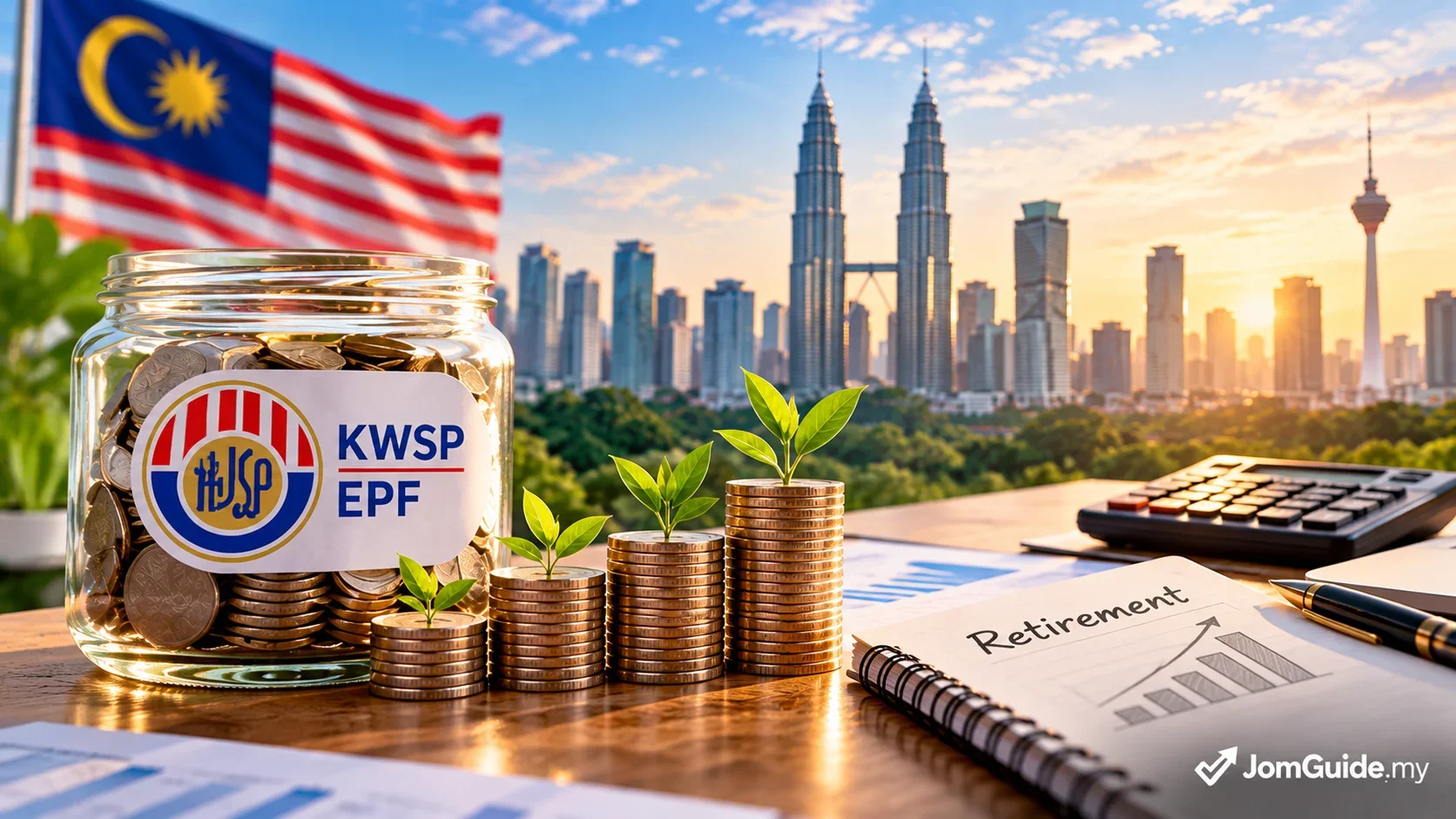
KWSP Account 3 Withdrawal: What Does Taking Out RM1,000 Really Cost?
Akaun Fleksibel is designed to be withdrawable. The real question is not whether you can take the money, but what future growth you give up. Here is RM500, RM1,000 and RM3,000 under 4%, 5% and 6% assumptions.


Source: Source: KWSP — Akaun Fleksibel Withdrawal
First, one thing should be clear:
JomGuide is not going to tell you that you must never touch Account 3.
It is called Akaun Fleksibel for a reason.
KWSP allows eligible members below 55 to withdraw from Akaun Fleksibel, subject to the applicable minimum withdrawal and account conditions.
So the question is not:
“Can I withdraw?”
You can.
The more useful question is:
“If I take RM1,000 today, what am I giving up?”
Our editor’s own approach is simple: if the money is needed, we would use it. It is a personal decision.
But before pressing Withdraw, it helps to understand the hidden cost.
The cost is not only RM1,000
If you withdraw RM1,000 today, your account falls by RM1,000.
But the longer-term cost can also include the future compounding that RM1,000 would otherwise have earned.
To make this easy to understand, we use three purely illustrative assumptions:
4%, 5% and 6%.
These are not forecasts of future EPF dividends.
What could RM1,000 become?
| Time | 4% | 5% | 6% |
|---|---|---|---|
| 10 years | RM1,480 | RM1,629 | RM1,791 |
| 20 years | RM2,191 | RM2,653 | RM3,207 |
| 30 years | RM3,243 | RM4,322 | RM5,743 |
At a simple 5% assumption, RM1,000 left to compound for 30 years becomes about RM4,322.
That future growth is the opportunity cost of using the money today.
What about RM500?
| Time | 4% | 5% | 6% |
|---|---|---|---|
| 10 years | RM740 | RM814 | RM895 |
| 20 years | RM1,096 | RM1,327 | RM1,604 |
| 30 years | RM1,622 | RM2,161 | RM2,872 |
What about RM3,000?
| Time | 4% | 5% | 6% |
|---|---|---|---|
| 10 years | RM4,441 | RM4,887 | RM5,373 |
| 20 years | RM6,573 | RM7,960 | RM9,621 |
| 30 years | RM9,730 | RM12,966 | RM17,230 |
These tables are not saying “never withdraw”.
They only show the opportunity cost.
Paying expensive debt is a different decision from casual spending
Suppose you use RM1,000 to reduce a much more expensive debt.
In that situation, giving up some future compounding may be completely reasonable if it prevents a higher financing cost from continuing to grow.
That is very different from withdrawing simply because:
“The money is there, so I might as well spend it.”
Neither choice is automatically right or wrong. They solve different problems.
What about emergencies?
That is exactly where flexibility matters.
A car repair, a family emergency or a short-term cash-flow problem may make liquidity more valuable today than future compounding.
The useful question is:
Is the problem this withdrawal solves today worth the future growth I am giving up?
If your answer is yes, then that is your decision.
A practical decision box
More understandable reasons to consider withdrawing
- urgent cash needs
- necessary family expenses
- avoiding more expensive debt
- a temporary cash-flow problem
Reasons worth thinking about twice
- no clear purpose
- spending only because the balance is visible
- the expense can easily be covered from existing cash
- repeatedly emptying Account 3 without any other retirement plan
This is not a rule. It is simply a way to distinguish different types of decisions.
Can you rebuild after withdrawing?
Yes, and this matters.
Someone who withdraws RM1,000 today but later increases savings is not in the same position as someone who continually empties the account and never replaces the money.
That is why all Account 3 withdrawals should not be judged as the same financial decision.
The one question to ask before pressing Withdraw
You do not need to tell yourself:
“Withdrawing is bad.”
And you do not need to pretend:
“It is Account 3, so there is no cost.”
A more accurate way to see it is:
It is your money, and you can use it — but the invisible price is the future compounding that no longer happens.
Know that price first. Then make your own choice.
Official reference: KWSP Akaun Fleksibel Withdrawal.
The 4%, 5% and 6% figures above are illustrations only and are not forecasts of future KWSP dividends.
Useful? Forward it to someone who needs it.
Malaysian policy and hot topics, 2–3 items a week, each with a one-line “so what”.