
Malaysia OPR at 2.75%: What Does It Actually Mean for Your Housing Loan?
Malaysia's OPR is currently 2.75%. See what that means for RM300k, RM500k and RM800k housing loans, including how a 0.25 percentage-point rate change could affect monthly instalments.

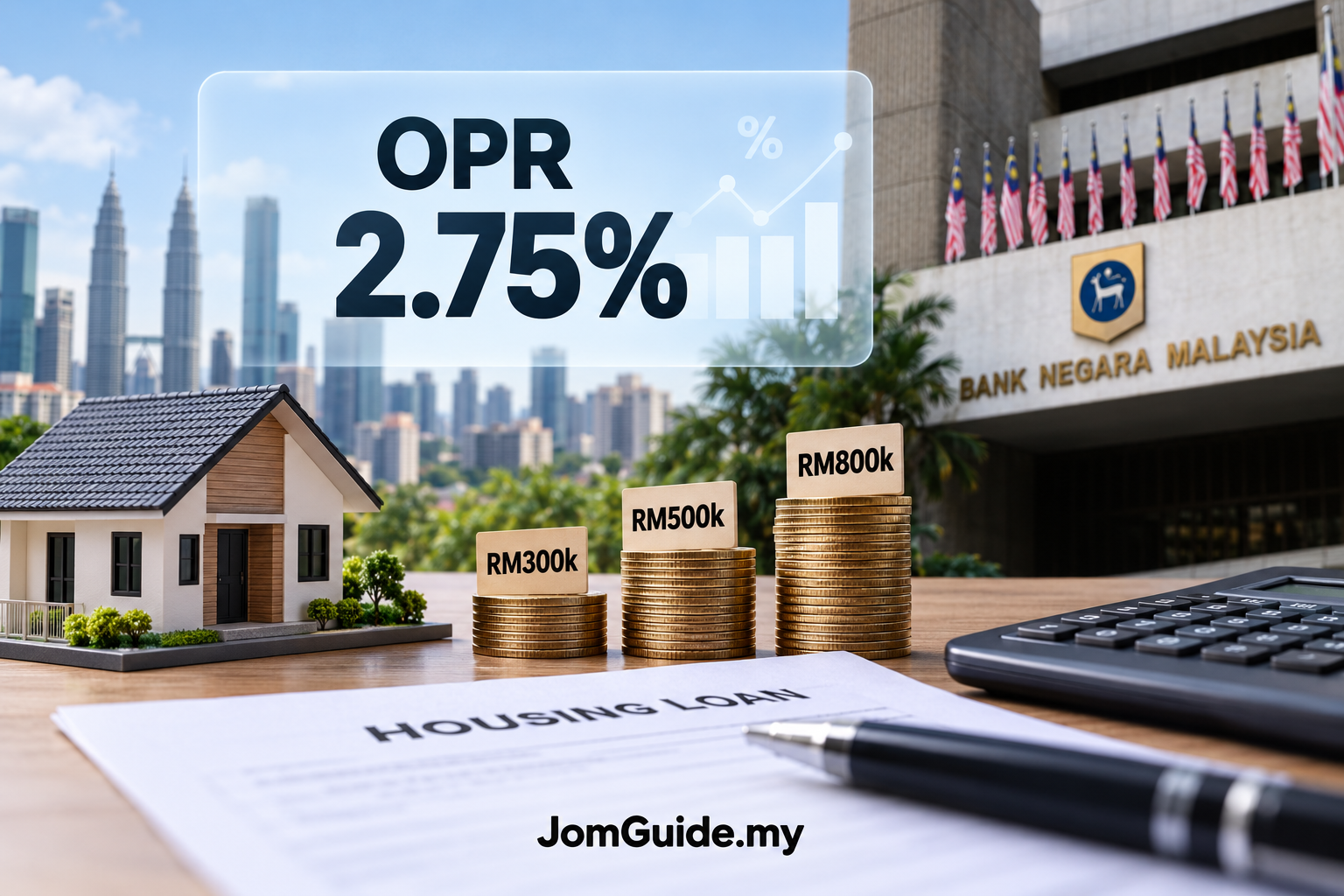
If you have a housing loan, every time you see:
“BNM keeps the OPR at 2.75%.”
you probably aren't wondering about monetary-policy theory.
You want to know:
“What happens to my housing loan?”
More specifically:
“How many ringgit does it change my monthly instalment by?”
As of September 2026, Bank Negara Malaysia's Overnight Policy Rate is 2.75%.
BNM has kept it at that level at all five MPC decisions so far in 2026. The next decision is scheduled for 5 November 2026.
So let's turn that percentage into actual ringgit.
How does OPR affect a Housing Loan?
The simplified chain is:
OPR → SBR / BR / BLR → Floating Housing Loan Rate → Monthly Instalment
For new retail floating-rate loans from 1 August 2022, the Standardised Base Rate became the common reference rate.
And:
SBR = BNM's OPR
That doesn't mean your housing-loan rate is only 2.75%.
Banks price a spread above the reference rate to reflect factors such as credit risk, operating costs and margins.
For illustration:
SBR 2.75% + 1.25% spread = 4.00% effective lending rate
The 4.00% rate used below is purely a mathematical example.
It is not a bank quotation.
What if rates move by 0.25 percentage points?
Let's use:
RM500,000 housing loan
30-year tenure
Illustrative current rate: 4.00%
Standard amortising-loan calculation
At 4.00%, the monthly instalment is approximately:
RM2,387
If the corresponding loan rate falls to 3.75%:
About RM2,316
That's roughly:
RM71 less per month.
If the rate rises to 4.25%:
About RM2,460
That's roughly:
RM73 more per month.
This is why saying:
“Lower OPR benefits borrowers.”
isn't enough.
Show me the ringgit.
RM300k vs RM500k vs RM800k
Using the same 30-year assumption:
Loan | 3.75% | 4.00% | 4.25% |
|---|---|---|---|
RM300k | RM1,389/month | RM1,432/month | RM1,476/month |
RM500k | RM2,316/month | RM2,387/month | RM2,460/month |
RM800k | RM3,705/month | RM3,819/month | RM3,936/month |
That means a 0.25 percentage-point movement is roughly:
RM300k loan: RM43/month
RM500k loan: RM70+/month
RM800k loan: around RM115/month
Again, these are illustrations.
Your actual result depends on your outstanding balance, remaining tenure, effective rate, loan structure and bank terms.
What about a 35-year Housing Loan?
Longer tenure generally reduces your monthly instalment.
Using RM500,000 at an illustrative 4.00%:
20 years: about RM3,030/month
30 years: about RM2,387/month
35 years: about RM2,214/month
That's why a 35-year loan can make a property feel much more affordable each month.
And that isn't automatically a bad thing.
If the monthly instalment is comfortably within your means, a longer tenure can reduce immediate cash-flow pressure.
But don't stop at the monthly figure.
The trade-off with a longer tenure
Using the same RM500,000 at 4.00%, assuming the rate remained unchanged throughout the loan:
Tenure | Monthly | Approx. Total Repayment |
|---|---|---|
20 years | RM3,030 | RM727k |
30 years | RM2,387 | RM859k |
35 years | RM2,214 | RM930k |
The longer tenure makes the monthly payment easier.
But if you actually take the full tenure to repay the loan, total interest is generally higher.
Our practical view is:
Make sure the monthly instalment is affordable first.
Then, if your income grows and your loan terms allow it:
Pay down the principal earlier when you comfortably can.
Why didn't my instalment change immediately after an OPR move?
First check:
Is your housing loan floating-rate?
Then:
Which reference rate does it use?
Newer floating retail loans may reference SBR.
Older loans may still use BR.
Even older facilities may reference BLR.
The introduction of SBR did not automatically convert every existing housing loan to SBR.
So before wondering why your bank hasn't changed the amount:
Check your facility agreement or loan statement.
SBR, BR and BLR in plain English
You don't need to memorise Malaysia's entire reference-rate history.
SBR
Standardised Base Rate
Used for new retail floating-rate loans from 1 August 2022.
The simple part:
SBR = OPR
BR
Base Rate
Mainly used for new retail floating-rate facilities between 2015 and 31 July 2022.
BLR
Base Lending Rate
The older reference-rate framework.
Some older housing loans can still be tied to BLR.
For an ordinary homeowner, the key question isn't memorising all three.
It's:
“Which one is my loan tied to?”
Floating Rate vs Fixed Rate
A floating-rate housing loan is the obvious one to watch when reference rates change.
A fixed-rate structure doesn't necessarily react in the same way.
So if your friend says:
“OPR fell and my housing loan got cheaper.”
don't automatically assume your loan will behave identically.
Check your own facility.
“The bank approved RM800k” doesn't mean you have to borrow RM800k
If a bank is willing to approve:
RM800,000
that tells you what the bank is willing to lend.
It doesn't automatically answer what you should comfortably borrow.
At the same time, there isn't one magic monthly-payment percentage that fits every household.
A more useful question is:
Can I comfortably handle this monthly instalment?
Then stress-test it.
What if the rate rises by 0.25 percentage points?
What about 0.50?
What if your household gets an unexpected expense?
What if income temporarily drops?
Do you still have a buffer?
An RM800k example
At RM800,000, 30 years and an illustrative 4.00%:
Monthly instalment:
About RM3,819
At 4.25%:
About RM3,936
Difference:
About RM116/month
RM116 may not sound dramatic.
Over a year, it's around RM1,400.
And a larger rate movement would naturally have a larger effect.
So when buying a home, don't only test:
“Can I afford it today?”
Also test:
“Can I still afford it if rates are somewhat higher?”
What should I check in a Housing Loan offer?
You don't need to turn an offer letter into a finance exam.
At minimum, understand:
1. Effective Lending Rate
Don't stop at the SBR headline.
2. Spread
SBR + 1.20%
and:
SBR + 1.50%
are not the same deal.
3. Tenure
Lower monthly payments don't automatically mean lower total borrowing cost.
4. Floating or Fixed
This affects how rate changes reach you.
5. Extra Repayments
Understand how additional payments are treated and whether they reduce principal.
6. Lock-in and Early Settlement Terms
Read them before you need to refinance or settle the loan.
What happens at the next OPR meeting?
BNM's next scheduled MPC decision is:
5 November 2026
That does not mean the OPR will rise or fall on that date.
There's no need to guess.
If OPR stays at 2.75%, the core explanation in this guide remains unchanged.
If it changes, we'll update the same page with:
Latest OPR
SBR
Effective date
RM300k / RM500k / RM800k examples
Estimated monthly instalment impact
The practical way to think about OPR
Homeowners don't need to panic every time there's an OPR headline.
Know four numbers:
Your outstanding loan balance
Your effective rate
Your monthly instalment
What ±0.25 percentage points means in ringgit
A percentage becomes useful when you translate it into your own monthly budget.
If a 0.25-point move means roughly RM70 per month on our RM500k example, you can decide what RM70 actually means to your household.
That's much more useful than simply reading:
“BNM cuts rates!”
The same principle applies when buying a home.
How much a bank is willing to lend is one number.
The number you need to live with every month is:
Your instalment.
Make sure that's affordable first.
And when your finances allow it:
Pay the housing loan down earlier.
FAQ
What is Malaysia's OPR now?
As of 30 September 2026, BNM's OPR is 2.75%.
The next scheduled MPC decision is 5 November 2026.
Does a 2.75% OPR mean my Housing Loan rate is 2.75%?
No.
SBR is linked directly to OPR, but the final loan rate also includes a spread and other pricing considerations.
How much could a 0.25-point change affect an RM500k loan?
Using a 30-year mathematical example, moving from 4.00% to 3.75% reduces the calculated monthly instalment from about RM2,387 to RM2,316 — roughly RM71.
Your actual loan will differ.
Why is my Housing Loan still using BR or BLR?
SBR applies to new retail floating-rate loans from 1 August 2022.
Older loans may continue using their existing BR or BLR reference.
Is a 35-year Housing Loan bad?
Not automatically.
A longer tenure lowers the monthly commitment but generally increases total interest if you take the entire tenure to repay it.
The first priority is making sure the monthly instalment is genuinely affordable.
Does an OPR increase always increase my Housing Loan?
Check your loan structure and reference rate.
Floating-rate facilities are more directly exposed to reference-rate movements.
When is the next OPR decision?
BNM's next MPC decision is scheduled for:
5 November 2026.