Does Unused Annual Leave Expire? Malaysia's 12-Month Rule, Carry-Forward Caps and Cashing Out Leave
Under section 60E of the Employment Act, you have 12 months after earning annual leave to take it before it can be forfeited. Entitlements, "use it or lose it by December" policies, carry-forward caps and when leave can be paid out.

Source: Source: Employment Act 1955 s.60E, Donovan & Ho (2023), Talenox
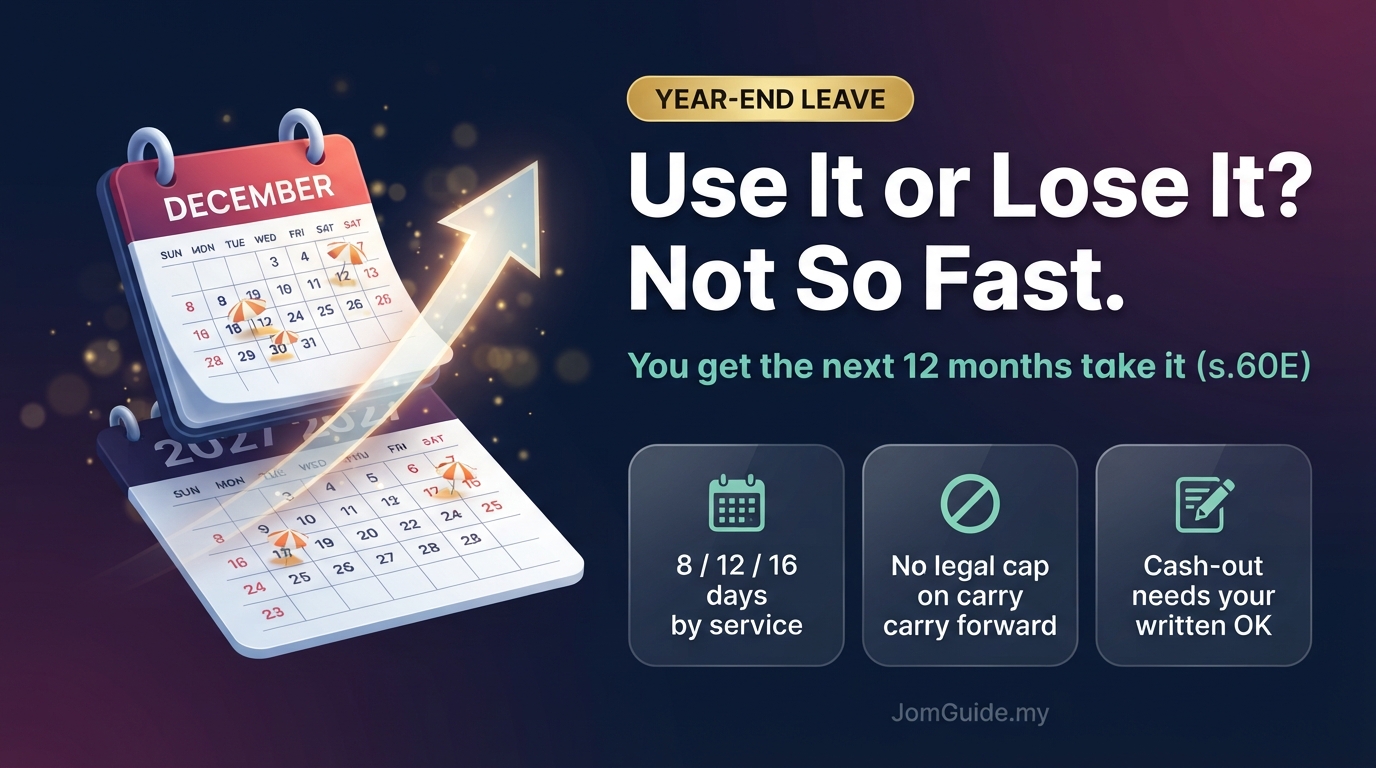
The short answer: under section 60E of the Employment Act 1955, your employer must let you take the leave earned for each 12 months of service within the following 12 months. Only after that can it be forfeited. Whether an "everything resets on 31 December" policy is lawful depends on how it works in practice. Leave can be paid out instead, but only if your employer asks and you agree in writing.
Since 1 January 2023, the Employment Act has applied to all employees.
How much leave are you entitled to?
| Length of service | Minimum annual leave per 12 months |
|---|---|
| Less than 2 years | 8 days |
| 2 to 5 years | 12 days |
| 5 years or more | 16 days |
These are statutory minimums; your contract can give more but not less. If you haven't completed your first 12 months, leave is generally pro-rated.
When does leave expire?
Section 60E(2) requires employers to let employees take their leave within 12 months after the end of each 12 months of continuous service. In practice:
- leave earned in 2026 can generally be taken during 2027;
- only leave still unused after that window may be forfeited.
The law firm Donovan & Ho makes two further points:
- Policies that restrict leave or shorten the statutory window may not comply.
- The Act sets no cap on carried-forward days, so a rule like "you can carry over no more than five days" may not comply.
Because leave accrues monthly, each day technically has its own expiry date. Many employers simplify this by setting expiry at the end of the following year, which is usually more generous than the legal minimum.
What about "use it or lose it by December"?
Many employers, including some the JomGuide team has come across, wipe out unused leave at year-end. Whether that complies comes down to:
- whether the forfeited leave has actually passed the statutory 12-month window; and
- whether employees had a genuine chance to take it.
For example, if leave earned from January to December 2026 is all wiped on 31 December 2026, the day earned in December had almost no chance of being used, which sits uneasily with section 60E.
If you're unsure whether your company's policy complies, you can ask the Labour Department (JTKSM).
Can leave be paid out?
Yes, with conditions. According to Donovan & Ho, replacing leave with pay while you're still employed requires:
- the employer to make the request; and
- the employee to agree in writing to give up some or all of the leave.
JomGuide's advice: if your employer offers to pay out leave and you weren't planning to use it, take the money. But you can't insist on it yourself, and any payout should be recorded in writing with the number of days and the amount.
Unused leave on resignation follows different rules; see Resigning With 8 Days of Annual Leave.
Three things to do before year-end
- Check your balance and expiry dates in your HR system, or confirm with HR in writing.
- Read your handbook's leave policy for any carry-forward or payout arrangements.
- Apply early. December is school-holiday and peak season, so earlier requests are easier to approve.
FAQ
Can my employer cap how many days I carry forward?
The Act sets no cap, and lawyers say such limits may not comply. You should be able to use leave within the statutory 12-month window.
Can I ask my employer to pay me instead of taking leave?
Generally not while employed. A payout must be requested by the employer and agreed to by you in writing.
Can annual leave and sick leave be swapped?
No. They are separate statutory entitlements.
My leave requests keep being refused and the leave is about to expire. What can I do?
Keep written records of the refusals and contact the Labour Department for advice or to complain.
This is general information, not legal advice. For your situation, consult the Labour Department or a lawyer.
Useful? Forward it to someone who needs it.
Malaysian policy and hot topics, 2–3 items a week, each with a one-line “so what”.
Related articles
More in Jom Explain-
Retrenched in Malaysia? Don't Sign Yet: How Termination Benefits Are Calculated, Plus PERKESO's Higher SIP Payouts From October
-
Does Your Employer Have to Pay a Year-End Bonus? Contractual vs Discretionary Bonuses in Malaysia
-
Behind on Strata Maintenance Fees? What Your JMB Can and Can't Do After the Court of Appeal Ruling