Malaysia Small Claims Court vs TTPM: RM5,000 Debt Claims and RM50,000 Consumer Disputes
A personal loan to a friend isn't the same as a consumer dispute. Compare Malaysia's RM5,000 Small Claims procedure and RM50,000 TTPM tribunal, with a RM4,000 example, Form 198 steps, fees and enforcement limits.

Source: Malaysian Judiciary Small Claims Guide and Civil Claims; KPDN TTPM Rules and Filing (checked 28 Oct 2026)
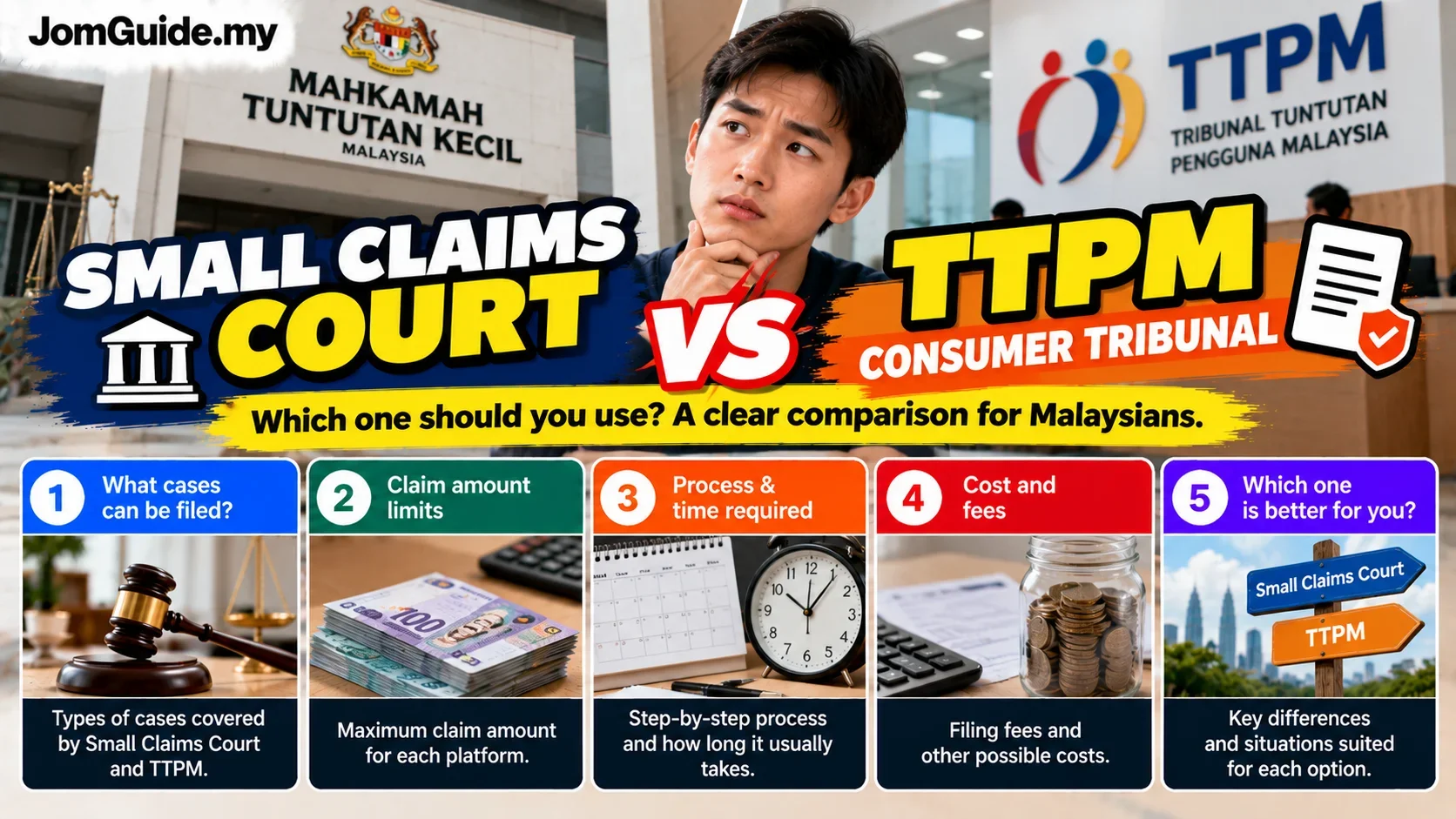
A friend owing you RM4,000 and a shop failing to deliver a RM4,000 service may call for different legal routes—even though the amount is identical. In Malaysia, an eligible Small Claims Court action can be brought by an individual claimant for no more than RM5,000. The Tribunal for Consumer Claims Malaysia (TTPM) is for qualifying consumer goods and services disputes, generally up to RM50,000 and arising within its three-year jurisdiction window. A bigger monetary ceiling does not mean the tribunal takes every debt claim.
Check the relationship and subject matter before choosing an institution. Judiciary civil-claims information; TTPM jurisdiction.
Small Claims Court vs TTPM
| Issue | Small Claims (Magistrates' Court procedure) | TTPM consumer tribunal |
|---|---|---|
| Who generally uses it | Individual claimant with an eligible civil claim | Qualifying consumer with a dispute involving goods or services |
| Monetary limit | RM5,000 | RM50,000 |
| Private money lent to a friend | Potentially appropriate, subject to evidence and procedure | Normally outside consumer goods/services jurisdiction |
| Ordinary consumer dispute with a trader | May require assessing available court routes | Potentially suitable, subject to exclusions |
| Starting document | Form 198 / Writ | Form 1 / Borang 1 |
| Published initial filing fee | RM20 for the Small Claims writ | RM5 for a TTPM claim |
| Legal representation | Generally parties appear themselves under the Small Claims procedure, subject to legal exceptions | Separate tribunal representation rules apply |
TTPM has jurisdictional exclusions, including certain land matters and particular professional or regulated services. Not every claim below RM50,000 belongs there. Always refer to the tribunal's jurisdiction guidance.
One hypothetical case: a friend owes RM4,000
Imagine you lent a friend RM4,000. You have a bank transfer receipt and WhatsApp messages showing the money was a loan, the agreed repayment date has passed, and the friend has not repaid it.
The critical questions are:
- Can you establish that the money was borrowed rather than gifted?
- Is the claim amount within the RM5,000 small-claims threshold?
- Can you identify the correct defendant and provide an address where court papers may be validly served?
- Do you have a clear timeline of messages, transfers, agreed repayment date and subsequent requests?
You can consider approaching the appropriate Magistrates' Court registry about the Small Claims procedure. This is a hypothetical illustration, not a prediction that the evidence will be accepted or that you will win. Lending money privately does not become a consumer purchase merely because the amount is small.
How an individual Small Claims case generally works
The Malaysian Judiciary's self-representation guide describes the process:
- Check eligibility and jurisdiction. The claimant is an individual, and the amount is within the Small Claims procedure's monetary limit. Confirm with the appropriate court registry if the case has unusual circumstances.
- Organise your records. Keep loan messages, bank transfer evidence, repayment promises and follow-up correspondence. Make a chronology of what happened.
- Prepare Form 198 (Writ). The court guide says to obtain the form from a subordinate-court registry and prepare four copies. It lists a RM20 filing fee for the writ; other steps may have separate charges.
- File and serve the sealed writ. Properly serve the defendant following court requirements and submit an Affidavit of Service. The Judiciary guide mentions a separate RM8 fee for the relevant filing.
- Await a defence or the hearing. The guide says a defendant may file a Form 199 defence within 14 days after service. Do not assume a judgment without following the actual court notices and process.
- Present your evidence. Small Claims hearings are before a magistrate; parties generally present their own case rather than being represented by a lawyer, although legal advice beforehand may help.
- Understand enforcement. Even after a successful judgment, payment is not automatic. Where necessary, the Judiciary guide refers to further steps, including Form 208 / Notice to Show Cause, depending on non-compliance and the court's directions.
Official explanation: Judiciary Small Claims Guide (PDF). RM20 is the writ's initial fee, not necessarily the total cost of every possible stage. For complex facts, limitation concerns or difficulties locating a defendant, ask the registry or a qualified adviser about your circumstances.
When is TTPM the better starting point?
Consider TTPM when you are a qualifying consumer who paid a business for goods or a service and the disagreement falls within the consumer tribunal's statutory jurisdiction. The published threshold is RM50,000 for a qualifying claim, generally arising within three years. The relationship, nature of the transaction and statutory exclusions are as important as the amount.
A typical filing route is:
- Preserve the order, agreement, payment record, product or service description and messages with the trader.
- Make a clear request to the seller or service provider and keep its response.
- Consult the official e-Tribunal system and its Form 1 (Borang 1) instructions.
- File through the permitted online or registry process and pay the published RM5 filing fee.
- Follow the tribunal's directions on notice/service and attend the scheduled hearing.
- If an award is made but not complied with, ask the tribunal about its formal enforcement/non-compliance process—an award is not a same-day refund guarantee.
Sources: TTPM jurisdiction and filing guidance.
Situations not to confuse
A private loan: usually examine civil court options; TTPM is not an all-purpose debt collector.
A refund from a retailer: TTPM might apply if the claimant and subject matter fall within its consumer jurisdiction. Check exclusions.
A private loan exceeding RM5,000: the ordinary civil-court route may be relevant; the extra amount does not make it a TTPM claim.
Property title or particular professional services: specialist procedures or tribunal exclusions may apply. Verify before filing.
A routine unpaid loan is not automatically a crime; any genuine suspicion of fraud requires separate facts and the appropriate reporting procedure.
Common questions
Can I take a friend owing RM4,000 to TTPM? Normally not for an ordinary personal loan. Check the Small Claims route instead.
What if the loan was agreed only on WhatsApp? Messages and payment records may be relevant; the court determines admissibility and weight. There is no guaranteed outcome.
If I win, is my money immediately returned? No guarantee. Enforcement may take further steps, time and expense.
Does TTPM accept every RM50,000 debt? No. It hears qualifying consumer disputes, not every unpaid debt.
Source note: Malaysian Judiciary civil-claims overview, Judiciary Small Claims guide, and TTPM official tribunal. Checked 28 October 2026. General information only, not individual legal advice.
Related articles
More in Jom Money-
Driving Into Singapore From 2027: VEP Rises to S$50 a Day, Free Days and Evening Hours Scrapped. Here's What It Costs You
-
STR 2026 Phase 4 Is Being Paid: Up to RM500 for Households, RM150 for Seniors, 4–6 November, New Recipients From the 16th
-
When Is STR 2026 Phase 4 Paid? Not Announced Yet: What You Can Do Now, Plus STR 2027 Applications