Shelf Price RM3, Checkout RM3.30: Consumer Rights and KPDN Complaints
What if a Malaysian shop charges more at the till than the shelf tag? Understand the Labuan RM3 versus RM3.30 case, practical steps, KPDN e-Aduan and TTPM claims.

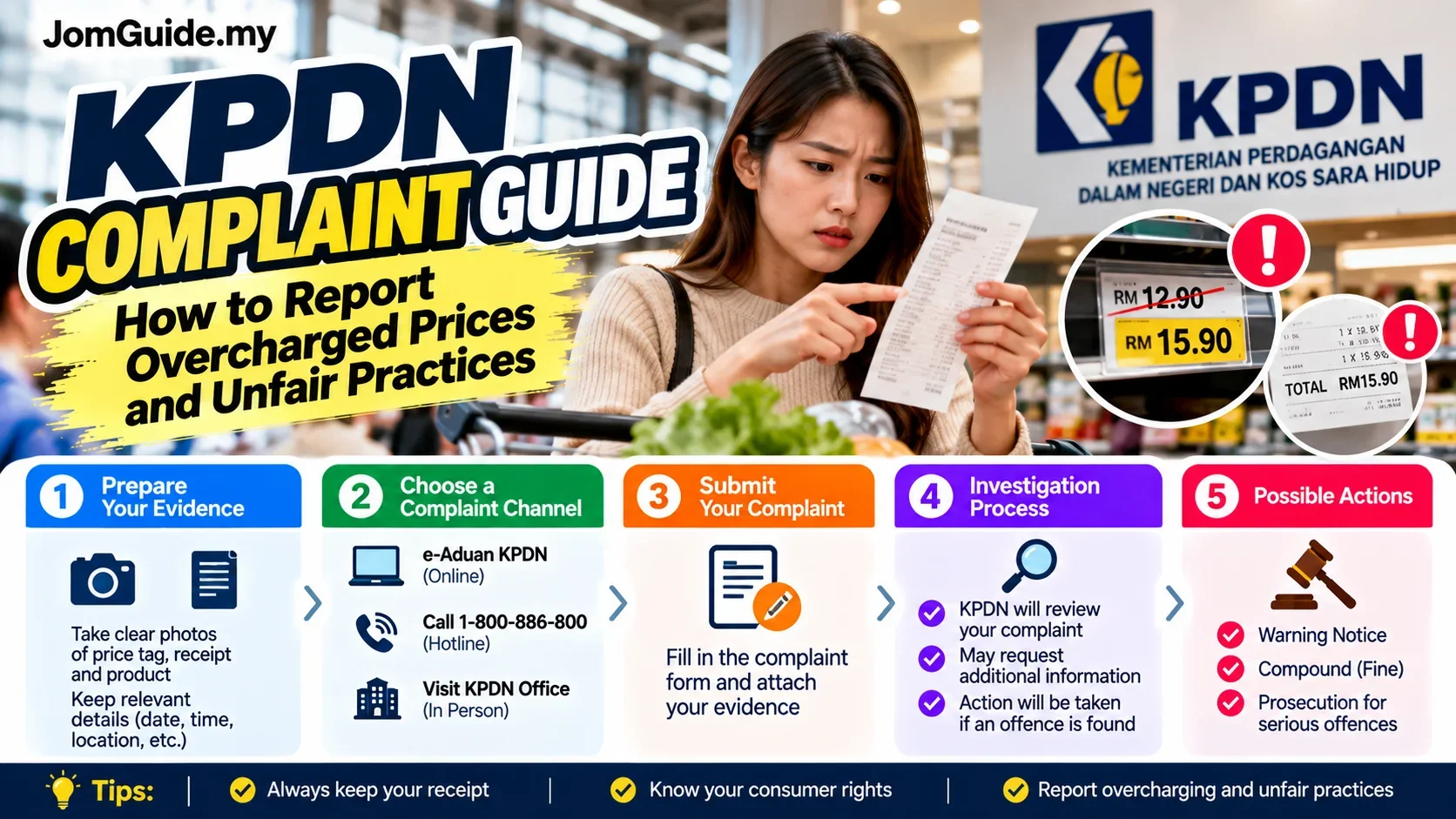
Source: Labuan KPDN enforcement case; official KPDN e-Aduan and TTPM (26 Oct 2026)
Checked 26 October 2026. If a supermarket shelf displays RM3.00 but the checkout charges RM3.30, you have a legitimate reason to ask for an explanation and, where appropriate, make a consumer complaint. That does not establish an automatic legal right to buy every mispriced product at the lowest displayed price, regardless of the facts.
The real RM3 versus RM3.30 case in Labuan
In September 2026, officers from the Domestic Trade and Cost of Living Ministry (KPDN) inspected a business in Labuan. A chocolate product was displayed at RM3, but the checkout scanner charged RM3.30, a difference of 30 sen.
KPDN Labuan said the discrepancy could mislead a customer making a purchasing decision on the displayed price. The business was suspected, according to the published report, of conduct falling under section 12(1)(a) of the Consumer Protection Act 1999 (Act 599) concerning misleading price representation. That is a report of investigation or enforcement action, not a verified court conviction.
The department urged retailers to keep shelf labels and point-of-sale (POS) system prices consistent, and buyers to keep receipts. Read the reported KPDN case.
Five reasons prices might not match
| What you see | What might explain it | What to verify |
|---|---|---|
| Shelf RM3, checkout RM3.30 | Old shelf label, POS update not synced or wrong item | Barcode, packaging size and receipt |
| Promotional tag RM9.90, scanner RM12.90 | Offer expired or required membership | Dates, membership conditions and SKU |
| Different price for a similar product | Different pack weight or variant | Exact item or unit size |
| Restaurant menu differs from final charge | Service charge, tax, portion difference or outdated menu | What was disclosed and what was ordered |
| One item appears twice on receipt | Duplicate scanning | Item quantity and amount charged |
A higher total is not by itself proof of an unlawful practice. Equally, a retailer cannot dismiss a potentially misleading display merely by saying the system has another price.
Must the retailer honour the shelf price?
The careful answer is: you can ask, but outcomes depend on the facts and law.
A materially inconsistent display may raise consumer-protection concerns. You can request a price correction, the difference refunded, an explanation, or—where possible—cancellation of the transaction. A store may offer one of these remedies on the spot. However, the precise product code, promotional terms, an obvious labelling mistake and whether the advertised price was misleading can all affect the assessment.
A KPDN enforcement complaint and a consumer's claim for financial redress are not the same procedure. Reporting an incident does not automatically put money back in your account.
What to do at the checkout
1. Preserve a useful set of evidence
Take a photograph of the item and its complete shelf label, showing any promotion dates, pack size, quantity and barcode. Keep the receipt, date, store branch and relevant conversation or case number. Avoid photographing unrelated customers unnecessarily.
2. Give the store a chance to check
You could say: “The displayed label shows RM3.00, but this item scanned at RM3.30. Could you check whether the barcode and offer match, and explain the difference?”
Sometimes the cause is a delayed system update, a misplaced item or an expired promotion. Ask for corrected documentation if a refund or adjustment is made. You do not need to assume that the cashier personally caused the problem.
3. Decide whether formal escalation is useful
If you believe a misleading practice occurred, especially if it keeps recurring, an enforcement complaint may be appropriate. If your primary aim is compensation for a private transaction, consider the separate consumer-claims route if your case is eligible.
Store, KPDN e-Aduan or TTPM: which route?
| Route | Primary purpose | Typical reason to choose it |
|---|---|---|
| Retailer or supervisor | Resolve the discrepancy promptly | Explanation, adjustment, cancellation or refund |
| KPDN e-Aduan | Report suspected breaches of consumer-trade rules | Potentially misleading price displays, recurring practices or unresolved concerns |
| TTPM / e-Tribunal | Pursue a qualifying consumer claim | Formal financial remedy where jurisdiction and evidence support it |
The Tribunal for Consumer Claims Malaysia (TTPM) says its jurisdiction generally covers personal, household and domestic purchases, claims up to RM50,000, and causes of action arising within three years. Its FAQ lists an online filing option and a RM5 filing fee. Business purchases and various excluded claim types may fall outside its remit. Check the current rules before filing.
Neither a report to KPDN nor a TTPM filing guarantees that a refund or award will follow. The proportionate response depends on the loss, evidence and the conduct involved.
The cost difference in two examples
Confirmed news case: RM3 versus RM3.30
The reported gap was RM0.30. It may be a small personal loss, but a systemic mismatch matters to future shoppers. The useful question is whether the retailer is aware of the discrepancy and fixes it.
Hypothetical example: RM299 versus RM349
Imagine a household appliance marked RM299 scans at RM349: RM50 more. Confirm the exact model and whether the promotion was valid, then ask for the store's explanation. That hypothetical difference alone does not establish illegality or guaranteed reimbursement.
What about online platforms?
Online checkout disputes depend on order confirmations, voucher conditions and platform refund mechanisms rather than physical shelf labels. Use the platform's own transaction and dispute records. For a separate practical guide, see JomGuide's Shopee and Lazada consumer guide.
Quick questions
Can I complain over 30 sen? You can raise the issue with the retailer and report potential misleading pricing to KPDN with evidence. Whether a formal claim is proportionate is a separate decision.
What is the most useful evidence? The exact product, its complete price label, any promotion conditions and the checkout receipt together.
Does filing with KPDN mean I get the difference back? Not necessarily. KPDN handles enforcement matters; a financial claim can require its own process.
Can I demand the lower price? You may request it, but do not assume an unconditional rule for every circumstance. Examine what was advertised and what happened.
Sources: Reported Labuan KPDN case, KPDN e-Aduan, TTPM jurisdiction, TTPM FAQ. Checked 26 October 2026.
Useful? Forward it to someone who needs it.
Malaysian policy and hot topics, 2–3 items a week, each with a one-line “so what”.
Related articles
More in Jom Explain-
Retrenched in Malaysia? Don't Sign Yet: How Termination Benefits Are Calculated, Plus PERKESO's Higher SIP Payouts From October
-
Does Unused Annual Leave Expire? Malaysia's 12-Month Rule, Carry-Forward Caps and Cashing Out Leave
-
Does Your Employer Have to Pay a Year-End Bonus? Contractual vs Discretionary Bonuses in Malaysia