Malaysia e-Invoice 2026: RM3 Million Threshold and MyInvois Setup Guide
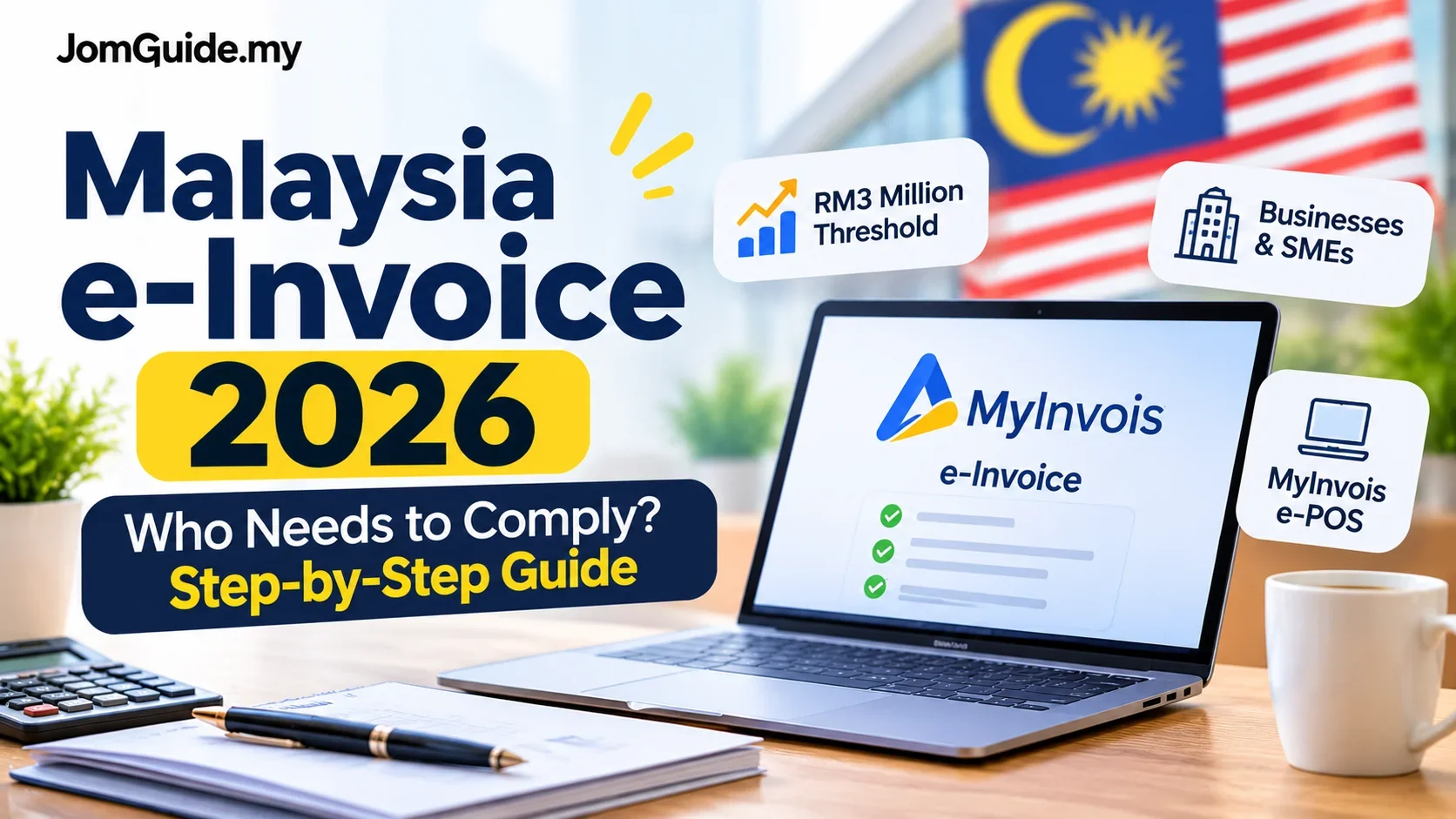
A practical guide for Malaysian business owners: check the RM3 million e-Invoice threshold and corporate exceptions, then learn the steps to issue your first invoice using MyInvois.

Source: HASiL e-Invoice Guidelines v4.8 / Specific v4.9, official notices and MyInvois
Checked: 23 October 2026. If your business turns over RM1 million or more, the question isn't simply whether to buy e-Invoice software. It is whether your business is required to implement e-Invoicing, when that obligation applies, and which workflow will actually fit your sales operations.
Malaysia raised the qualifying MSME exemption threshold from RM1 million to below RM3 million, effective 1 September 2026. That exemption is subject to conditions, including the ownership and related-company tests. Treat RM3 million itself as a boundary requiring a formal check, not an automatic pass. Refer to HASiL's announcements and Guideline v4.8 / Specific Guideline v4.9.
First decide whether you have an implementation obligation
Annual turnover or revenue is not net profit, bank balance or a director's salary. For an ordinary standalone business, this is an initial screening table, not a ruling:
| Illustrative annual revenue | First action |
|---|---|
| RM1 million | Check whether the updated exemption and related-party criteria apply |
| RM2 million | Confirm group ownership and whether e-Invoicing is already in use |
| RM2.9 million | Check eligibility carefully rather than guessing from a headline |
| RM3 million | Boundary case: verify the precise qualifying conditions with HASiL |
| RM4 million | Do not presume the under-RM3m exemption applies; confirm your implementation phase |
Older material mentioning an RM1 million exemption can be out of date after September 2026. Equally, a higher threshold is not a blanket instruction for businesses already operating under e-Invoicing to stop. Ask your finance or tax adviser to document the entity's status where the facts are complex.
Enterprise versus Sdn Bhd: why company structure matters
A sole proprietor, a standalone company and a subsidiary may have different practical assessments. An Enterprise owner should confirm the business's annual revenue, tax identity, commencement year and any existing implementation obligation. A Sdn Bhd also needs to consider non-individual shareholders, holding companies, related companies and joint ventures.
A small subsidiary should not assume it qualifies solely because its own sales are below RM3 million. Prepare a simple sheet listing entity, revenue, ownership, related entities, implementation status and effective date before choosing software.
Three implementation routes
| Route | Most useful for | Trade-off |
|---|---|---|
| MyInvois Portal | Lower invoice volumes, manual entry | Free official portal, but staff must enter and review transactions |
| MyInvois e-POS | MSMEs needing sales and inventory functions | Free POS with e-Invoice capability; suitability depends on existing workflow |
| Accounting/POS/ERP integration | Businesses issuing many invoices | Automation is possible, but integration, maintenance and data quality cost money |
HASiL describes MyInvois e-POS as a free digital POS platform for MSMEs, with sales, inventory, reporting and e-Invoice functions. No business should purchase new software just because a vendor claims that a deadline is approaching.
How to issue your first e-Invoice in MyInvois
These are operational steps based on the official portal process. Menu labels may change.
- Prepare your business information: taxpayer identification number (TIN), business particulars, contact information, transaction details and customer information where required.
- Sign in to MyTax and activate your account if necessary.
- Apply for the appropriate role: Business Owner for a sole proprietorship; Company Director / Organisation Administrator for companies and most other entity types. Representatives need the correct permissions.
- Access MyInvois, switch to the intended taxpayer profile and activate or verify the business profile as directed.
- Create the correct document type. Enter seller and buyer details, products or services, quantities, consideration and applicable tax fields; review before submission.
- Submit for validation. Only share it as a validated e-Invoice after successful processing. Download or print the visual representation for the buyer.
- Reconcile with your sales ledger. If something is wrong, use the portal's permitted cancellation or adjustment-document process rather than quietly altering a PDF.
HASiL provides a testing environment, separate from production. Test data is not carried into the real tax database. Read the MyInvois user guide before issuing live documents.
What if customers do not ask for individual e-Invoices?
Do not assume every transaction can be consolidated. B2B, B2C and special transaction categories are not identical. Where official rules allow ordinary receipts and consolidated e-Invoices, follow the relevant conditions, exceptions and submission timing.
Phase-specific interim relaxation through 2027 should not be confused with a permanent exemption. The Specific Guideline remains the source of truth.
An owner's pre-launch checklist
- Verify exemption eligibility and any shareholder or group exceptions
- Confirm whether implementation is already mandatory for this taxpayer
- Verify TIN, MyTax role and staff permissions
- Decide how sales, refunds and customers feed into invoicing
- Identify which transactions may be consolidated under current rules
- Train staff to check validation results and correct mistakes formally
Frequently asked questions
Is a normal invoice PDF an e-Invoice?
Not by itself. The relevant e-Invoice must meet the required submission and validation process. A designed PDF alone is not proof of validation.
What if revenue crosses RM3 million later?
Implementation timing depends on the applicable assessment-year rules and existing obligations. Do not infer a universal start date from the day of crossing the threshold.
Must a business use MyInvois e-POS?
No. It is a free official option. Businesses may consider the Portal or approved system integration depending on their needs.
Does implementing e-Invoicing replace income tax filing?
No. e-Invoicing does not remove normal tax return obligations.
The practical takeaway
Establish the legal requirement before paying for a system. Try the official route with a real, properly documented transaction, then decide whether automation will save more effort than it costs.
Sources (checked 23 Oct 2026): HASiL guideline library, official announcements, MyInvois documentation, free e-POS. General education only; complex corporate cases require individual review.
Useful? Forward it to someone who needs it.
Malaysian policy and hot topics, 2–3 items a week, each with a one-line “so what”.