TNB 800kWh Rule: What Happens at 500, 600, 700, 800, 900 and 1,000kWh?
Malaysia's domestic electricity bill protection threshold has been raised from 600kWh to 800kWh. Here's what it means for households using 500–1,000kWh, including AFA, the RM10 retail charge, 8% SST and the October bill adjustment.

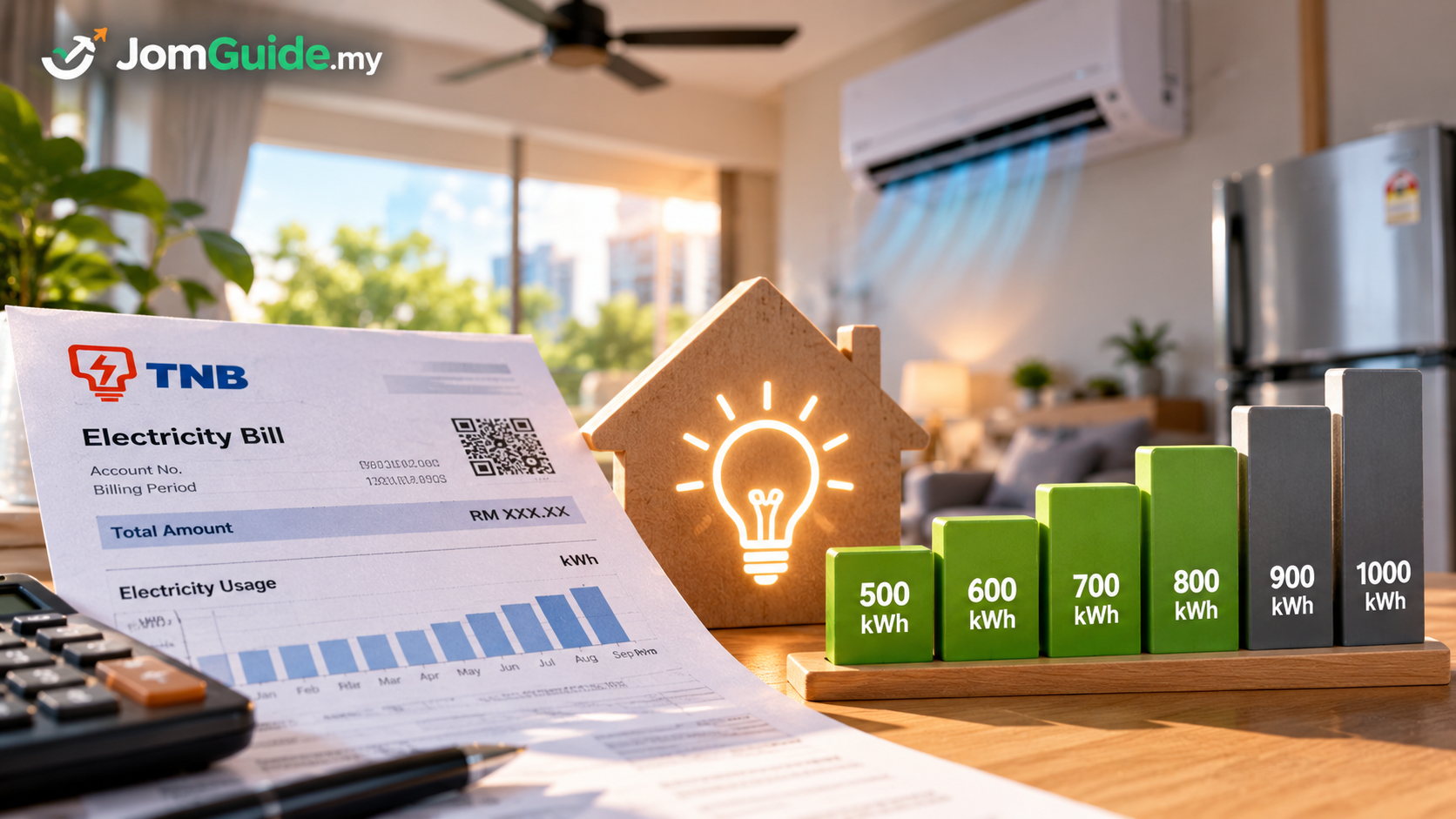
Malaysia has raised the domestic electricity bill protection threshold from 600kWh to 800kWh per month.
The enhanced protection applies to electricity consumed from 1 September to 31 December 2026.
Domestic customers using no more than 800kWh per month are protected through exemptions covering:
Automatic Fuel Adjustment (AFA)
The RM10 retail charge
8% SST
And there's one timing detail worth knowing:
The reduction relating to September consumption will be credited directly to the October electricity bill.
For households whose electricity use has climbed because of hotter weather, haze or heavier air-conditioning use, the new threshold can make a meaningful difference.
Does my household qualify?
Here's the simplest way to look at it:
Monthly usage | 800kWh protection |
|---|---|
500kWh | ✅ Yes |
600kWh | ✅ Yes |
700kWh | ✅ Yes |
800kWh | ✅ Yes |
900kWh | ❌ Above threshold |
1,000kWh | ❌ Above threshold |
The key number is:
800kWh or below.
Exactly 800kWh still qualifies.
What actually changed from 600kWh to 800kWh?
The biggest difference is for households sitting between:
601kWh and 800kWh.
Under the previous threshold, these households were already above the protected 600kWh level.
Under the temporary enhanced measure, they now fall within the protected range.
This matters because household electricity consumption can move quite quickly during hot periods.
A home that normally uses around 580kWh could cross 600kWh simply because its air conditioners run longer.
The government specifically cited hotter weather and haze as factors that had pushed some households above the previous 600kWh threshold.
TNB says the expanded threshold brings nearly one million additional domestic customers into the protected group, taking the total to more than eight million customers, or around 90% of its domestic users.
What if I use 500kWh?
A 500kWh household was already below the previous 600kWh threshold.
So the move to 800kWh doesn't fundamentally change its protected status.
It remains within the:
≤800kWh protected group.
The biggest new benefit is therefore not aimed at 500kWh users, but households previously sitting between 601kWh and 800kWh.
What about 600kWh?
A household using 600kWh also remains within the protected range.
But the higher threshold gives households near 600kWh more breathing room.
If your consumption regularly moves between, say, 580kWh and 620kWh, going slightly above 600kWh no longer immediately puts you beyond the temporary protection threshold.
700kWh: one of the clearest examples
A 700kWh household shows exactly why the threshold change matters.
Previously:
700 > 600kWh
Now:
700 ≤ 800kWh
During the September–December 2026 protection period, that household falls within the new protected group and receives the applicable AFA, retail charge and SST exemptions.
What if I use exactly 800kWh?
You still qualify.
The official wording is:
800kWh and below.
So:
799kWh → protected
800kWh → protected
The line is not “below 800kWh”.
It's:
No more than 800kWh.
What happens at 900kWh?
A household consuming 900kWh is above the new protection threshold.
Don't interpret the policy as:
The first 800kWh automatically receives all the exemptions and only the final 100kWh is treated differently.
The protection is described as applying to domestic customers whose monthly consumption is 800kWh and below.
A 900kWh monthly total therefore does not fall within that ≤800kWh group.
Your actual bill should still be checked against TNB's billing calculation for that month.
And at 1,000kWh?
The same principle applies.
1,000kWh is above the 800kWh protection threshold.
If your household regularly consumes 900–1,000kWh or more, it's useful to look beyond this temporary measure and understand where the electricity is going.
Common areas to review include:
Air-conditioning
Water heaters
Clothes dryers
Refrigerators
High-power appliances
How long the home is occupied each day
Whether a Time-of-Use tariff is worth investigating
The point isn't simply to force consumption below an arbitrary number.
It's to understand what is driving the bill.
So how much can I actually save?
TNB says affected households can expect bill reductions of around 13%, with savings of up to RM47 per month.
The words “up to” matter.
It does not mean every household using 800kWh will automatically save RM47.
Your actual difference depends on your consumption, billing period and the charges applicable to the bill.
AFA can also change as fuel and foreign-exchange conditions change.
That's why JomGuide isn't giving you a made-up table claiming:
500kWh = exactly RMXX saved
600kWh = exactly RMXX saved
700kWh = exactly RMXX saved
A precise ringgit figure needs the actual billing inputs.
What is AFA?
AFA stands for:
Automatic Fuel Adjustment.
It was introduced on 1 July 2025 following Malaysia's electricity tariff restructuring, replacing the previous ICPT mechanism.
In simple terms, electricity generation depends partly on fuel.
Fuel costs and foreign-exchange rates change.
AFA is a two-way mechanism designed to reflect those changes more regularly in electricity pricing.
That means it can work in either direction depending on the underlying costs.
It's therefore misleading to think of AFA simply as a permanent new “extra TNB charge”.
Under the temporary 800kWh protection measure, eligible domestic users are protected from AFA during the applicable period.
What is the RM10 retail charge?
Malaysia's restructured electricity tariff separates the different cost components more clearly.
One of them is the retail charge.
Under the enhanced protection measure, eligible domestic customers using no more than 800kWh receive an exemption from the RM10 monthly retail charge.
Why does SST matter?
The temporary protection also includes an exemption from 8% SST.
So this isn't an AFA-only measure.
The three headline protections are:
AFA + Retail Charge + SST
That's also why looking only at the AFA rate doesn't tell you the entire impact on a household bill.
Why does September consumption show up in the October bill?
The enhanced protection applies from:
1 September to 31 December 2026.
However, the measure was announced in mid-September.
TNB says the reduction relating to September will therefore be credited directly to consumers' October electricity bills.
If you're trying to check whether you've received it, pay attention to the billing period rather than looking only at the month printed on the bill.
Where can I find my kWh usage?
For this policy, the most important number on your bill isn't RM.
It's:
kWh.
Your electricity bill shows your consumption for the billing period, while myTNB can also help you monitor usage.
If your home has a smart meter, watching the consumption trend can help you spot changes earlier.
For example:
Last month: 560kWh
This month: 690kWh
Now you know your household has used an additional 130kWh.
The next step is working out what changed.
Why can air-conditioning push a household over the threshold?
Air conditioners can be a major part of household electricity consumption.
And during hot weather, the difference isn't simply whether you switch one on.
It's also:
How long it runs.
A household that normally runs an air conditioner for four hours each evening may use considerably more electricity if that rises to eight hours.
The effect can be larger when several rooms are being cooled.
That's why raising the threshold from 600kWh to 800kWh is particularly relevant to households whose normal consumption already sits close to 600kWh.
But the goal shouldn't be to compromise reasonable comfort or health needs just to stay below a threshold.
More practical steps include:
Using a sensible temperature setting
Using a timer
Cleaning air-conditioner filters
Keeping doors and windows closed while cooling
Avoiding cooling empty rooms
Comparing monthly kWh rather than only the ringgit bill
TNB's previous energy-efficiency guidance has also recommended air-conditioner settings around 24–26°C and using a timer.
Is the 800kWh threshold permanent?
Not under the current announcement.
The enhanced protection currently applies to electricity consumption from:
1 September to 31 December 2026.
Don't automatically assume the same threshold will continue into 2027.
Any extension or replacement should be checked against future announcements from the government, PETRA, the Energy Commission or TNB.
JomGuide quick answer
If you just want to know where you stand:
500kWh → Protected
600kWh → Protected
700kWh → Protected
800kWh → Protected
900kWh → Above threshold
1,000kWh → Above threshold
Current protection period:
1 September–31 December 2026
For eligible domestic customers using ≤800kWh:
AFA exemption + RM10 retail charge exemption + 8% SST exemption
September reduction:
Credited to the October bill
TNB's stated potential reduction for affected households:
Around 13%, up to RM47 per month.
But your actual result depends on your own consumption and bill calculation.
So when your next TNB bill arrives, don't look only at:
“How many ringgit?”
Also check:
“How many kWh did my household actually use?”
FAQ
When does the TNB 800kWh rule apply?
The enhanced protection applies to domestic electricity consumption from 1 September to 31 December 2026.
Does exactly 800kWh qualify?
Yes. The protection covers domestic customers using 800kWh and below.
What about 801kWh?
801kWh is above the 800kWh threshold and therefore falls outside the ≤800kWh protection group.
How much will I save at 700kWh?
700kWh is within the protected range, but the kWh figure alone isn't enough to guarantee one fixed ringgit saving. The actual bill depends on the applicable billing inputs.
What is the maximum saving?
TNB says affected households can expect bill reductions of around 13%, with savings of up to RM47 per month.
Why is the September reduction appearing in October?
TNB says the reduction relating to September consumption will be credited directly to the October electricity bill.
What is AFA?
AFA is the Automatic Fuel Adjustment mechanism, which reflects changes in fuel costs and foreign-exchange rates and replaced ICPT from July 2025.
How do I check whether I'm below 800kWh?
Check the consumption figure in kWh on your TNB bill or monitor your electricity usage through myTNB.