Malaysia Haze API 100, 150 & 200: What to Do About Work, Exercise and Schools
Understand Malaysia's API/IPU levels at 100, 150 and 200, check official APIMS readings, and learn the difference between exercise precautions, school rules and outdoor work.

Source: DOE APIMS, MOE haze guidance October 2026, DOSH workplace haze guidelines
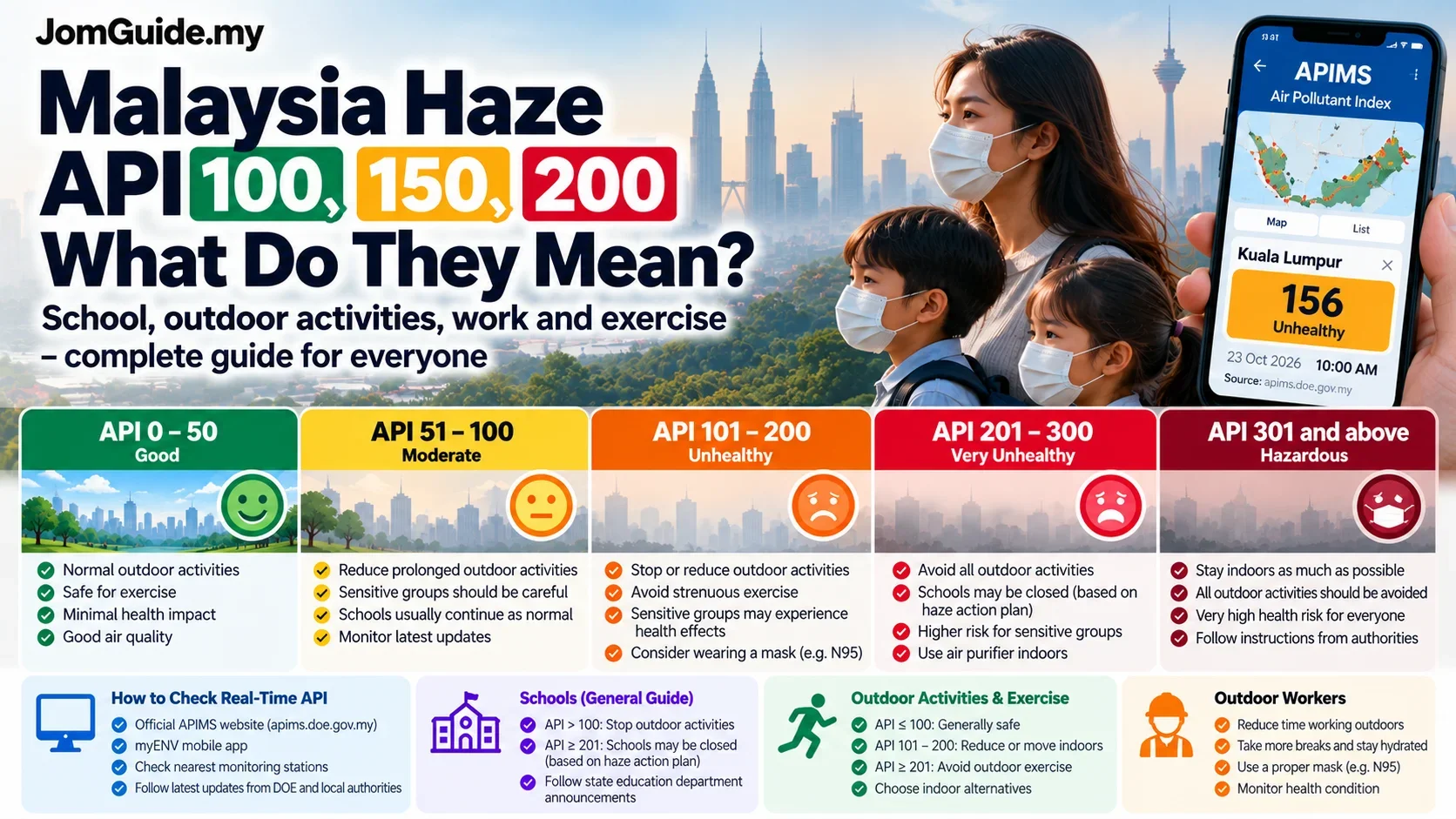
Checked: 23 October 2026. Malaysia's Air Pollutant Index (API, or IPU in Bahasa Malaysia) tells you how polluted the air is. But a reading of 100, 150 or 200 doesn't mean exactly the same thing for a runner, school or outdoor worker.
The clearest way to act is to separate air-quality classification, official school measures and workplace precautions. Start with the Department of Environment's APIMS dashboard, then check the nearest station and the time of its latest reading.
What do API 100, 150 and 200 mean?
| API/IPU | Category | Practical reading |
|---|---|---|
| 0–50 | Good | Ordinary outdoor activities generally appropriate |
| 51–100 | Moderate | Keep an eye on changes and individual needs |
| 101–150 | Part of the 101–200 unhealthy category | Reduce prolonged and vigorous outdoor exposure |
| 150 | Still in the unhealthy range | Not a standalone nationwide automatic school-closure threshold |
| 200 / above 200 | Important school policy threshold; 201–300 is very unhealthy | Minimise outdoor exposure and follow official school/workplace action |
| Above 300 | Hazardous | Follow relevant official precautions and warnings |
Important precision: A reading of exactly 100 falls within the moderate classification; 101 starts the unhealthy band. Likewise, the dashboard groups 201–300 as very unhealthy. Do not mistake an interpretation table for a school closure notice.
What should schools do when API exceeds 100?
The Ministry of Education directed schools to suspend outdoor assemblies, sporting activities and other outdoor activities in affected areas once API exceeds 100.
On 15 October 2026, the ministry clarified the school closure approach under Malaysia's National Haze Action Plan (PTJK), referring to the API 200 threshold. Follow current MOE, state education department (JPN), district education office (PPD) and school notices for the actual decision and timing.
Why do some posts say API 150 means school closure?
Different thresholds appeared in earlier guidance and during the October haze episode. That does not make 150 a separate automatic nationwide closure rule under the updated announcement. At 150, air quality is unhealthy, so exposure precautions matter even if schools remain open.
This article explains the rules for the general public rather than attempting a real-time school-by-school list.
Is outdoor exercise safe at API 100 or 150?
The answer depends on intensity, time spent outside and your personal health.
- 51–100: Monitor current conditions before planning long sessions outdoors.
- 101–200: Reduce long or strenuous outdoor workouts. People more susceptible to respiratory effects should be especially cautious.
- 201–300: Avoid or minimise non-essential outdoor activity, and consider indoor alternatives until conditions improve.
- If you feel significantly unwell: Stop the activity and seek appropriate medical assessment, particularly for breathing problems or chest symptoms.
A mask alone is not a guarantee that prolonged, strenuous exercise outdoors becomes safe.
What if you work outside?
The Department of Occupational Safety and Health (DOSH) workplace haze guidance recommends risk assessments and measures based on API levels. In particular:
- At API above 100, strenuous outdoor work should be minimised and susceptible employees need additional protection.
- At API above 200, strenuous outdoor work should be avoided and susceptible workers should be reassigned to indoor duties where possible.
- Employers should consider the suitability, fit and correct use of respiratory protection when required, along with opportunities to reduce exposure.
- Managers should communicate updated conditions and review workplace activities, rather than assuming one number automatically stops every industry.
Read the official workplace haze guidelines. This document is older, so check it alongside current workplace safety requirements.
How to check the official API in Malaysia
- Visit DOE APIMS.
- Locate the nearest monitoring station to your area.
- Check the reading and its timestamp. Do not share an old screenshot as today's live figure.
- Review the category and use it together with any official MOE, JPN or employer instructions.
- If the station is distant or the reading is stale, recognise that it may not capture local conditions perfectly.
API is an index based on pollutant measurements and running averages. It is not a personal real-time exposure sensor.
Frequently asked questions
Are API and IPU the same?
Yes. API is the English abbreviation and IPU is the Malay abbreviation for Malaysia's air-pollution index.
Does API 150 automatically close all schools?
No. It is unhealthy air quality, but it is not the updated standalone nationwide closure trigger.
Does API 200 mean every workplace must shut?
No. School measures and employer health-and-safety decisions follow different legal and operational processes.
Can a mask make jogging outdoors safe regardless of API?
No. Reducing prolonged strenuous outdoor exposure remains important.
Where can I check today's reading?
Use the official APIMS dashboard and check the timestamp and nearest station.
The takeaway
Instead of forwarding an undated image declaring that API 150 means every school must close, follow three steps: read the current local API, match precautions to your activity, and follow the responsible authority's latest instruction.
Sources (checked 23 Oct 2026): DOE APIMS, MOE announcements, DOSH workplace haze guidance. School threshold interpretation also references the 15 October 2026 MOE clarification; the latest official local notice takes precedence.
Useful? Forward it to someone who needs it.
Malaysian policy and hot topics, 2–3 items a week, each with a one-line “so what”.