Malaysia's RM3 Million e-Invoice Threshold: Does Your Business Still Need to Comply?
Malaysia's e-Invoice exemption threshold has moved to RM3 million, but turnover alone doesn't tell the whole story. Here's how businesses at RM500k, RM1m, RM2m, RM3m and RM4m should think about the new rules and what small businesses should prepare now.

If you've recently seen headlines saying:
“Malaysia's e-Invoice exemption threshold is now RM3 million.”
you might assume:
“My business doesn't make RM3 million a year, so I can forget about e-Invoice.”
Don't make that assumption yet.
The simple version is:
Many qualifying MSMEs with annual turnover or revenue of up to RM3 million may be exempt from mandatory e-Invoice implementation.
But turnover isn't the only thing that can matter.
Business structure, related companies and other exemption conditions can affect whether the exemption applies.
So if you're a small-business owner, don't panic.
Your first step isn't buying software.
It's answering:
Is my business actually exempt?
A 30-second e-Invoice check
Use this as a starting point:
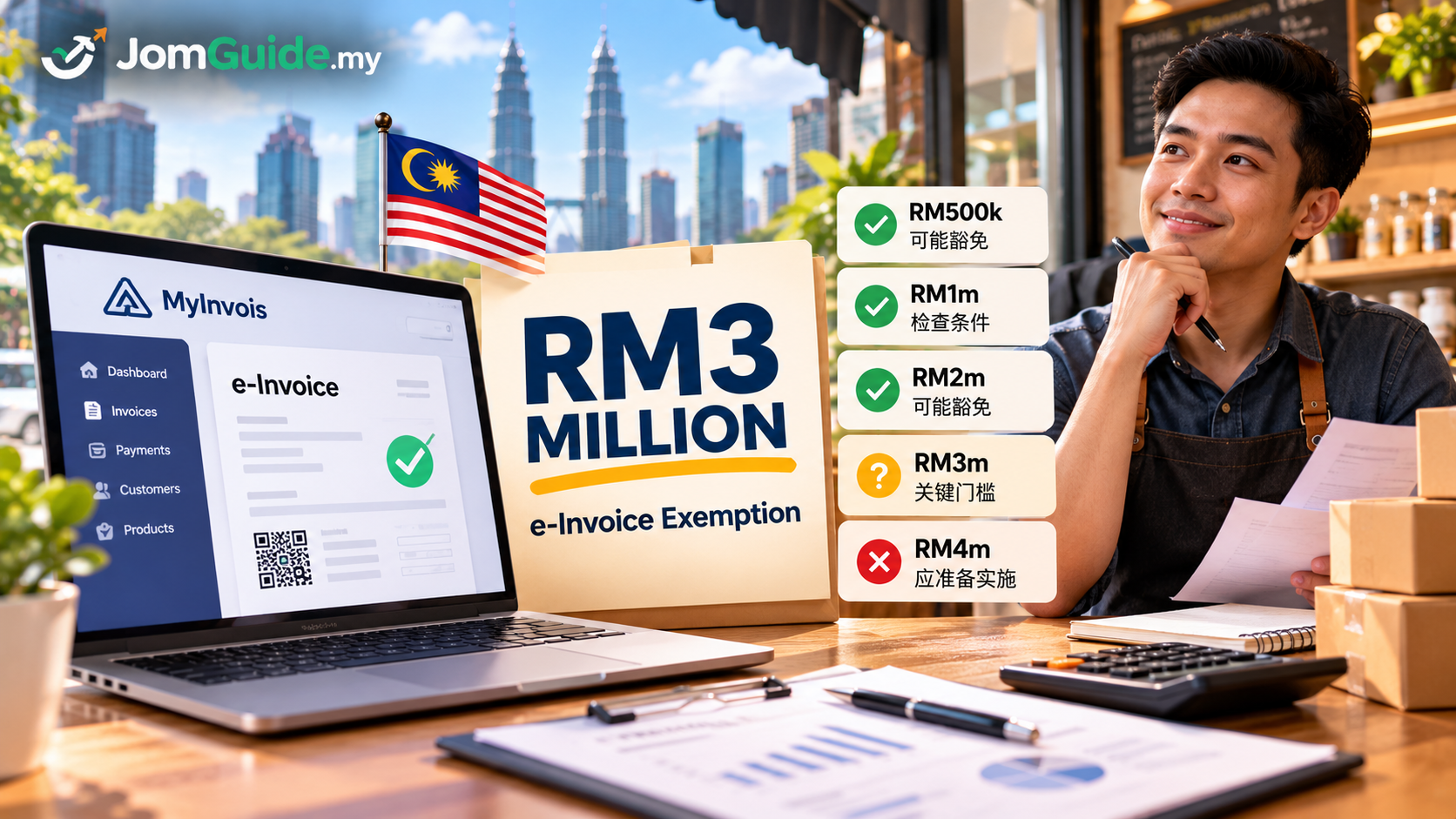
Annual turnover / revenue | What should you do? |
|---|---|
RM500,000 | Likely within the exemption range, but check the MSME exemption conditions |
RM1 million | Don't rely on the number alone; verify the applicable exemption criteria |
RM2 million | May fall within the RM1m–RM3m MSME exemption range; check business structure and other conditions |
RM3 million | You're at the key threshold; verify your actual turnover and applicable rules carefully |
RM4 million | Don't assume the RM3m MSME exemption applies; check your mandatory implementation date |
This is a screening guide.
It isn't a final tax determination.
If you're close to RM3 million or your corporate structure is more complicated, check the latest HASiL rules.
What does RM3 million actually refer to?
The threshold refers to:
Annual turnover or revenue.
It doesn't mean:
Profit
Cash in the bank
The owner's personal income
Cash left after paying expenses
Suppose your business generates:
RM2.5 million in annual revenue.
After paying for stock, salaries, rent, utilities and other expenses, your profit is only:
RM200,000.
You don't compare the RM200,000 profit with the RM3 million e-Invoice threshold.
Revenue and profit are different things.
For many small-business owners, that's the first distinction to understand.
Why is everyone talking about RM3 million now?
Malaysia's e-Invoice implementation framework has been adjusted several times.
The latest changes expand the exemption available to qualifying micro, small and medium businesses with annual turnover or revenue of up to RM3 million.
For small businesses, that's immediate relief.
But there's another side to the story.
Every change to the rules creates another learning cost.
A business owner learns one implementation timeline.
Then it changes.
They start preparing a system.
Then the threshold changes.
For a company with a finance department, that might mean another meeting.
For Malaysia's many family businesses, sole proprietors, hawkers and micro businesses, the reality can be very different.
Some don't even have a consistent bookkeeping process yet.
Their first concern isn't:
“Should I integrate through API or ERP?”
It's:
“Where do I even start?”
What if my business makes RM500,000?
Suppose your annual turnover is:
RM500,000.
If you meet the relevant MSME exemption conditions, you may not need to rush into an expensive e-Invoice implementation.
But being exempt and ignoring business records completely are two different things.
Start building basic records for:
Sales
Purchases
Receipts
Suppliers
Expenses
Your business may not remain at RM500,000 forever.
If it grows — or the rules change again — starting from organised records will make the transition much easier.
What about RM1 million?
Around RM1 million, don't rely on someone telling you:
“Everything below RM3m is exempt now.”
HASiL's guidance contains additional conditions depending on turnover range and business circumstances.
So do two things:
Confirm that your business qualifies for the current exemption.
Then:
Start organising your accounting and transaction records anyway.
You don't necessarily need an expensive system today.
But you should understand what e-Invoice is and what would be required if your business eventually needs to implement it.
What about RM2 million?
The same principle applies.
RM2 million is below RM3 million, but the headline threshold shouldn't be the end of your assessment.
Check your:
Business entity
Annual turnover / revenue
Corporate or shareholding structure
Related companies
Latest HASiL exemption criteria
If you're genuinely exempt:
Great.
Don't buy software simply because everyone else is talking about e-Invoice.
But if your business has grown from RM500,000 to RM2 million and is still expanding, now is a sensible time to learn.
Not because implementation is necessarily required tomorrow.
Because changing systems becomes harder as a business gets larger.
What if I'm around RM3 million?
If your turnover is close to the threshold:
Don't guess.
RM2.95m, RM3.00m and RM3.05m are not numbers you should classify based on a social-media headline.
Check:
Which financial year's figures apply
Your actual annual turnover or revenue
The applicable exemption conditions
Your mandatory implementation timing
Growing businesses should prepare before the deadline arrives.
What if my business makes RM4 million?
If your annual turnover or revenue is already RM4 million:
Don't treat the RM3 million MSME exemption as your default answer.
Find out:
When does my business have to implement e-Invoice?
Then review:
Accounting system
POS
Invoice workflow
Customer information
Supplier records
Staff processes
MyInvois or system integration
At this stage, the question is no longer simply whether you should learn about e-Invoice.
It's how to implement it without disrupting the business.
What if I suddenly cross RM3 million?
Businesses don't stay at exactly the same revenue forever.
You could go from:
RM2.4m
to:
RM3.4m
and later:
RM4m.
Being exempt previously doesn't mean you're permanently exempt.
When your turnover changes, check the HASiL rules and implementation timeline that apply at that point.
Malaysia's e-Invoice rules have already changed more than once.
Don't use an old WhatsApp screenshot to make a future tax-compliance decision.
Check the latest official information.
What about a new business?
A newly established business shouldn't simply assume:
“It's my first year and I'm below RM3 million, so none of this matters.”
HASiL provides implementation treatment for new businesses and operations as well.
Once operations begin, check the latest rules based on your circumstances and turnover.
If you expect the business to grow quickly, build proper records from the beginning.
What if I've already implemented e-Invoice but I'm now exempt?
This is a situation some businesses may face.
You may already have:
Registered for MyInvois
Trained staff
Changed accounting software
Started issuing e-Invoices
Paid for integration
Then the rules changed.
If you now appear to qualify for an exemption:
Don't immediately switch everything off.
First verify that your business actually meets the latest exemption conditions and check the current treatment for businesses that have already implemented.
And if your system is working well, the learning hasn't necessarily been wasted.
Better digital records can still improve bookkeeping and business management.
What you want to avoid is paying for an expensive system nobody in the business knows how to use.
If I'm exempt, should I still learn about e-Invoice?
Yes — but that doesn't mean every small hawker needs to spend thousands of ringgit on software today.
Both extremes are unnecessary.
If you're clearly exempt and still very small
Focus first on:
Basic bookkeeping.
Know how much you're selling, buying and spending.
That's useful regardless of e-Invoice.
If you're approaching RM3 million and growing
Start learning about:
Basic e-Invoice workflow
MyInvois
Whether your accounting software supports it
How customer and supplier information is managed
Don't wait until the final week.
If you're already above the applicable threshold
Check the latest HASiL implementation timeline and prepare properly.
What about hawkers and traditional micro businesses?
This is one group that can easily be forgotten in discussions about digitalisation.
Not every Malaysian business has:
A finance department
An ERP system
A full-time accountant
Cloud accounting
Many are family-run.
Some still rely heavily on:
Paper records
WhatsApp orders
Cash
QR payments
Excel
The owner doing the books
For these businesses, the first e-Invoice question may not be:
“How do I issue an e-Invoice?”
It may be:
“Am I recording my business transactions properly in the first place?”
If sales, purchases and expenses aren't consistently recorded, jumping straight into API integration misses the bigger problem.
Start with the basics.
Why learn early if I'm exempt?
Because if your business grows:
You may eventually need this knowledge.
An exemption gives you more preparation time.
It doesn't mean e-Invoice knowledge will never matter.
But learning early doesn't mean:
Spending money today.
It can simply mean:
Understand what e-Invoice is
Confirm whether you're exempt
Improve your transaction records
Check whether your existing accounting/POS system can support it
Upgrade only when it becomes necessary
That's a much more manageable learning curve.
JomGuide's message to small-business owners
Don't panic.
Start by checking:
Is my business currently exempt?
If it is, you've gained preparation time.
You don't need to buy software just because everyone around you is talking about e-Invoice.
But if your business is growing:
Learn the knowledge gradually before you urgently need it.
Malaysia's e-Invoice rules have changed several times.
The best way to reduce future compliance stress isn't chasing every WhatsApp message.
It's:
Keep proper accounts, know your turnover, and check the latest HASiL rules that apply to your business.
FAQ
Is every business below RM3 million exempt from e-Invoice?
Don't rely on turnover alone. Qualifying MSMEs with annual turnover or revenue of up to RM3 million may be exempt, but business structure and other conditions can affect eligibility.
Does the RM3 million threshold refer to profit?
No. It refers to annual turnover or revenue, not profit after expenses.
Does a business with RM500,000 turnover need e-Invoice?
If it meets the applicable exemption criteria, it is likely to fall within the exemption range. Verify this against the latest HASiL guidance.
What about RM2 million turnover?
It may qualify for the MSME exemption, but you should still check the relevant eligibility conditions rather than relying on the number alone.
What happens if I exceed RM3 million?
Check the latest HASiL implementation timeline and determine when mandatory implementation applies to your business.
Should I learn about e-Invoice even if I'm exempt?
You don't need to rush into expensive implementation, but understanding the basics and developing proper bookkeeping habits can reduce the cost and difficulty of a future transition.
What about hawkers?
Start by checking whether your business qualifies for the current exemption. For many micro businesses, establishing consistent sales, purchase and expense records is a useful first step.
Where should I check the latest e-Invoice rules?
Use HASiL's official e-Invoice portal and current guidelines rather than relying on old articles, social posts or forwarded messages.